
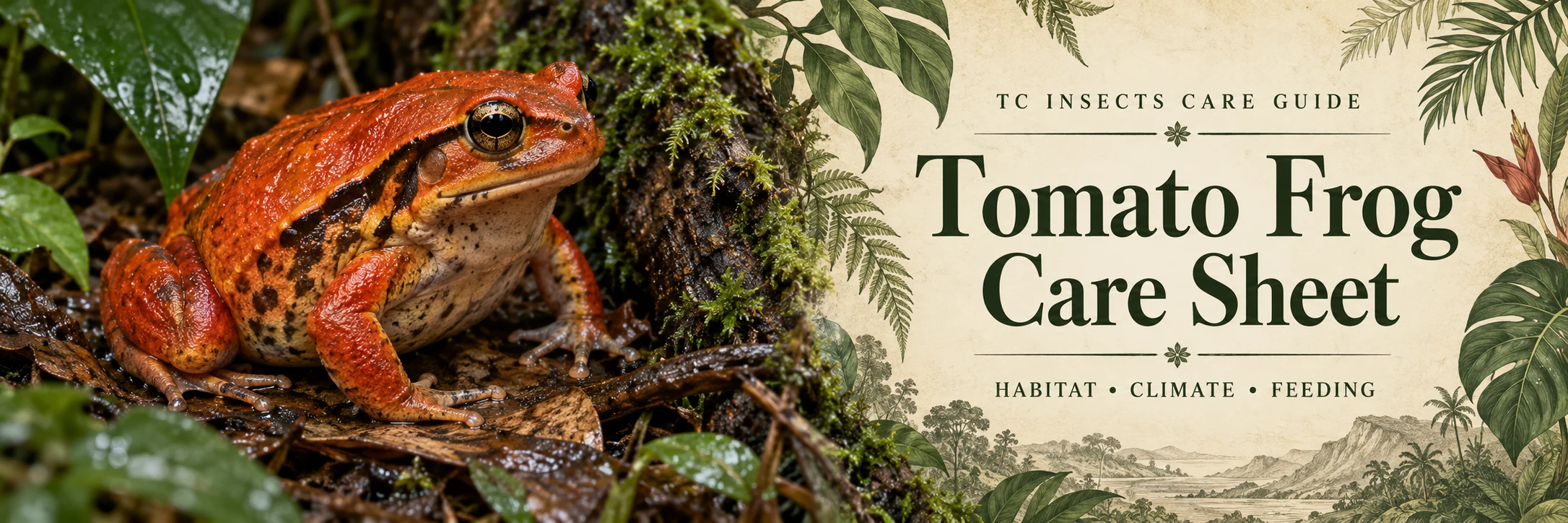
Tomato Frog Care Sheet
A practical guide to deep burrowing substrate, moderate tropical temperatures, clean humidity, properly sized feeders, and the everyday signals of a thriving tomato frog.
Meet the Tomato Frog
Captive-bred staple
Most pet-trade tomato frogs are captive-bred Dyscophus guineti. The redder D. antongilii has historically been restricted; their husbandry is the same.
Buried by design
These semi-fossorial ambush hunters spend the day buried to the eyes, then prowl and feed after dark.
Hands-off defense
A startled frog may release a white sticky secretion that irritates skin and eyes—excellent biology and a clear reason to avoid handling.
What you will need
A soft rainforest floor
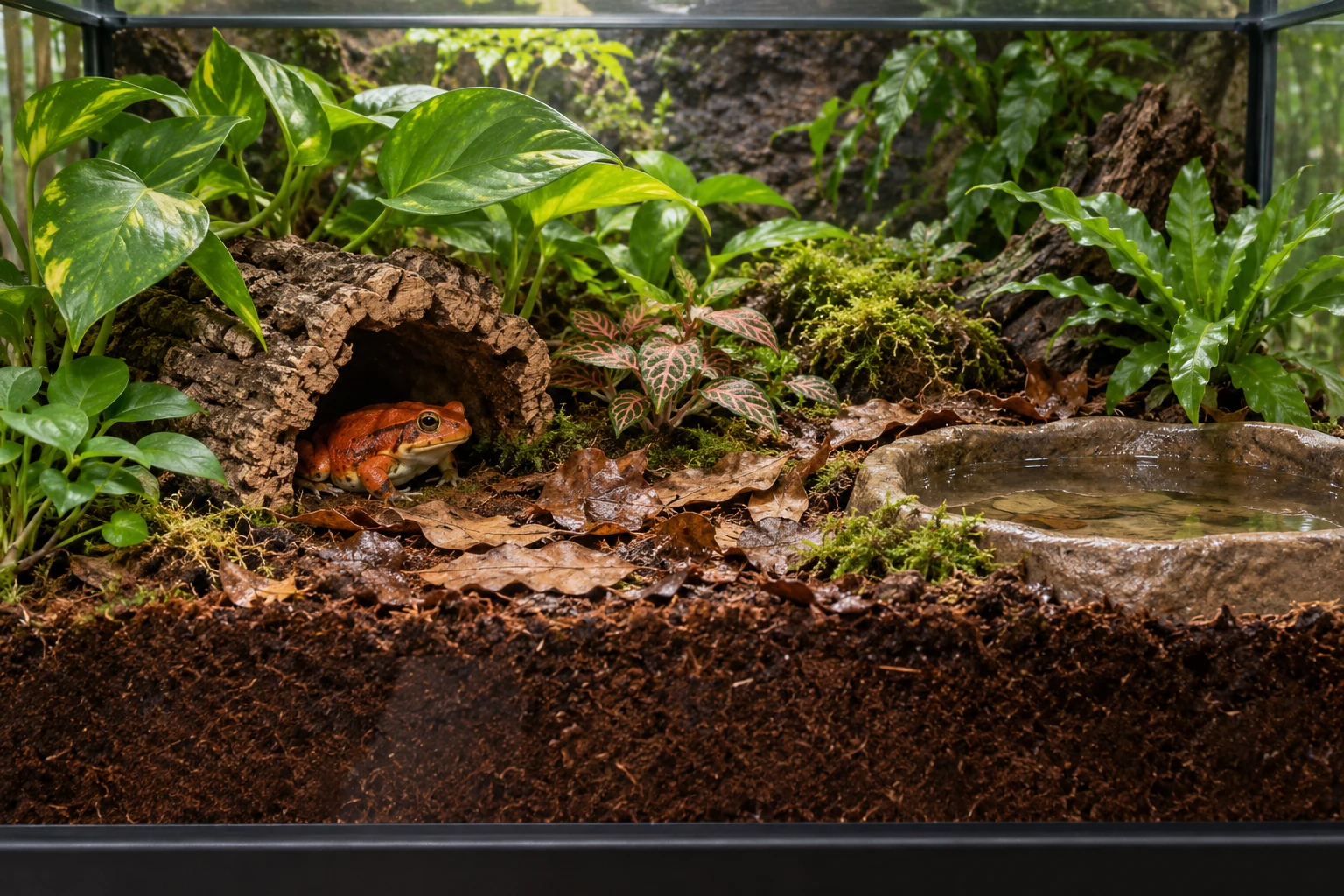
A 20-gallon-long enclosure gives one frog or a similar-size pair ample room. Floor area and substrate depth matter far more than height.
- Provide three or more inches of plain coco fiber across the floor.
- Keep it damp enough to hold a burrow but never muddy.
- Sink a broad shallow water dish at one end and refresh it daily.
- Add cork and dense plant cover; avoid gravel and rock chips near food.
Conditions at a glance
| Parameter | Target | Notes |
|---|---|---|
| Enclosure | 20 gallon long, single or pair | Two females or a male and female pair work |
| Day temperature | 72 to 78 F | Ordinary warm room; no basking blast |
| Night temperature | About 68 F is fine | Gentle drops are natural |
| Humidity | 50 to 75 percent | Substrate moisture plus misting |
| Substrate depth | 3 or more inches | Burying is the whole lifestyle |
| Water | Shallow dish, dechlorinated, refreshed daily | They soak at night |
| Prey size | Half-inch items for adults | The mouth is smaller than the frog suggests |
| Lighting | 12 hour cycle | Low-output UVB optional |
Heating, lighting, humidity, and water
Diet and feeding
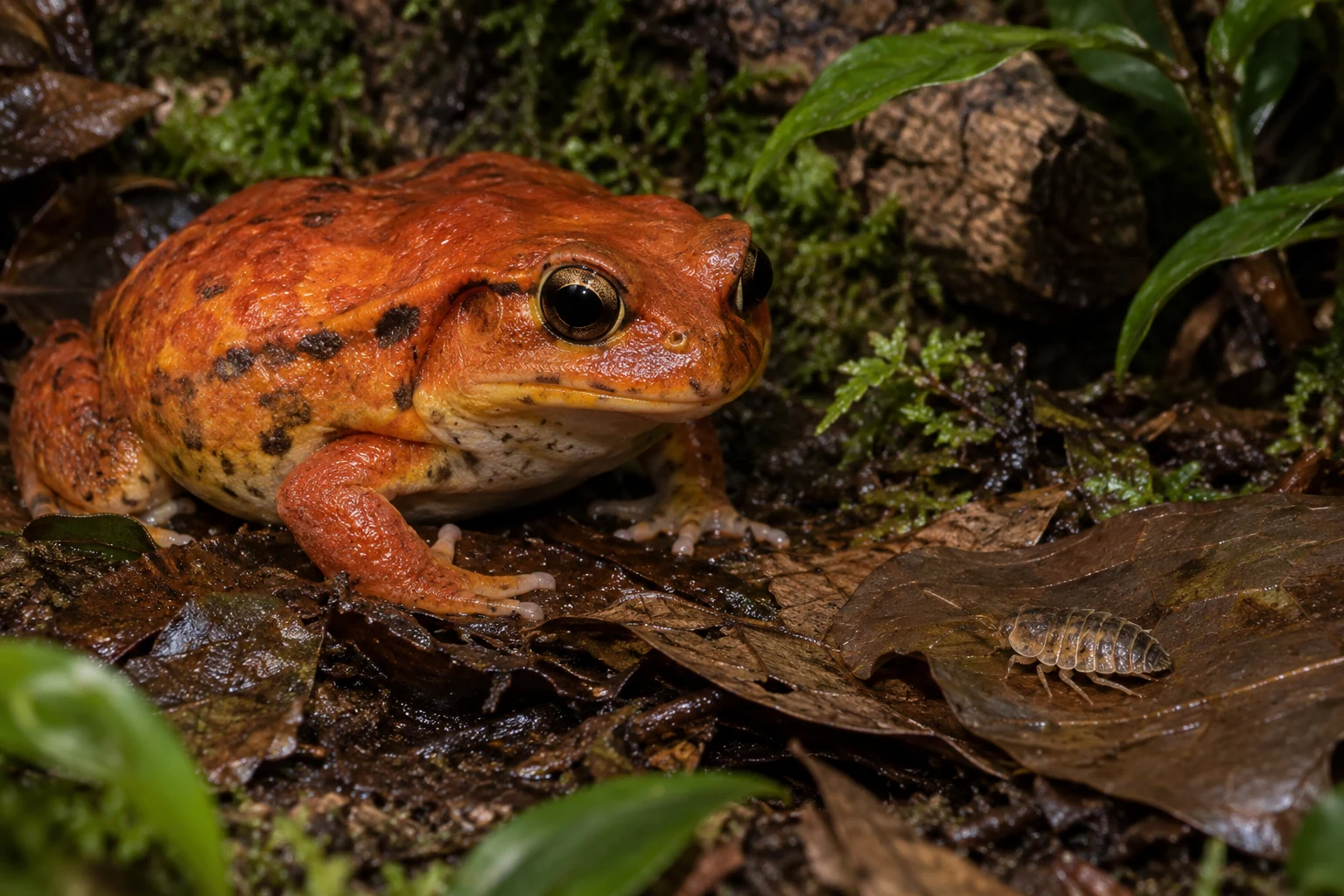
The wide body hides a modest mouth. Adults do best on half-inch prey rather than the larger items another frog of similar mass might take.
- Use small gut-loaded dubia nymphs as a staple.
- Rotate small mealworms and black soldier fly larvae.
- Offer nightcrawler pieces as a soft treat.
- Feed at night by tong or dish so prey does not vanish into the substrate.
Feeding schedule
| Life Stage | What To Feed | How Much | How Often | Supplements |
|---|---|---|---|---|
| Froglet to juvenile | Quarter-inch dubia nymphs, small BSFL | 2 to 4 tiny items | Daily or every other day | Calcium + D3 at most feedings; multivitamin weekly |
| Subadult | Small dubia, small mealworms, BSFL | 3 to 4 items | Every 2 to 3 days | Calcium + D3 twice weekly; multivitamin every other week |
| Adult | Half-inch dubia, BSFL, mealworms | 3 to 5 items | 2 to 3 times per week | Calcium + D3 weekly; multivitamin every other week |
Bioactive setup and safe handling
Safe cleanup crew
Springtails and dwarf white isopods work naturally in moist soil beneath leaf litter.
Plant the edges
Give the center to the excavator and place sturdy plants in corners the frog disturbs less often.
Move by container
For necessary transfers, cup the frog into a container using wet gloves. Avoid grabbing and wash afterward.
Health and troubleshooting
A healthy tomato frog is glossy, plump without becoming spherical, and reliably buried. Dull dry skin is the clearest early distress flag.
| What You See | Most Likely Cause | What To Do |
|---|---|---|
| Buried all day, every day | Completely normal semi-fossorial behavior | Nothing; evening is their hour |
| Dull, dry-looking skin | Dehydration or low humidity | Refresh the dish, mist, check substrate moisture through its depth |
| White sticky film after handling | Defensive secretion | Leave the frog alone; wash your hands well; handle less |
| Refusing food | Prey too large, or temps drifted | Drop prey size to half-inch or below; verify 72 to 78 F |
| Swollen, lethargic, no waste | Impaction from particles or oversized prey | Shallow lukewarm soak; tong-feed going forward; vet if unresolved |
| Redness on belly or thighs | Bacterial infection from damp, dirty substrate | Vet promptly; replace substrate; tighten dish hygiene |
| Frog looks pale orange, not red | Age, sex, or diet carotenoids | Males and juveniles run lighter; gut-load well and let females color up with maturity |
Tomato Frog FAQ
Why is my tomato frog not bright red?
Is the white sticky stuff dangerous?
Can tomato frogs live together?
Why is my tomato frog always buried?
What size food should tomato frogs eat?
Do tomato frogs need a heat lamp?
How long do tomato frogs live?
Are tomato frogs endangered?
Setting up for a Tomato Frog?
Email us the enclosure size and frog's age. We will help size the prey and weekly plan correctly.
