
Frilled Dragon Care Sheet
Complete husbandry for the frilled dragon, also called the frilled lizard or frill-necked lizard (Chlamydosaurus kingii): a tall arboreal enclosure, basking and UVB, humidity without respiratory trouble, why it eats insects rather than salad, what a frill display really means, and a troubleshooting chart.
Hobby sheets say ten; a zoo manual reports about twenty.
Including the tail. Males are often twice the weight of females.
Not dangerous, but tall setups and nerves take experience.
Meet the Frilled Dragon
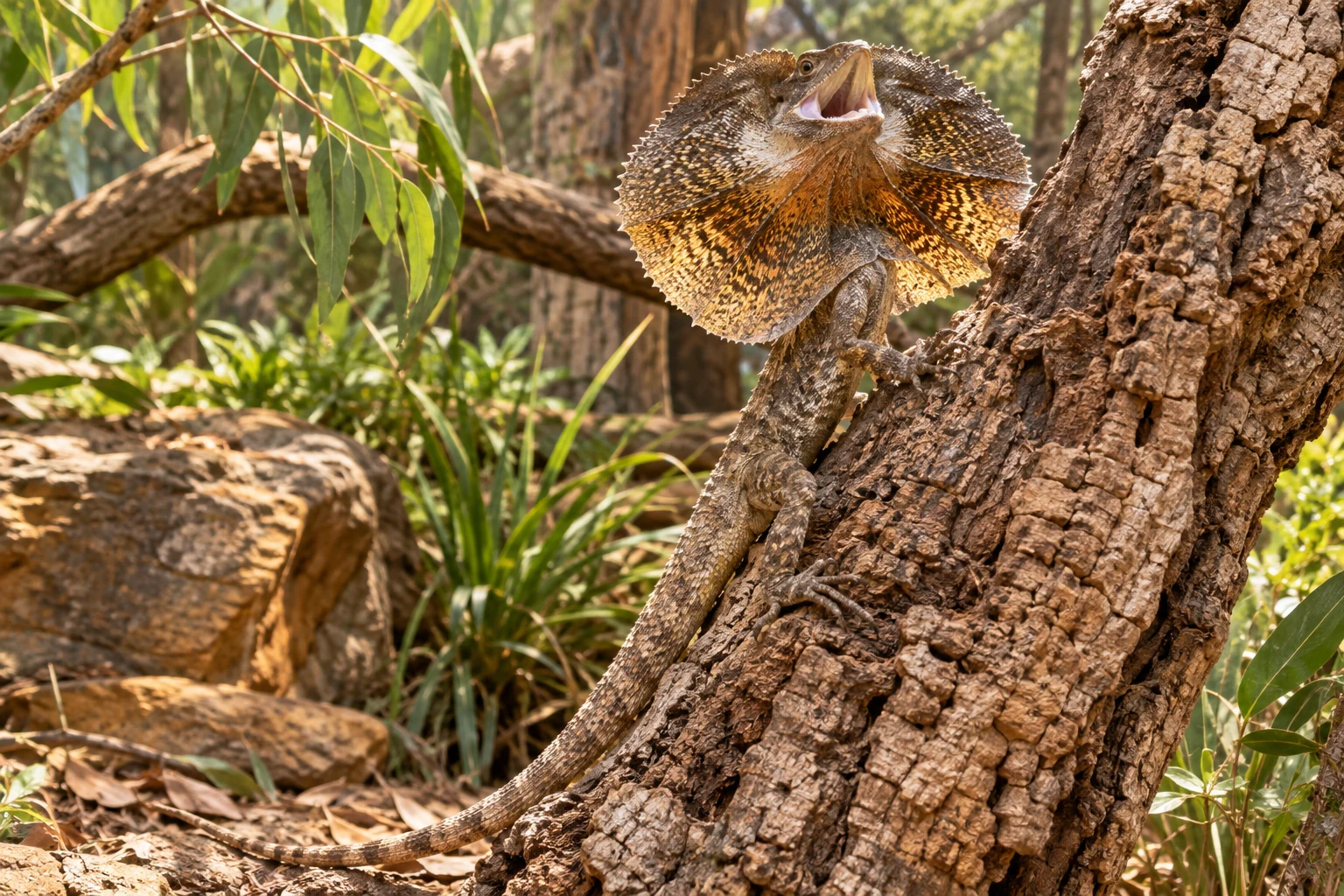
The frilled dragon is the lizard with the umbrella. When startled it gapes its mouth, the frill of skin around its neck snaps open on long cartilage spines, and it hisses and sometimes lunges. It is one of the most famous displays in the animal world, and it is a bluff: a frightened animal trying to look too big to eat.
Frilled dragons come from northern Australia and southern New Guinea, where they spend around 90 percent of their time on tree trunks and branches, coming down mainly to feed after rain. They are the only species in their genus. Adults reach about three feet including the long tail, and males are far heavier than females.
Because Australia bars commercial wildlife exports, frilled dragons in the US and Europe are captive-bred, and many are believed to descend from New Guinea lines. They rate intermediate to advanced, not because they are dangerous, but because they need tall, warm, well-ventilated enclosures and often stay nervous. They are better watched than held.
What You Will Need
Think vertical. A frilled dragon's enclosure is a tree with walls around it.
Conditions at a Glance
The whole environment on one card.
| Parameter | Target | Notes |
|---|---|---|
| Enclosure | At least 4 ft tall x 2 ft deep x 2 to 3 ft wide | Height matters more than floor space |
| Basking branch | About 115 F | Measured on the branch with a temp gun |
| Warm zone air | 85 to 100 F | A zoo standard gives 95 to 100 F at the hot end |
| Cool zone | 75 to 81 F | A real gradient from top to bottom |
| Night | Down to about 75 F | Non-light heat only if the room falls below about 64 F |
| UVB | 10.0 tube within about 12 in of the basking spot | About 12 hours a day |
| Humidity | 50 to 70 percent | High humidity without airflow causes respiratory infection |
| Diet | Insects | Greens optional, never the staple |
| Housing | One, or one male with females | Males fight |
A Tall, Secure Enclosure
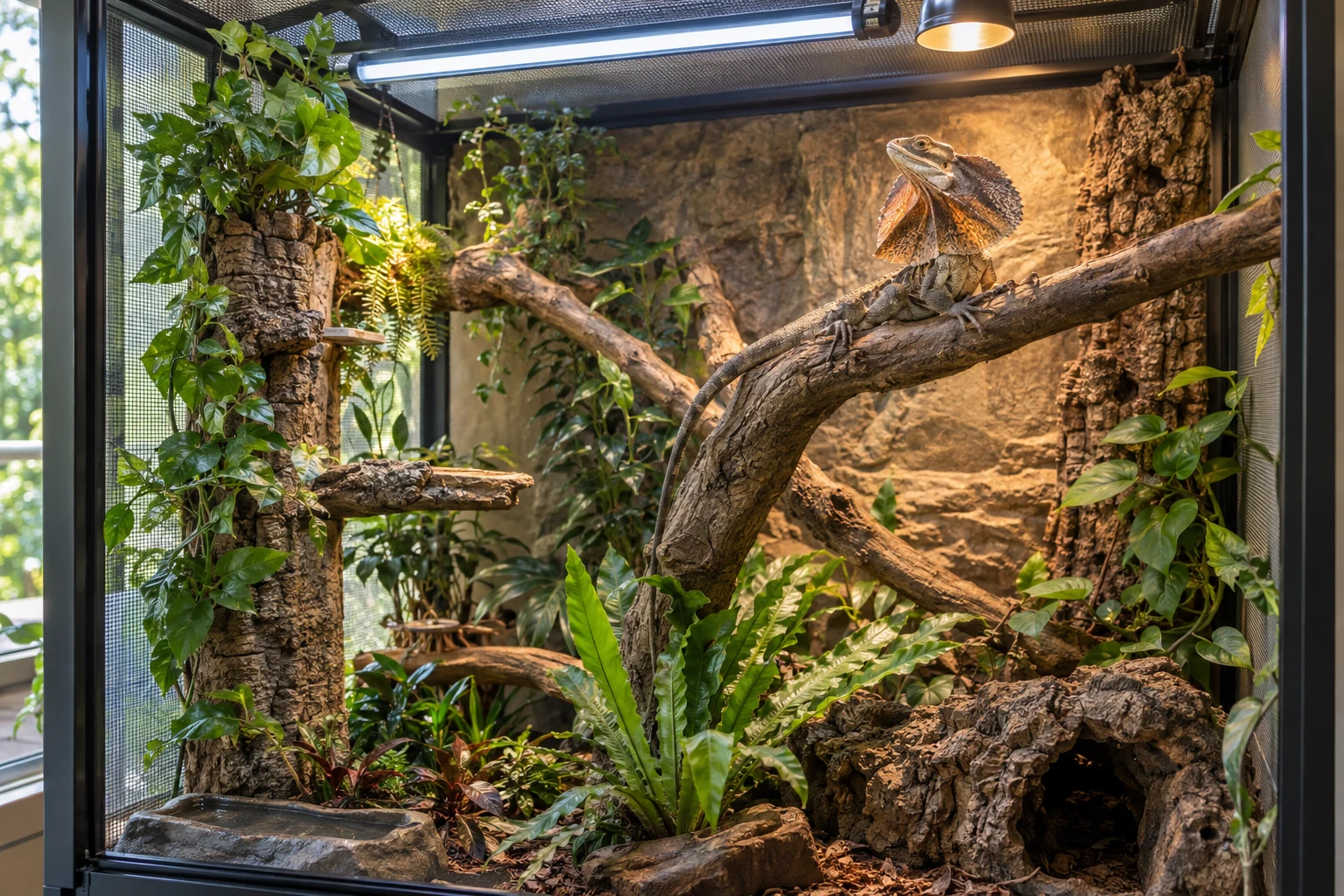
Height comes first. A frilled dragon lives up a tree, and an enclosure that lets it climb well above you is what makes it feel secure and active. Hobby care sheets give at least four feet tall by two feet deep by two to three feet wide as a workable minimum for one adult, while a professional zoo standard for an exhibited pair runs to nearly eight feet on each side. Treat the hobby numbers as the floor, not the goal.
Fill the space with sturdy branches running floor to ceiling, and add at least one visual barrier, such as foliage or a solid panel, so the lizard can get out of sight. A frilled dragon that feels constantly exposed is a stressed frilled dragon, and one common sign is a raw, scabbed nose from pushing against the glass.
Because this species climbs rather than burrows, substrate can stay shallow and dry: about two inches of coarse sand or sandy soil, with plain paper towel for hatchlings so they do not swallow sand while grabbing insects. Male frilled dragons fight each other, so keep one lizard, or one male with females in a large enclosure.
Heat, UVB and Humidity
Give the top of the enclosure a focused basking branch around 115 degrees under a lamp, with warm zone air between 85 and 100 degrees and a cooler zone around 75 to 81. A zoo manual gives 95 to 100 degrees for the hot end, while hobby sheets describe a hotter focal branch; they measure different things, so provide both a warm zone and a distinctly hotter basking branch. Guard the lamp, because frilled dragons do not reliably move away from something burning them.
Use a 10.0 strength UVB tube within about 12 inches of the basking position, since UV intensity falls quickly with distance, on a roughly 12 hour day. Replace T5 HO tubes about every six months, because their UV output fades long before the visible light does.
Humidity is a balance. Aim for 50 to 70 percent using a large water bowl and misting, and pair it with real ventilation on a side or rear wall. Humidity held high without airflow leads straight to respiratory infection, and cold drafts cause the same problem, so vents belong on the walls rather than only in the lid.
Feeding: Insects, Not Salad
Frilled dragons are often fed like bearded dragons, and it is a real mistake. Bearded dragons eat a large share of vegetables; frilled dragons are fundamentally insect eaters. In the wild they take ants, termites, beetles, grasshoppers, caterpillars and cicadas, and one major Australian zoo feeds its frilled dragons insects alone. Some institutions add a little dark leafy green or an occasional pinkie mouse, but those are optional extras, not the centre of the diet.
Roaches, black soldier fly larvae, hornworms and silkworms make a strong captive menu. Feed hatchlings small insects once or twice a day and adults about three times a week, and cut back if the lizard gets heavy, since overfeeding is a fast route to obesity. Dust insects with calcium plus D3 and a multivitamin at most feedings, with extra calcium for breeding females.
Water needs its own attention. Keep a large shallow bowl available, but many frilled dragons drink more readily from moving droplets on leaves or their snout than from still water, so mist daily or nearly daily. For portion guidance across reptiles, see how many feeder insects to feed your reptile.
| Life Stage | Main Prey | How Often | Supplements | Notes |
|---|---|---|---|---|
| Hatchling | Small roaches, small BSFL, small silkworms | Once or twice daily | Calcium with D3 and multivitamin most feedings | Paper towel floor avoids swallowed sand |
| Juvenile | Small to medium roaches, BSFL, hornworms | Daily to every other day | Calcium with D3 and multivitamin most feedings | Mist for droplets daily |
| Adult | Medium to large roaches, hornworms, silkworms | About 3 times a week | Calcium with D3 and multivitamin most feedings | Cut back if it gets heavy |
Everything a frilled dragon keeper needs from this guide. Untick anything you already have, then add the rest in one click.
What the Frill Means
An occasional frill display when a frilled dragon is startled or handled is normal, and in a new animal it usually fades over weeks to months as the lizard settles. Frequent displays without an obvious trigger are different. They signal chronic stress, usually from too few hiding places, too much handling, wrong temperatures, or a perceived rival such as a reflection or another lizard in view.
Never provoke a display to see the frill. A well-adjusted frilled dragon rarely displays at all, so a calm lizard with its frill folded like a collar is the sign you have the enclosure right. Frilled dragons are not venomous and rarely bite, but they have long canine-like teeth that can give a painful bite if cornered, sharp claws, and a tail that lashes hard.
One more myth to drop: chilling a frilled dragon in a refrigerator to calm it for handling is still passed around, and a zoo veterinary reference specifically warns against it because of the risk of respiratory and digestive problems.
Health and Troubleshooting
The frill is also your early warning system. A lizard that displays far more than usual is telling you something changed.
| What You See | Most Likely Cause | What To Do |
|---|---|---|
| Raw or scabbed nose | Pushing against glass in a small or exposed enclosure | Add a visual barrier; reassess size; clean the wound |
| Clicking, wheezing, open-mouth breathing | Respiratory infection from humidity without airflow, or drafts | Fix ventilation, humidity and temperatures; reptile vet |
| Frill flaring several times a day, no trigger | Chronic stress | Add hides and barriers, handle less, check temperatures |
| Retained shed on toes or tail tip | Low humidity | Raise humidity, soak or damp compress, ease skin off gently |
| Losing weight while eating normally | Maladaptation stress, most common in the first two years | Find and remove the stressor; vet check |
| Soft jaw, bent limbs, fractures | Metabolic bone disease | Fix calcium and UVB; urgent vet visit |
| Burn marks on the back or head | Basking lamp too close or unguarded | Move and guard the lamp; vet for burns |
| Heavy body, fat at the tail base | Overfeeding | Feed less often until weight normalises |
Frilled Dragon FAQ
Keep reading: bowl feeding versus loose feeding.
Feeding a Frilled Dragon?
Tell us its size and we will match an insect menu that keeps it lean and hydrated. Real keepers answer our email.
TC INSECTS · Real keeper advice from a working Texas insect farm
