

Five-Lined Skink Care Sheet
Complete husbandry for the common five-lined skink, the blue-tailed skink of eastern backyards (Plestiodon fasciatus): the state laws to check before keeping one, enclosure, heat and the right strength of UVB, what blue-tailed skinks eat by age, tail loss, and a troubleshooting chart.
About six in the wild; captive records are thin.
Nose to tail tip. The blue tail fades with age.
Easy to feed, but shy, fast, and stressed by handling.
Meet the Five-Lined Skink
If a child in the eastern United States has caught a lizard, there is a good chance it was a five-lined skink. Juveniles are unforgettable: glossy black with five cream to yellow stripes and a brilliant electric-blue tail. That tail is why so many people search for a blue-tailed skink, which is a nickname rather than a separate species. As they mature the stripes fade toward brown, the blue dulls, and breeding males develop an orange-red head.
Its scientific name is Plestiodon fasciatus, and older books call it Eumeces fasciatus. It ranges from New England and southern Ontario down to Florida and west to Texas, living under logs, bark and leaf litter at woodland edges and in backyards.
Two look-alikes share much of that range. The southeastern five-lined skink is nearly identical and is usually told apart by a row of scales under the tail, and the broad-headed skink grows much larger, up to about 12 inches. Care for all three is similar, but the law is not always the same, which is why the next section comes first.
Found One Outside? Read This First
Whether you may keep a native skink is decided by your state wildlife agency, and the answers vary more than most people expect. The five-lined skink is listed as Threatened in Connecticut and Endangered in Vermont, so taking one there is off the table. Virginia allows one native reptile per household and none from public land. North Carolina and Maryland allow up to four without a permit. Ohio requires a license to keep native reptiles, and Indiana and Pennsylvania require a hunting or fishing license to collect them. Georgia's pet rules reportedly bar keeping native skinks at all, so confirm with Georgia DNR before keeping one there.
The part that is never negotiable: an animal that has lived in captivity should not be released somewhere new, because it can carry parasites and disease into wild populations. If you catch a skink just to look at it, the kindest option is a short visit and a release at the exact spot you found it, the same day.
If you would rather not catch one at all, five-lined skinks are sold at reptile expos and by online retailers. Ask the seller about origin, since many are still wild-collected, and plan a fecal parasite check for any new animal.
What You Will Need
The setup is simple and inexpensive. The two items people skip, and should not, are UVB and a humid hide.
Conditions at a Glance
The whole environment on one card.
| Parameter | Target | Notes |
|---|---|---|
| Basking surface | 85 to 90 F | Measured on the basking spot with a temp gun |
| Cool side | 70 to 75 F | A real gradient lets the skink choose |
| Night | Upper 60s to low 70s F | Lights off; a natural drop is fine |
| UVB | Ferguson Zone 2, 10 to 12 hours | Lower output than a desert basker needs |
| Humidity | 40 to 60 percent | Plus a humid hide for shedding |
| Substrate | 2 to 3 inches, diggable | Topsoil, coco fiber and sand blend |
| Diet | Insects and invertebrates only | No fruit or vegetables |
| Housing | One adult, or one male with one or two females | Never two males |
Enclosure, Heat and UVB
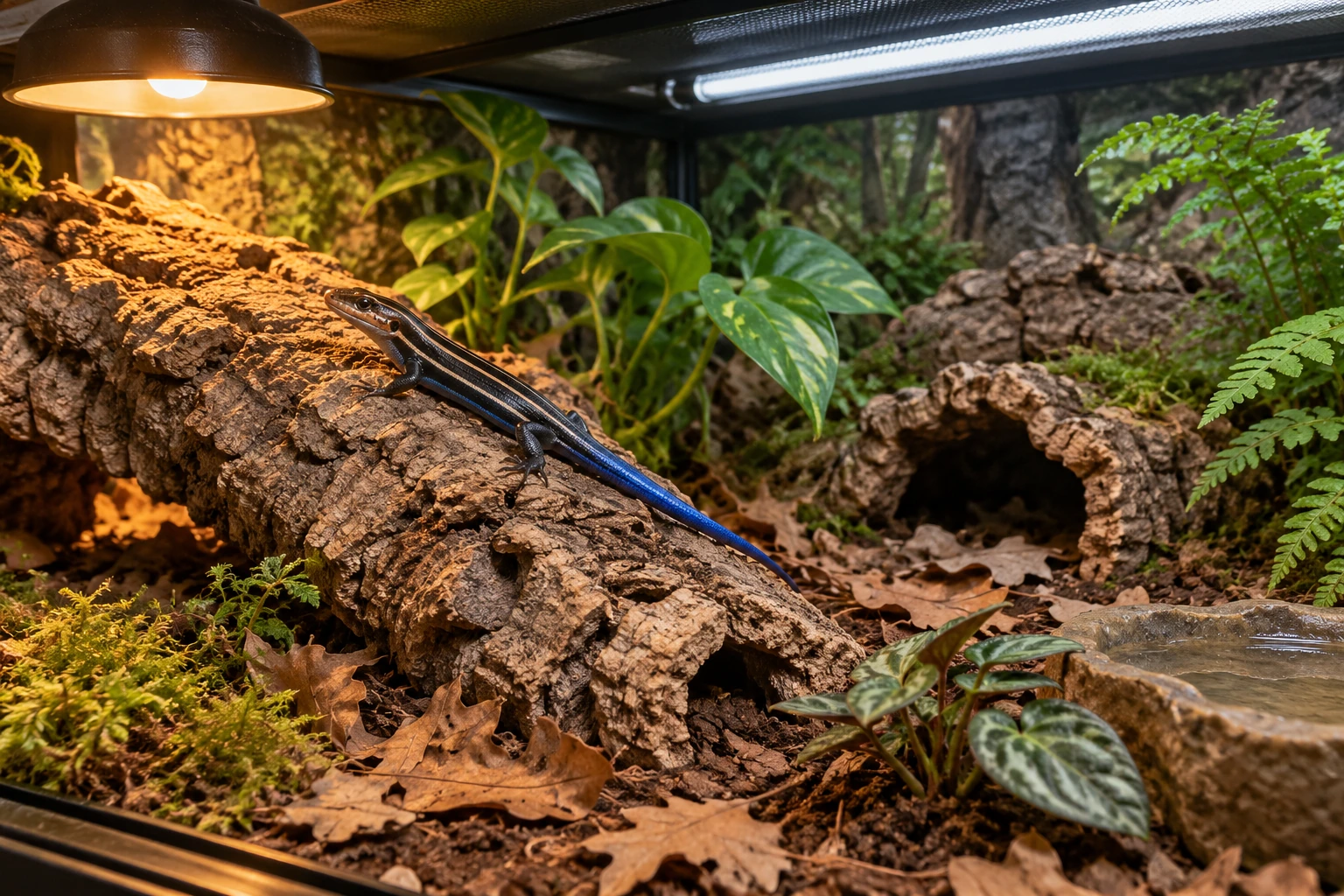
A 20 gallon long is the minimum for one adult, and 30 to 40 gallons makes it far easier to build a proper gradient from a warm basking end to a cool retreat. Five-lined skinks mostly live on the ground and climb onto logs and snags, so lay the enclosure out horizontally with plenty of cover: half-buried cork bark, flat stones to hide beneath, leaf litter, and a piece of climbing wood.
Put a basking bulb over one end so the surface beneath it reaches 85 to 90 degrees, with the cool end around 70 to 75. A heat mat under the warm end can back up the bulb in a cold room but should not replace it. Let temperatures fall into the upper 60s or low 70s at night with the lights off.
UVB is required. Five-lined skinks are partial-sun lizards, placed in Ferguson Zone 2, so they need less intensity than a full-sun desert species. A lower-output 5 to 7 percent T5 HO tube, mounted at the distance its manufacturer recommends, fits them better than the strongest tubes sold for bearded dragons. Run it 10 to 12 hours a day.
Keep humidity around 40 to 60 percent with light misting every day or two, and add a humid hide packed with damp sphagnum moss. That hide is where a skink goes to shed cleanly.
What Blue-Tailed Skinks Eat
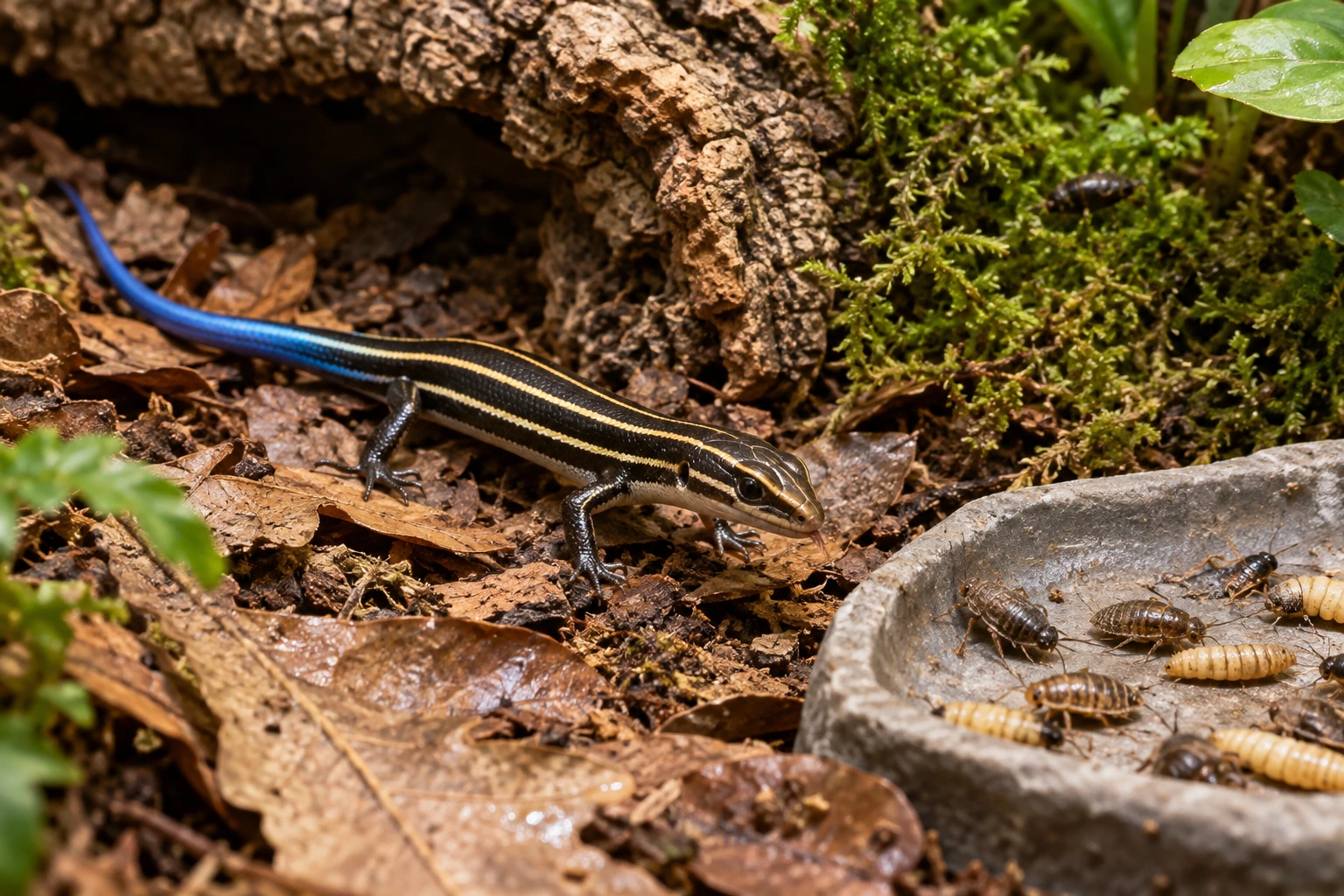
Five-lined skinks eat insects and other small invertebrates and no plant matter at all; wild skinks take crickets, grasshoppers, beetles, spiders and snails. In captivity, small roaches, black soldier fly larvae and small red runner roaches make a varied staple. Offer prey no wider than the space between the skink's eyes.
Feed juveniles daily and adults every one to two days. With good UVB in place, dust most feedings with calcium without D3, use calcium with D3 only sparingly, and add a multivitamin about once a week for juveniles and less often for adults. Never stack two D3 sources.
Resist feeding insects from the yard. They can carry pesticides and parasites, brightly coloured insects are often toxic, and fireflies should never be fed to any lizard, since their toxins have killed pet lizards. For portions, see how many feeder insects to feed your reptile.
| Life Stage | Prey Size | How Often | Supplements | Notes |
|---|---|---|---|---|
| Hatchling | The smallest roaches, fruit flies, tiny BSFL | Daily | Calcium most feedings; multivitamin weekly | Prey no wider than the space between the eyes |
| Juvenile | Extra small roaches, small BSFL | Daily | Calcium most feedings; multivitamin weekly | Fastest growth; the bright blue tail stage |
| Adult | Small roaches, BSFL, small red runners | Every 1 to 2 days | Calcium most feedings; multivitamin less often | Blue fades; males may turn orange-headed |
Everything a five-lined skink keeper needs from this guide. Untick anything you already have, then add the rest in one click.
Handling and the Dropped Tail
Five-lined skinks are shy and fast, and most never enjoy being handled. A frightened skink may bite, which is a harmless pinch, but its main defense is the tail. Grab a skink by the tail and it will let it go on purpose, leaving the tail wriggling for minutes to distract a predator while the lizard escapes.
A lost tail grows back over one to several months, but the new one is shorter, greyer and supported by cartilage instead of bone, and it cannot be dropped again at the same point. If it happens, keep the skink on clean substrate that will not stick to the wound, handle it as little as possible, keep supplements consistent, and see a vet if bleeding continues or the site looks infected.
And no, blue-tailed skinks are not venomous or poisonous to people. That is folklore, and so is the old story that they are a kind of scorpion.
Winter Slowdowns and Brumation
Wild five-lined skinks brumate from roughly October or November to March in logs, crevices and burrows. A pet kept warm year-round does not need to brumate. If a captive skink slows down and loses its appetite in autumn, confirm temperatures and UVB first, and talk with a reptile vet before deliberately cooling any lizard.
Health and Troubleshooting
Most problems in captive skinks trace back to lighting, humidity, or the stress of being wild-caught.
| What You See | Most Likely Cause | What To Do |
|---|---|---|
| Soft or kinked limbs, tremors | Metabolic bone disease from weak UVB or low calcium | Exotics vet; correct UVB and supplements |
| Old skin stuck on toes or tail tip | Humidity too low, no humid hide | Humid hide, short lukewarm soak; never peel dry skin |
| Wrinkled skin, sunken eyes | Dehydration | Mist, refill the dish, soak; vet if severe |
| Refusing food for days | Wrong temperatures, weak UVB, stress, or an autumn slowdown | Check with meters, add cover, handle less; vet after 1 to 2 weeks |
| Moving specks near eyes or limb folds | Mites | Quarantine, vet-directed treatment, full enclosure clean |
| Eating well but losing weight | Internal parasites, common in wild-caught skinks | Fecal exam by a reptile vet |
| Tail dropped | Grabbed or cornered | Clean setup, minimal handling, watch the wound |
Five-Lined Skink FAQ
Keep reading: whether you can keep a lizard you found outside.
Caring for a Five-Lined Skink?
Tell us its size and we will match feeders small enough for it. Real keepers answer our email.
TC INSECTS · Care sheets written at the farm, not copied from forums · Porter, Texas
