
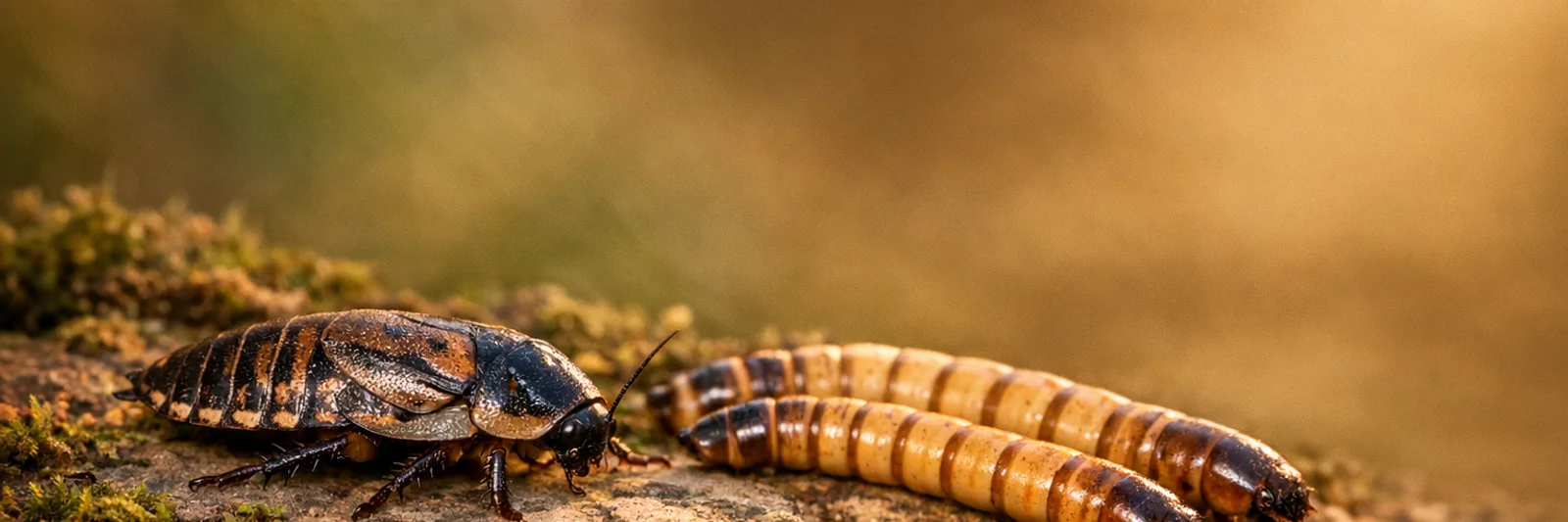
- For daily feeding, dubia roaches are the leaner, safer staple: they run about 6 to 7% fat, cannot bite or pinch, and carry the best calcium ratio of any feeder roach.
- Dubia Roaches carry more protein on an as-fed basis (20 to 23%).
- Nearly every feeder insect is calcium-deficient with an inverted calcium-to-phosphorus ratio, so dust with a calcium supplement and gut-load before feeding.
- These figures are on an as-fed (live) basis compiled from published feeder-insect composition research, so they are guidance, not guarantees.
Dubia Roaches
- Much leaner at about 6 to 7% fat
- Cannot bite or pinch your animal or you
- Best calcium ratio among feeder roaches
- Silent and odorless, and cannot climb smooth walls
Superworms
- Larger and more filling for big appetites
- Store at room temperature, no fridge needed
- High in fat at roughly 17 to 18%, so not a daily staple
- Can pinch or bite, so size them to the animal
| Dubia Roaches | Superworms | |
|---|---|---|
| Protein | 20 to 23% | 19 to 20% |
| Fat | 6 to 7% | 17 to 18% |
| Moisture | 65 to 72% | about 58% |
| Calcium : Phosphorus | about 0.29:1 | about 0.1:1 |
| Calcium | Low (roughly 700 to 800 mg/kg); still dust | Very low (roughly 177 mg/kg) |
| Dust with calcium? | Yes | Yes |
| Gut-load? | Yes | Yes |
| Best known for | High-protein everyday staple; best calcium ratio among feeder roaches | Larger, high-fat feeder for bigger appetites; room-temperature storage |
Nutrition: Close on Protein, Far Apart on Fat
On protein these two are almost even. Dubia roaches run a little higher, but the gap is small and will not make or break a healthy animal. The real difference is fat. Superworms are one of the fattiest common feeders at roughly 17 to 18%, while dubia sit down around 6 to 7%. That fat is not a win, it is the reason superworms cannot be a daily staple. A steady diet of fat-heavy feeders can leave a reptile overweight over time.
Both feeders share the usual feeder-insect weakness: their calcium-to-phosphorus ratio is inverted, so they carry far more phosphorus than calcium. Dubia have the better ratio of the two, about 0.29 to 1 versus roughly 0.1 to 1 for superworms, but neither is close to balanced. Whichever you feed, dust with a calcium supplement and gut-load before feeding.
Size, Storage, and Everyday Care
Superworms are large, which is exactly why keepers reach for them. One superworm goes a long way for an adult bearded dragon or a tegu, and they keep at room temperature for weeks without refrigeration, which makes them easy to stock. Dubia are also low-maintenance and shelf-stable in a warm bin, and they are silent, odorless, and cannot climb smooth plastic or glass.
The trade-off with size is that a superworm is a mouthful. For small or young reptiles, a large superworm can be too big to swallow safely, so match the feeder to the animal. Dubia come in a full range of sizes, which makes them easier to fit to smaller pets and growing juveniles.
Safety: Superworms Can Pinch
This is a real difference, not a small one. Superworms have working jaws and can pinch or bite, both the animal that is eating them and the hand that feeds them. That is why many keepers crush the head of a superworm before offering it, or only feed them under supervision. Dubia roaches, by contrast, cannot bite and have no interest in harming your animal, which is part of why they are such a trusted everyday staple.
Both feeders share a chitin shell, the hard outer layer that some smaller or younger reptiles find harder to digest. It is one more reason to size either feeder to your animal and not overdo the larger, tougher options.
Cost and Shipping
Superworms are inexpensive per insect and store well at room temperature, so they are an easy thing to keep on hand for larger animals. Dubia cost a bit more but pay you back in shelf life and daily usability across many pets. Both ship well as live insects, and every TC Insects order is checked against real, current weather before it leaves, backed by our Live Arrival Guarantee.
Which One Should You Choose?
Choose Dubia Roaches if
- You want a lean feeder you can offer every single day
- You are feeding smaller or younger reptiles that need a range of sizes
- You want a feeder that cannot bite, pinch, smell, or climb out
- You keep bearded dragons, most geckos, or monitors
Choose Superworms if
- You keep a large, hungry animal like an adult beardie or tegu
- You want a filling feeder to rotate alongside a leaner staple
- You prefer a feeder that stores at room temperature
- You are comfortable sizing them right and watching for pinching
Frequently Asked Questions
Are superworms or dubia roaches better for bearded dragons?
It depends on the age. For daily feeding, dubia roaches are the better staple because they are much leaner and cannot bite. Superworms are a great filling feeder for adult bearded dragons, but their high fat makes them better as a rotation feeder or occasional treat than an everyday staple. Avoid large superworms for babies and juveniles.
Do superworms have more protein than dubia roaches?
No, they are very close on protein, and dubia actually run slightly higher. The real difference is fat: superworms are one of the fattiest common feeders at roughly 17 to 18%, while dubia sit around 6 to 7%. So superworms are richer overall, but not because of protein.
Can superworms be a staple feeder?
For most reptiles, no. Superworms are too high in fat to be the only feeder in the diet. They work best as a filling feeder for large, active animals, or in rotation with a leaner staple like dubia roaches. Feeding them exclusively can lead to an overweight animal over time.
Are superworms too fatty for reptiles?
They are high in fat, at roughly 17 to 18%, which is why they are not recommended as a daily staple for most reptiles. That richness is fine in moderation and useful for big or active animals, but a leaner feeder like dubia roaches is the better everyday choice.
Do superworms bite?
Yes, superworms have working jaws and can pinch or bite both your animal and you. Many keepers crush the head before feeding or only offer them under supervision. Dubia roaches, by contrast, cannot bite, which is one reason they are a safer everyday staple.
Keep comparing: Dubia vs Mealworms· Superworms vs Mealworms· Dubia vs Crickets· Feeder Nutrition Chart
