
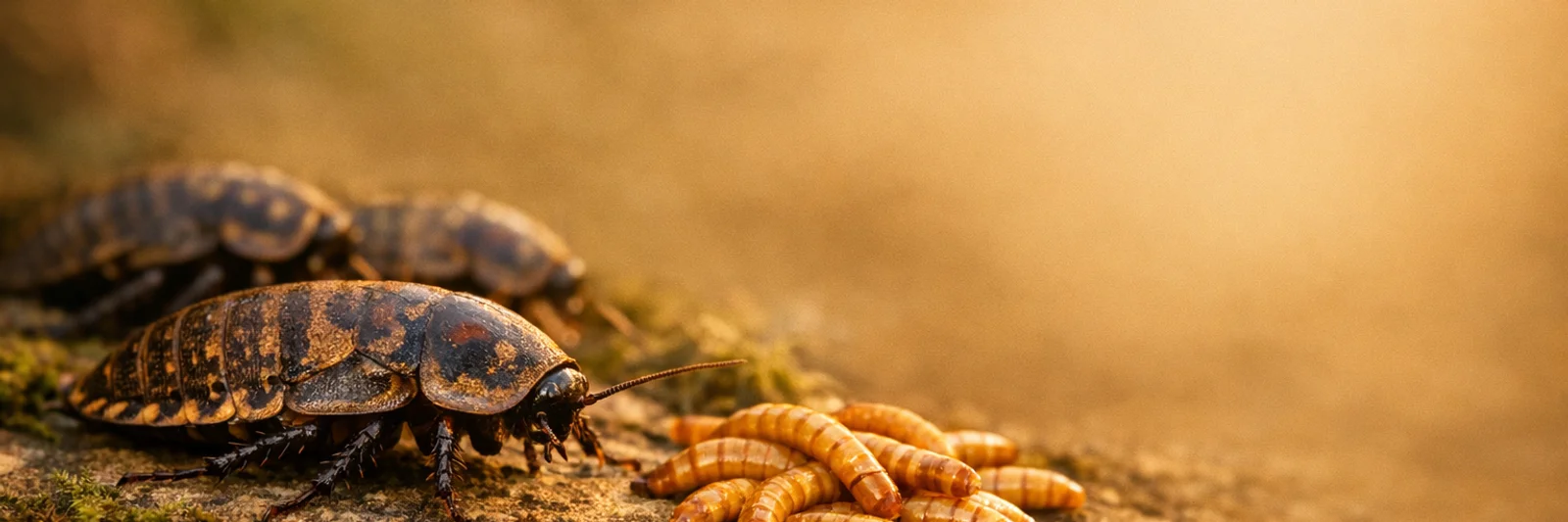
- For an everyday staple, dubia roaches are the better all-around choice: they are leaner, higher in protein, hold more moisture, and have a soft body that is easy to digest.
- Dubia Roaches carry more protein on an as-fed basis (20 to 23%).
- Nearly every feeder insect is calcium-deficient with an inverted calcium-to-phosphorus ratio, so dust with a calcium supplement and gut-load before feeding.
- These figures are on an as-fed (live) basis compiled from published feeder-insect composition research, so they are guidance, not guarantees.
Dubia Roaches
- Higher protein and leaner than mealworms
- Soft-bodied, so easier to digest
- More moisture to help keep animals hydrated
- Best calcium ratio among feeder roaches, though you still dust
Mealworms
- Cheap and widely available
- Fridge-storable for weeks with almost no care
- Higher in fat, which is fine as a treat, not a staple
- Hard chitin shell that can be tough on small or young animals
| Dubia Roaches | Mealworms | |
|---|---|---|
| Protein | 20 to 23% | 18 to 20% |
| Fat | 6 to 7% | about 13% |
| Moisture | 65 to 72% | about 62% |
| Calcium : Phosphorus | about 0.29:1 | about 0.05:1 |
| Calcium | Low (roughly 700 to 800 mg/kg); still dust | Very low (roughly 169 mg/kg), very high phosphorus |
| Dust with calcium? | Yes | Yes |
| Gut-load? | Yes | Yes |
| Best known for | High-protein everyday staple; best calcium ratio among feeder roaches | Cheap, easy, fridge-storable staple; higher fat and a hard shell |
Nutrition: Lean Staple vs Fatty Treat
This is where the two really split. Dubia roaches run a little higher in protein and, just as importantly, are much leaner. Mealworms carry roughly double the fat of dubia, which is great for putting weight on a thin animal but too rich for daily feeding. Over time, a mealworm-heavy diet can lead to an overweight, under-nourished pet. Dubia are the everyday staple; mealworms are the occasional treat.
Both feeders are low in calcium with an inverted calcium-to-phosphorus ratio, so both need dusting. Mealworms are the weaker of the two here: they are very low in calcium and very high in phosphorus, so a calcium supplement matters even more with them. Dubia have the best calcium ratio among feeder roaches, but you should still dust and gut-load whichever one you feed.
The Shell: Why Impaction Comes Up
Mealworms have a harder outer shell, made of chitin, than a soft dubia roach does. For a healthy adult reptile, that shell is usually no problem. But for small, young, or newly hatched animals, larger or harder-shelled prey can be difficult to digest and is often linked to impaction concerns, especially if the animal is kept a little too cool to digest well.
Dubia are soft-bodied and easier on a small digestive system, which is a big reason keepers reach for them as a growth-stage staple. If you do feed mealworms to smaller animals, size them down and keep them to a treat rather than a daily meal. Freshly molted (white) mealworms are softer, but they are hard to source consistently.
Storage and Daily Hassle
This is mealworms' real advantage. You can keep them in a tub of bran in the fridge, where the cold slows them down, and they will hold for weeks with almost no attention. There is no colony to heat, no smell, and no noise. For a keeper with one or two pets who wants a feeder that just waits in the kitchen, mealworms are hard to beat on convenience.
Dubia are also easy to keep and live for months, but they want warmth to stay active and to breed, so they are more of a small colony than a grab-and-go container. Neither is difficult. Mealworms simply win the low-effort, low-space contest, which is exactly why so many people keep a cup of them as a backup.
Cost and Shipping
Mealworms are one of the cheapest feeders you can buy, which is a genuine point in their favor as a treat or backup. Dubia cost a bit more, but you are paying for a leaner, higher-protein staple with more moisture, so the value depends on the job you need done. Both ship well as live insects, and every TC Insects order is checked against real, current weather before it leaves, backed by our Live Arrival Guarantee.
Which One Should You Choose?
Choose Dubia Roaches if
- You want one feeder to build a daily diet around
- You are feeding small, young, or growing animals
- You want leaner, higher-protein, higher-moisture prey
- You would rather avoid the fat and hard shell of mealworms
Choose Mealworms if
- You want a cheap, low-effort treat or backup feeder
- You need something you can store in the fridge for weeks
- You are feeding a healthy adult that handles harder shells fine
- You want to rotate in variety alongside a proper staple
Frequently Asked Questions
Are dubia roaches better than mealworms?
As an everyday staple, yes. Dubia are leaner, higher in protein, hold more moisture, and are soft-bodied, so they are easier to digest. Mealworms are cheaper and store better in the fridge, which makes them a fine convenience treat, just not the best sole staple, since they are higher in fat and low in calcium.
Can bearded dragons eat mealworms every day?
It is not the best idea. Mealworms are high in fat and low in calcium, so a daily mealworm diet can lead to an overweight, under-nourished dragon over time. They work well as an occasional treat, but a leaner staple like dubia roaches, dusted with calcium, is a better daily feeder.
Do mealworms cause impaction?
They can be harder to digest for small, young, or newly hatched animals because of their firmer chitin shell, especially if the animal is kept too cool to digest well. For a healthy adult reptile, appropriately sized mealworms are usually fine. Size prey to the animal, dust with calcium, and keep enclosure temperatures correct.
Are mealworms a good staple feeder?
They are better as a treat than a sole staple. Mealworms are cheap, easy, and fridge-storable, but they are higher in fat, very low in calcium, and have a harder shell. A leaner, higher-protein feeder like dubia roaches makes a stronger everyday staple, with mealworms rotated in for variety.
Do mealworms have enough calcium?
No. Mealworms are very low in calcium and very high in phosphorus, giving them a poor calcium-to-phosphorus ratio. You must dust them with a calcium supplement before feeding. This is true of most feeder insects, but it matters even more with mealworms.
Keep comparing: Dubia vs Crickets· Dubia vs Superworms· Superworms vs Mealworms· Feeder Nutrition Chart
