
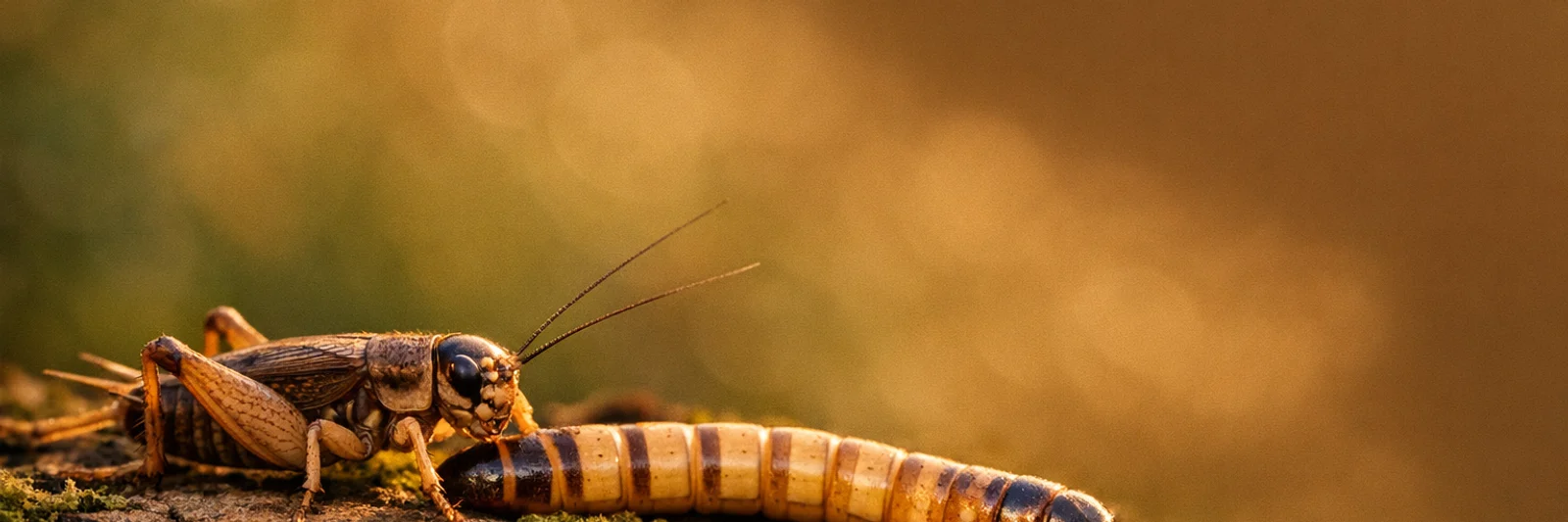
- For everyday feeding, crickets are the better staple of these two: they are lean, soft-bodied, and their constant hopping triggers a strong feeding response in most reptiles.
- Nearly every feeder insect is calcium-deficient with an inverted calcium-to-phosphorus ratio, so dust with a calcium supplement and gut-load before feeding.
- These figures are on an as-fed (live) basis compiled from published feeder-insect composition research, so they are guidance, not guarantees.
Crickets
- Lean and low in fat, safe to feed daily
- Constant movement triggers a strong feeding response
- Soft-bodied and easy for small animals to eat
- Noisy, smelly, and short-lived, so they need restocking often
Superworms
- Large and filling for bigger appetites
- High in fat, best as an occasional feeder, not a daily staple
- Store at room temperature for weeks with little fuss
- Too big for small or young animals
| Crickets | Superworms | |
|---|---|---|
| Protein | 15 to 21% | 19 to 20% |
| Fat | 3 to 7% | 17 to 18% |
| Moisture | 69 to 77% | about 58% |
| Calcium : Phosphorus | about 0.12:1 | about 0.1:1 |
| Calcium | Low (roughly 275 mg/kg); must dust | Very low (roughly 177 mg/kg) |
| Dust with calcium? | Yes | Yes |
| Gut-load? | Yes | Yes |
| Best known for | Balanced, widely available staple that triggers a strong feeding response | Larger, high-fat feeder for bigger appetites; room-temperature storage |
Nutrition: Lean vs Rich
The two are close on protein, but they part ways on fat, and that is the whole story here. Crickets are lean, which is exactly what you want in a feeder your animal eats most days. Superworms carry far more fat, so they are richer and more filling per bite. That higher fat is not a flaw, it is a feature for animals that need to put on condition or that burn a lot of energy, but it is why superworms make a poor sole daily staple for the average pet.
Beyond fat, both share the same weakness as nearly every feeder insect: their calcium-to-phosphorus ratio is inverted, meaning far more phosphorus than calcium. That is why you dust with a calcium supplement and gut-load before feeding, no matter which one you reach for.
Size and Which Animals Fit
Superworms are large, and size decides a lot here. A big beardie, an adult monitor, or a large gecko can take a superworm easily and appreciate the bigger mouthful. A juvenile, a small gecko, or a dart frog cannot, and an oversized feeder is a real risk rather than a meal. Crickets come in a range of sizes and stay soft-bodied, so they suit small and young animals that superworms would overwhelm.
As a rule of thumb, a feeder should be no wider than the space between your animal's eyes. Crickets make it easy to match that across life stages, while superworms are built for the larger end of the range.
Care and Daily Hassle
This is where superworms quietly win the storage battle. They keep for weeks in a bin at room temperature with a bit of dry substrate and the odd piece of vegetable, and they do not chirp or smell. Crickets are the opposite: they are noisy, prone to a distinctive odor if a container gets damp or crowded, and short-lived, so you restock them often.
So the trade is real. Crickets give you the better feeding response and a safer daily fat level, but they are more work to keep alive. Superworms are almost no trouble to store, but you have to hold back and not overfeed the fat. Many keepers run crickets as the staple and rotate superworms in as a hearty change of pace.
Cost and Shipping
Both are affordable live feeders. Crickets are cheap per insect but shorter-lived, so replacement cost adds up over time. Superworms cost a little more per worm but store for weeks, which softens the difference. Both ship well as live insects, and every TC Insects order is checked against real, current weather before it leaves, backed by our Live Arrival Guarantee.
Which One Should You Choose?
Choose Crickets if
- You want a lean feeder you can offer most days
- Your animal needs movement to trigger a feeding response
- You are feeding smaller or younger animals that handle soft bodies better
- You want a classic, widely used staple in a range of sizes
Choose Superworms if
- You keep a larger reptile that needs a bigger, filling feeder
- You want a hearty feeder to rotate in a few times a week
- You would rather store a worm at room temperature for weeks
- You are helping an underweight animal put on condition
Frequently Asked Questions
Are crickets or superworms better for bearded dragons?
For everyday feeding, crickets are the better staple because they are lean and trigger a strong feeding response. Superworms are larger and much higher in fat, so they work best as an occasional feeder for adult dragons rather than a daily one. Dust and gut-load either way.
Do superworms have more protein than crickets?
No, the two are close on protein. The real difference is fat: superworms carry far more of it than crickets. So superworms are richer and more filling, not meaningfully higher in protein.
Can I feed superworms as a staple?
For most pets, superworms are too high in fat to be a sole daily staple. They are best offered a few times a week or reserved for larger animals and those that need to gain condition. A leaner feeder like crickets is the better everyday base.
Are superworms too big for my reptile?
They can be. Superworms are a large feeder, so they suit bigger reptiles like adult bearded dragons, monitors, and large geckos. For small or young animals, they are often too big, and crickets in a smaller size are the safer fit. A feeder should be no wider than the space between your animal's eyes.
Do crickets or superworms cause impaction?
Impaction risk is more about feeder size and husbandry than the species itself. An oversized feeder is the bigger concern, which is why matching the feeder to your animal's size matters. Superworms have a firmer body than a soft cricket, so keep them appropriately sized and part of a varied diet.
Keep comparing: Dubia vs Crickets· Dubia vs Superworms· Superworms vs Mealworms· Feeder Nutrition Chart
