
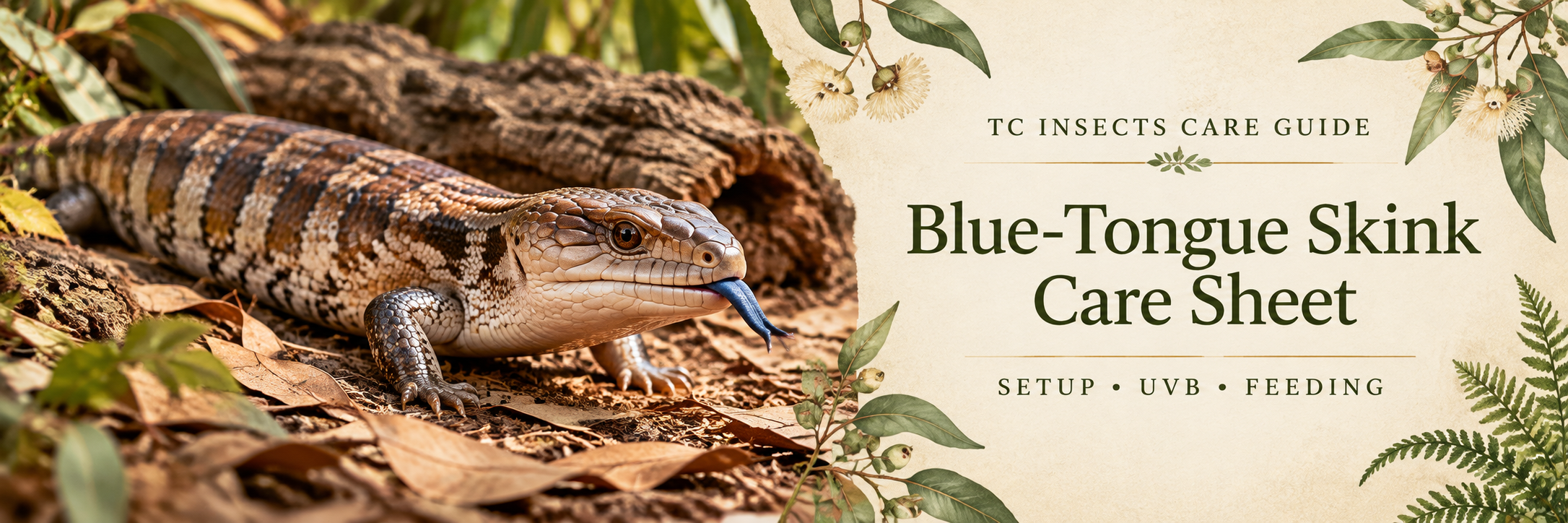
Blue Tongue Skink Care Sheet
Complete blue tongue skink husbandry (Tiliqua species): floor space over height, basking and UVB numbers, the omnivore diet split that confuses everyone, deep substrate for burrowing, and a troubleshooting chart.
Some individuals reach 30 in captivity.
Heavy bodied with very short legs; a real handful of lizard.
Famously docile and interactive, with straightforward needs.
Meet the Blue Tongue Skink
Blue tongue skinks are the most dog-like lizards in the hobby: heavy, slow, deliberate animals that learn their keeper, come out to see what is happening, and tolerate handling better than almost any other reptile. The name comes from the startling cobalt tongue they flash from a bright pink mouth when threatened, a bluff display from an animal with no other real defence.
Most in the trade are northern blue tongues from Australia, with Indonesian and other species also kept. They are terrestrial, diurnal, and omnivorous, which sets them apart from every other lizard in this library: no lizard here has a more varied diet.
Their body plan drives the enclosure: a long heavy body on tiny legs means they need floor space, not height, and deep substrate to burrow into. Height is wasted on an animal that cannot climb.
What You Will Need
The item people under-buy is the enclosure. A blue tongue is a big lizard in a low package.
Conditions at a Glance
One card. The diet row is the one that trips up keepers used to insectivores.
| Parameter | Target | Notes |
|---|---|---|
| Enclosure minimum | 4 x 2 x 2 feet for an adult | Floor space, not height; they cannot climb |
| Basking surface | 95 to 105 F | Measured on the surface, not in the air |
| Cool end | 75 to 80 F | A genuine gradient across the length |
| Night | 65 to 75 F | Lights fully off |
| UVB | Linear T5 tube | Diurnal baskers; replace every 6 to 12 months |
| Humidity | 40 to 60 percent | Varies by species; Indonesians want the higher end |
| Substrate depth | 4 to 6 inches | They burrow, and it is not optional behaviour |
| Diet | Omnivore: greens, protein, insects | Roughly half plant, half animal for adults |
| Housing | One per enclosure | Territorial; they will fight |
Enclosure, Heat and Substrate
An adult blue tongue needs at least a four by two by two foot enclosure, and more floor space is genuinely used by an animal that patrols. Height is irrelevant, because a blue tongue with a climbing structure is a blue tongue that falls off it.
Set a basking surface of 95 to 105 degrees at one end under a dimming-thermostat-controlled bulb, with a cool end at 75 to 80 and a full night drop with lights off. Fit a linear T5 UVB tube: these are diurnal baskers that use UVB heavily, and it belongs on the required list rather than the optional one.
Give four to six inches of a soil and cypress mix. Blue tongues burrow to sleep and to thermoregulate, and a shallow tank produces an animal that paces and pushes at the glass. Deep substrate is housing, not decoration.
Diet and Feeding
This is where blue tongues differ from every other lizard here: they are true omnivores, and a rough half-and-half split of plant and animal matter suits an adult. The plant half is chopped greens like collard, mustard, dandelion and endive plus squash and a little fruit. The animal half is where keepers get creative, and gut-loaded insects are the cleanest, most natural option.
Gut-loaded dubia roaches make an excellent protein staple, with black soldier fly larvae for calcium and superworms as an occasional treat. Many keepers also use a high quality wet dog or cat food as part of the protein rotation, which is a well-established practice in this species. Dust per the table, feed in a shallow dish, and adjust portions to body condition. Full sizing help is on our blue tongue skink feeder guide.
| Life Stage | Plant vs Animal | Portion | How Often | Supplements |
|---|---|---|---|---|
| Juvenile | About 30 percent plant, 70 percent animal | A shallow dish they finish in one sitting | Daily | Calcium + D3 most feedings; multivitamin weekly |
| Subadult | About 40 percent plant, 60 percent animal | A shallow dish per feeding | Every other day | Calcium + D3 twice weekly; multivitamin weekly |
| Adult | About 50 percent plant, 50 percent animal | A shallow dish per feeding | 2 to 3 times per week | Calcium + D3 weekly; multivitamin every other week |
Everything a blue tongue skink keeper needs from this guide. Untick anything you already have, then add the rest in one click.
The Bioactive Option
Deep substrate plus a burrowing lizard is a natural bioactive candidate, and the payoff is significant because blue tongues produce substantial waste. Springtails and dwarf white isopods work the lower layers, and those two small species stay the safe crew around a live animal.
Expect the skink to bulldoze the surface layout regularly, so plant sturdily at the edges. Our bioactive setup guide has the full build order.
Handling and Temperament
Blue tongues are among the best reptiles for handling. Most settle into calm regular sessions quickly, and many appear to genuinely tolerate or enjoy the attention. Support the whole body including the back legs, keep the animal low over a surface, and let a new skink settle and feed reliably for a week or two first.
The blue tongue display, mouth open and tongue out with a hiss, is a bluff rather than aggression, and it usually fades as the animal settles. Move slowly, scoop rather than grab from above, and it rarely appears at all.
Health and Troubleshooting
A healthy blue tongue is heavy bodied without being fat, clear eyed, alert to movement outside the glass, and shedding cleanly. Most problems come from too little space, missing UVB, or an unbalanced diet.
| What You See | Most Likely Cause | What To Do |
|---|---|---|
| Constant glass pacing or surfing | Enclosure too small or too shallow to burrow | Upgrade floor space; deepen the substrate to 4 to 6 inches |
| Wobbly gait, tremors, soft jaw | Metabolic bone disease from poor UVB or calcium | Fit or replace the T5 UVB now; correct dusting; exotics vet |
| Obesity, fat rolls at the limbs | Too much protein, too little plant matter | Move an adult toward a 50-50 split; reduce portion frequency |
| Stuck shed on toes and tail tip | Humidity too low for the species | Raise humidity to species range; add a humid hide; shallow soak |
| Refusing food and hiding constantly | Too cool, or a stress response after a move | Verify basking surface temperature; give a settling week |
| Mites around the eyes and ear openings | Introduced with a new animal or substrate | Exotics vet; treat the enclosure as well as the skink |
| Mouth gaping while basking | Normal thermoregulation | Nothing, if the basking surface is in range |
Blue Tongue Skink FAQ
Keep reading: the dusting schedule by species.
Feeding an Omnivore?
Tell us your skink's age and we will size the insect half of the diet and the dusting schedule. Real keepers answer our email.
TC INSECTS · Care sheets written at the farm, not copied from forums · Porter, Texas
