
Ball Python Care Sheet
Complete ball python husbandry (Python regius): enclosure and thermostat-controlled heat, the humidity band that prevents stuck sheds, the two-hide rule, why a fasting ball python is usually fine, and a troubleshooting chart.
Thirty-plus is documented. This is a decades-long animal.
Females larger and heavier; a manageable snake for most homes.
Calm and hardy, if you can accept a snake that skips meals.
Meet the Ball Python
The ball python is the most popular pet snake in the world, and deservedly so: it is calm, slow-moving, rarely bites, stays a manageable three to five feet, and lives for decades. The name comes from its defence, curling into a tight ball with its head tucked inside rather than striking. In the UK it is called the royal python, after the story that African rulers wore them as jewellery.
They come from the grasslands and forest edges of West and Central Africa, where they shelter in rodent burrows and termite mounds. That burrow-dwelling instinct shapes their care: they want tight, dark hides they can press against on all sides, and an open enclosure with nowhere to disappear produces a stressed snake that refuses food.
Feeding is where this species differs from every other animal in this library. Ball pythons eat whole rodents, not insects, so we do not sell their food. What we do supply is the bioactive cleanup crew for a naturalistic enclosure, and honest husbandry information, which is why this sheet exists.
What You Will Need
The two things worth spending real money on: a thermostat, and hides that are genuinely tight.
Conditions at a Glance
The whole environment on one card. Every heat source runs through a thermostat, without exception.
| Parameter | Target | Notes |
|---|---|---|
| Enclosure | 4 x 2 x 2 feet for an adult | Juveniles prefer smaller, tighter spaces |
| Warm side | 88 to 92 F | Thermostat controlled, measured at the surface |
| Cool side | 76 to 80 F | A real gradient across the enclosure |
| Ambient | About 80 F | Avoid cold air layers above the substrate |
| Humidity | 55 to 65 percent | Raise toward 70 percent during a shed cycle |
| Hides | Two minimum, warm and cool | Snug on all sides; this is not optional |
| Water | Bowl large enough to soak in | Change daily; they defecate in it |
| Feeding | Whole frozen-thawed rodents | We do not sell these; any feeder supplier does |
| Housing | One snake per enclosure | Never cohabit; risk of stress and cannibalism |
Enclosure, Heat and Hides
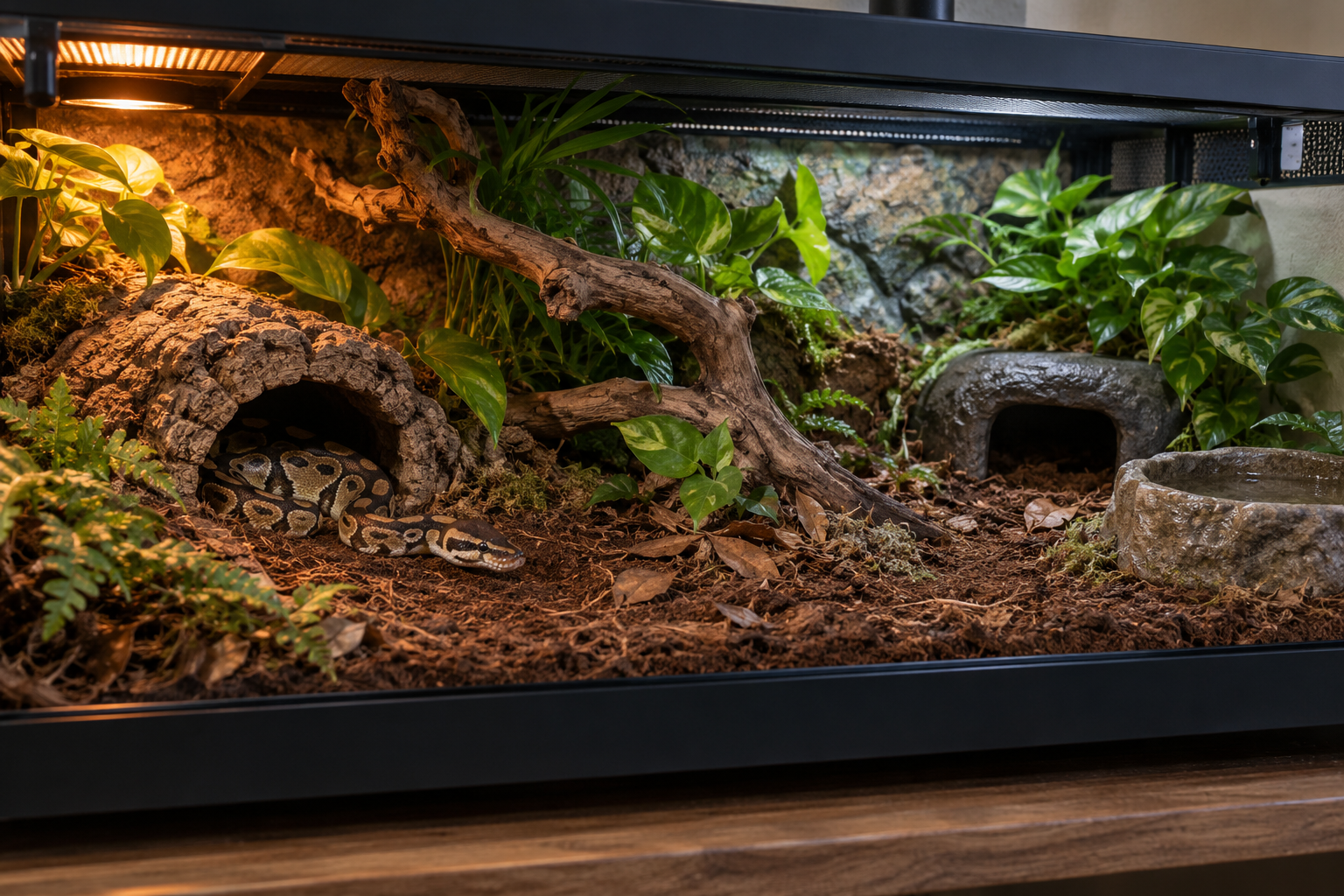
An adult ball python does well in a four by two by two foot enclosure, while juveniles are usually happier in something smaller where they can find the walls. Provide two hides at minimum, one on the warm side and one on the cool, and make them tight: a proper ball python hide touches the snake on all sides, which is the opposite of the roomy decorative caves sold for lizards.
Run the warm side at 88 to 92 degrees and the cool side at 76 to 80, with every heat source on a thermostat. Unregulated heat mats and lamps cause thermal burns in snakes that press against warm surfaces deliberately, and a thermostat is the cheapest insurance in reptile keeping. Add branches, cork and clutter across the floor, because a ball python with cover explores and one without it hides and refuses food.
Humidity and Shedding
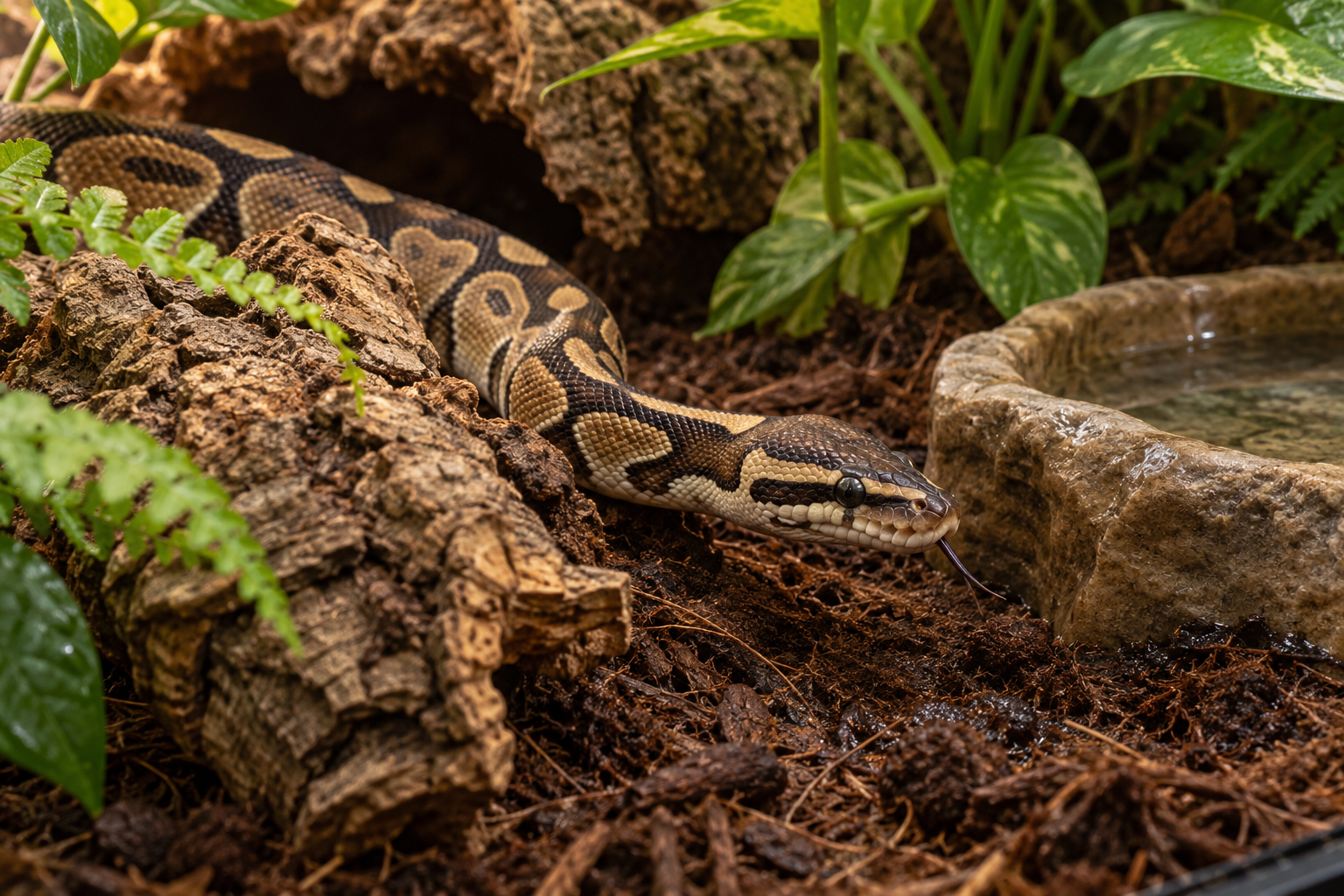
Hold humidity between 55 and 65 percent, raising it toward 70 during a shed cycle. Ball pythons shed in one piece when conditions are right, and the entire skin, including the clear eye caps, should come away together.
Stuck shed is the standard humidity complaint. If patches remain, especially retained eye caps or a ring of old skin at the tail tip, raise humidity, add a humid hide packed with damp moss, and let the snake soak. Never peel shed off a snake's eyes; retained eye caps are a vet matter if they do not clear on the next cycle. A snake going into shed turns dull and its eyes go blue and cloudy, and it is normal for it to refuse food and hide for that week.
Feeding and the Hunger Strike
Ball pythons eat whole prey: appropriately sized frozen-thawed rats or mice, offered warm with tongs, roughly every one to two weeks depending on age and size. Prey should be about the width of the snake at its widest point. We do not sell rodents, and any reputable feeder supplier will; what we do supply is the bioactive cleanup crew below.
The famous ball python behaviour is fasting. A healthy adult may refuse food for weeks or even months, particularly in winter and in breeding season, and this is normal for the species rather than a crisis. Weigh the snake monthly: a fasting snake holding its weight is fine and simply needs its meal re-offered every week or two. Progressive weight loss, a spine becoming prominent, or a juvenile refusing repeatedly are the cases that warrant a husbandry review and then a vet.
Most refusals trace back to husbandry rather than illness: temperatures drifting, hides that are too open, an enclosure with no cover, too much handling, or prey offered at the wrong temperature. Check those first, every time.
| Life Stage | Prey Size | How Often | Notes | Handling |
|---|---|---|---|---|
| Hatchling | Prey about the width of the snake | Every 5 to 7 days | Smaller, tighter enclosure helps feeding response | Wait 48 hours after a meal |
| Juvenile | Prey about the width of the snake | Every 7 to 10 days | Steady growth; weigh monthly | Wait 48 hours after a meal |
| Adult | Prey about the width of the snake | Every 10 to 14 days | Fasting for weeks is normal; track weight, not meals | Wait 48 hours after a meal |
Everything a ball python keeper needs from this guide. Untick anything you already have, then add the rest in one click.
The Bioactive Option
A ball python enclosure converts to bioactive well, and it is a genuine quality-of-life upgrade for an animal that spends its life in contact with the substrate. Use warm-tolerant cleanup crews: springtails plus dwarf white isopods handle waste in the damp lower layers, and those two small species are the safe choice around a live animal.
Give a deep substrate that holds humidity, and expect the snake to rearrange the surface. Our ball python cleanup crew guide covers exactly which crew suits their warmth and humidity, and the bioactive setup guide has the full build.
Handling and Temperament
Ball pythons are among the calmest snakes kept, and most tolerate regular gentle handling once settled. Support the body along its length rather than holding the head or letting the snake dangle, keep sessions to ten or fifteen minutes, and always wait at least 48 hours after a meal before handling to avoid regurgitation.
A snake that balls up is telling you it feels insecure, not that it is aggressive. Give a new snake a week or two undisturbed and a couple of successful meals before starting handling at all.
Health and Troubleshooting
A healthy ball python has clear eyes between sheds, a rounded body with no prominent spine, a strong grip, and clean nostrils and mouth. Most problems are heat, humidity, or a hide that is not tight enough.
| What You See | Most Likely Cause | What To Do |
|---|---|---|
| Refusing food for weeks, weight steady | Normal ball python fasting | Re-offer every 7 to 14 days; weigh monthly; check temps and hides |
| Refusing food AND losing weight | Husbandry problem or illness | Audit temperatures, humidity and hide tightness; then exotics vet |
| Shed coming off in pieces, stuck eye caps | Humidity too low | Raise humidity, add a damp moss hide, allow soaking; vet for retained eye caps |
| Wheezing, bubbles at the nostrils, open-mouth breathing | Respiratory infection | Exotics vet promptly; verify warm-side temps are being held |
| Soaking in the water bowl constantly | Mites, or the enclosure is too warm or too dry | Inspect closely for mites; verify temperatures and humidity; vet if mites are present |
| Burn marks on the belly | Unregulated heat source | Remove the heat source now; fit a thermostat; vet for the burn |
| Regurgitating a meal | Handled too soon after eating, prey too large, or temps too low | Wait 2 weeks before offering a smaller meal; fix temps; vet if it repeats |
Ball Python FAQ
Keep reading: what to have ready the first week.
Building a Bioactive Python Enclosure?
Tell us your enclosure size and humidity and we will size a warm-tolerant cleanup crew for it. Real keepers answer our email.
TC INSECTS · Real keeper advice from a working Texas insect farm
