
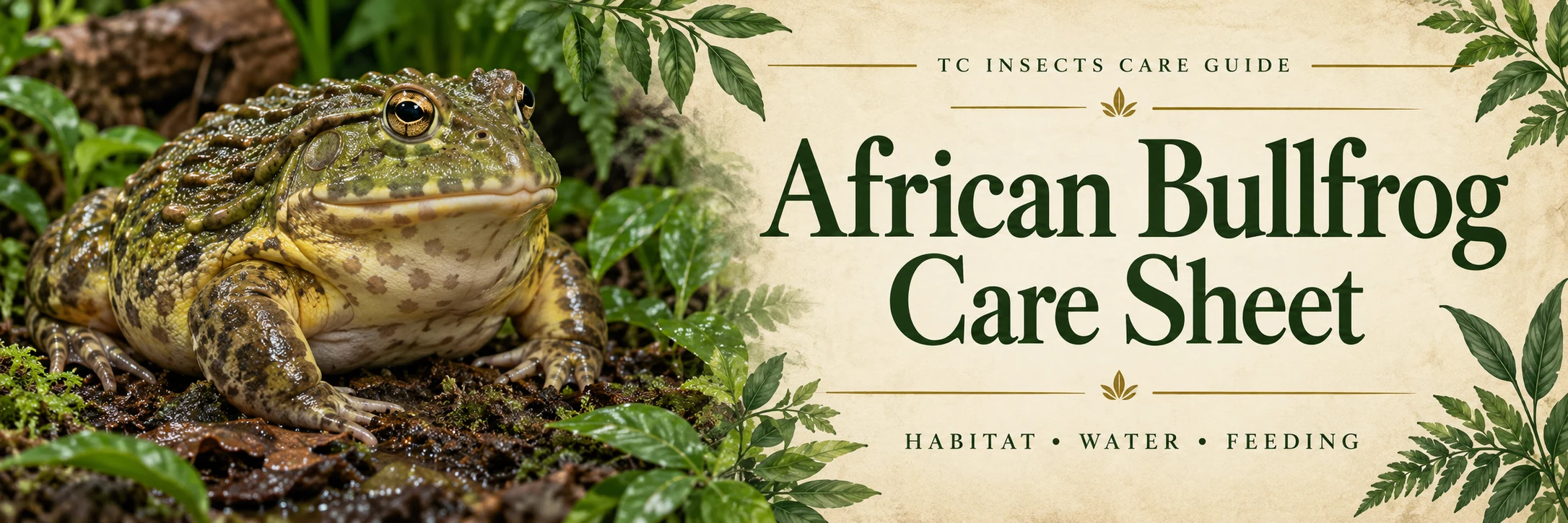
Everything you need to keep an African bullfrog (Pyxicephalus adspersus, the pixie frog) healthy for decades: exact enclosure specifications, temperatures, deep substrate, water routine, age-based feeding guidance, and practical troubleshooting when something looks off.
A true long-term commitment; well-kept bullfrogs routinely outlive the family dog several times over.
Females stay far smaller, usually 3.5 to 4.5 inches. Big males can pass two pounds.
Forgiving needs, but portion control and clean water are non-negotiable.
Meet the African Bullfrog
The African bullfrog is a sit-and-wait ambush predator from the seasonal grasslands of southern Africa, and one of the largest frogs on earth. Keepers call them pixie frogs, a nickname taken from the genus Pyxicephalus rather than their size, because there is nothing small about a mature male: a broad olive body with raised skin ridges, a head that is mostly mouth, and a bite backed by tooth-like points on the lower jaw called odontodes.
What makes them special as pets is the combination of imposing size, simple needs, and genuine boldness. A bullfrog that has settled in will track your movement across the room and lunge at food with shocking speed for an animal that spends ninety percent of its day motionless. Think of it as a pet boulder with opinions.
In the wild they endure brutal dry seasons by burying themselves and sealing into a cocoon of shed skin, sometimes for months. That biology explains half of their captive care: deep diggable substrate, tolerance of a wide temperature band, an appetite built for feast-and-famine, and the occasional multi-day disappearing act that scares new keepers for no reason.
What You Will Need
The full setup runs well under the cost of the frog itself in most cases, and nothing on this list is optional except the upgrades marked as such. Buy it all before the frog comes home.
Conditions at a Glance
Print this, tape it inside the cabinet door, and you have the whole environment on one card. Details for each number follow below.
| Parameter | Target | Notes |
|---|---|---|
| Enclosure minimum | 20 gal long juvenile; 40 breeder adult male | Floor space matters; height is wasted |
| Day temperature | 75 to 85 F ambient | Warm zone near 88 F at most |
| Night temperature | Low 70s F | A gentle drop is natural and healthy |
| Humidity | 50 to 80 percent | Substrate damp, never swampy |
| Substrate depth | 3 to 6 inches | Burying is mandatory behavior |
| Water | Wide shallow soak dish | Dechlorinated, dumped and refilled daily |
| Lighting | 12 hour day and night cycle | Low-output UVB optional but beneficial |
| Housing | One frog per enclosure, always | This species eats roommates |
Habitat in practice
Build for the animal on the ground
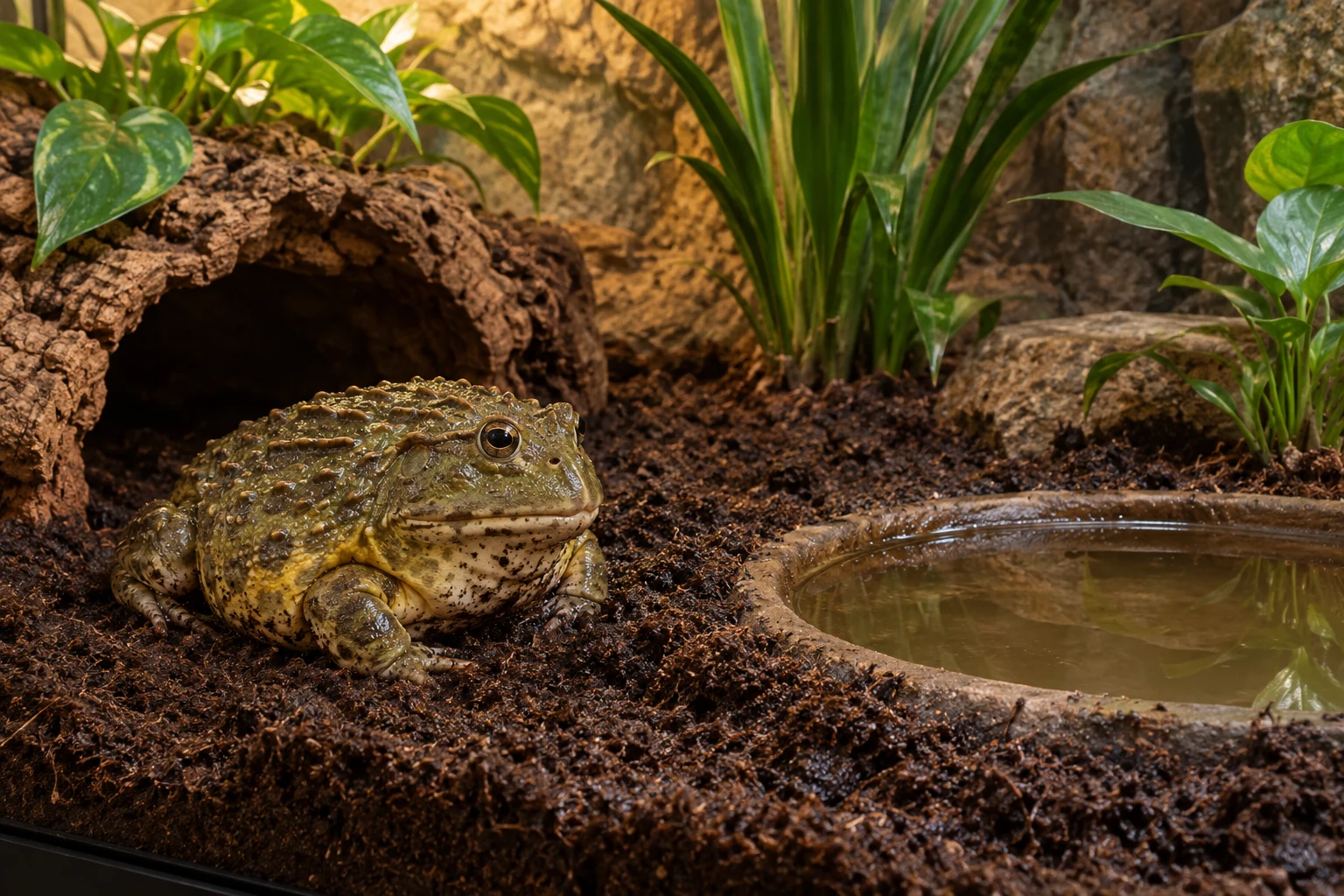
Wide floor space, deep diggable substrate, a temperature gradient, and a heavy shallow soak dish form the foundation. The enclosure should support natural burrowing while keeping clean water within easy reach.
Enclosure and Setup
Floor space matters far more than height, because this is a burrowing ground dweller that never climbs. A 20 gallon long works for a juvenile, and a single adult male does well in a 36 by 18 inch footprint, the size sold as a 40 gallon breeder. Bigger is always welcome, but the frog will spend most of its time half-buried in one favorite corner regardless.
House one frog per enclosure, always. African bullfrogs are famous cannibals; in the wild, a male guarding tadpoles will eat some of the very froglets he protected. Two bullfrogs in one tank eventually becomes one larger bullfrog. Skip gravel and small bark chips anywhere near the feeding zone, since anything that fits in that enormous mouth will be swallowed with dinner.
Layout stays simple: deep substrate across the whole floor, the soak dish sunk flush at one end, and a piece of cork or a low plant for cover if you like the look. The frog will bulldoze whatever you arrange into the shape it prefers, which is part of the charm.
Heating and Lighting
Aim for an ambient range of 75 to 85 degrees with a warm zone near 88, dropping into the low 70s at night. A low-wattage heat bulb or a ceramic heat emitter on a thermostat handles this easily; heat mats struggle to push warmth up through the deep substrate a bullfrog needs, so treat them as a backup rather than the main source.
Put the probe thermometer at substrate level on the warm end, not taped high on the glass, because the frog lives on the floor and the difference between air and soil temperature can run several degrees. Check the cool end too; the point of a gradient is that the frog chooses.
A simple 12 hour day and night cycle keeps their rhythm steady. Low-level UVB is optional if you dust feeders with vitamin D3, but a shade-dweller strength UVB tube is a genuine upgrade the frog will use, and it makes supplement timing more forgiving.
Substrate, Humidity and Water
Give them 3 to 6 inches of moist coco fiber, plain topsoil, or a mix of the two. Burying is not optional behavior for this species; a bullfrog that cannot dig itself a form will sit exposed and stressed. Keep the substrate damp enough to clump in your hand without dripping, which usually lands humidity in the right 50 to 80 percent band.
The water dish is half the husbandry. Use a wide, shallow dish the frog can sit in comfortably, filled with dechlorinated water only, because amphibian skin absorbs whatever touches it and city chlorine burns. Bullfrogs soak and defecate in their dish, so empty, rinse, and refill it every single day. Most preventable bullfrog illness traces back to a dirty soak dish.
Spot clean the substrate weekly and do a full substrate change every month or two in a standard setup. If that sounds tedious, the bioactive route below removes most of it.

Feeding in practice
Portion control beats appetite
African bullfrogs eat enthusiastically past the point of health. Use long tongs, rotate appropriate invertebrate feeders, follow the life-stage table, and judge meals by body condition—not by how willing the frog is to keep eating.
Diet and Feeding
Feeding is where new keepers go wrong, because a bullfrog will eat with enthusiasm long past the point of health. If your frog is developing a double chin and its back ridges are disappearing into fat, cut the schedule back, not the frog. The table below is the honest version of what a healthy bullfrog actually needs at each stage.
Dubia roaches are the ideal staple: meaty, easy to gut-load, and available in every size your frog will ever need. Superworms make an excellent meaty rotation for adults, calcium-rich black soldier fly larvae round out variety, and nightcrawlers from any bait shop are a soft, well-loved addition we happily recommend even though we do not sell them. Rodents are a rare treat at most, a few times a year, because rodent-heavy diets cause fatty liver disease. Feed from a dish or tongs to keep substrate out of the gut, and get the full portion plan on our African bullfrog feeder guide.
| Life Stage | What To Feed | How Much | How Often | Supplements |
|---|---|---|---|---|
| Froglet to juvenile | Small to medium dubia, BSFL, chopped nightcrawler | 3 to 5 items sized under the mouth width | Daily or every other day | Calcium + D3 twice weekly; multivitamin every other week |
| Subadult | Medium to large dubia, superworms, nightcrawlers | A few solid items per meal | 2 to 3 meals per week | Calcium + D3 twice weekly; multivitamin every other week |
| Adult | Large dubia, superworms, nightcrawlers, rare rodent treat | One proper meal, not a buffet | 1 to 2 meals per week | Calcium + D3 weekly; multivitamin every other week |
Everything a african bullfrog keeper needs from this guide. Untick anything you already have, then add the rest in one click.
The Bioactive Option
A deep-soil bioactive setup suits this species beautifully and takes over the between-cleanings maintenance. Seed the substrate with springtails and dwarf white isopods, which process waste in the damp lower layers where the frog spends its time. Stick to those two small crew species around any live animal; larger isopods are best kept to enclosures without a resident.
Choose tough, well-rooted plants at the edges of the enclosure and accept some bulldozing, because a bullfrog landscapes wherever it pleases. Our bioactive setup guide walks the whole build from drainage layer to seeding schedule.
Handling and Temperament
This is a watch-me animal, not a hold-me animal. Beyond the stress handling causes any amphibian, a large bullfrog bites hard enough to draw blood, and those jaw projections mean it holds on. When you genuinely need to move one, use wet nitrile gloves or scoop it into a container from behind, and never handle with lotion, soap residue, or sanitizer on your hands, because their skin absorbs all of it.
Respect the feeding response. Most bullfrog bites happen when a hand moves like food during dinner time, which is exactly what long tongs are for.
Health and Troubleshooting
Most bullfrog problems announce themselves visually, and almost all of them trace back to one of four causes: dirty water, wrong temperatures, missed supplements, or too much food. Use the chart, fix the husbandry first, and involve an exotics vet when the chart says so; finding an amphibian-comfortable vet before you need one is a genuinely useful weekend task.
| What You See | Most Likely Cause | What To Do |
|---|---|---|
| Buried and motionless for days | Normal behavior, or an estivation response | Nothing, if substrate is moist and weight is stable; recheck temps and humidity if it stretches past a week or two |
| Refusing food for weeks with weight loss | Temperatures too low, or illness | Verify warm-end temps at substrate level; weigh weekly; vet if weight keeps dropping |
| Red flush on legs or belly | Red leg, a serious bacterial infection | Vet promptly; upgrade water hygiene and sanitize the enclosure |
| Swollen body, lethargy, no waste | Impaction, often from gravel or oversized prey | Shallow lukewarm soak; remove particle hazards; vet if it does not pass |
| Soft jaw, tremors, weak limbs | Metabolic bone disease from missed dusting | Fix the calcium and D3 schedule immediately; add low-level UVB; vet for confirmed cases |
| Dull, dry, cocoon-like skin | Environment too dry | Raise humidity, refresh the soak dish, mist the substrate |
African Bullfrog FAQ
Keep reading: tong feeding safely.
Setting Up for a Bullfrog?
Tell us the frog's age and size and we will point you at the right feeder sizes and a sane weekly plan. Real keepers answer our email.
TC INSECTS · Real keeper advice from a working Texas insect farm
