
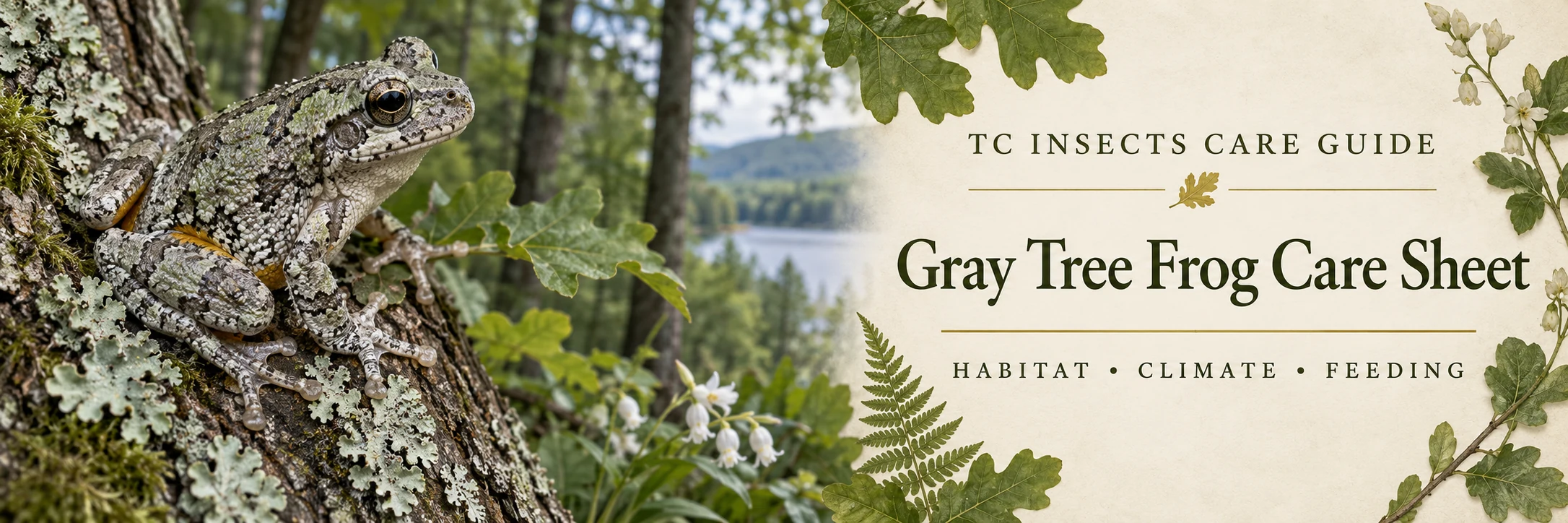
Gray Tree Frog Care Sheet
A practical guide to a cool temperate arboreal setup, legal wild-frog decisions, seasonal behavior, properly sized feeders, and the everyday signals of a healthy gray tree frog.
Meet the Gray Tree Frog
Two species, one care sheet
Dryophytes versicolor and Cope's gray tree frog share the name and range. They look alike, and their captive care is the same.
Built for the seasons
They shift from ash gray to bark brown or moss green, flash orange-yellow thighs when leaping, and tolerate cool nights that stress tropical frogs.
Small frog, huge voice
Males produce a musical trill far louder than their size suggests, especially in spring and after misting.
Found one outside? Decide before you catch.
What you will need
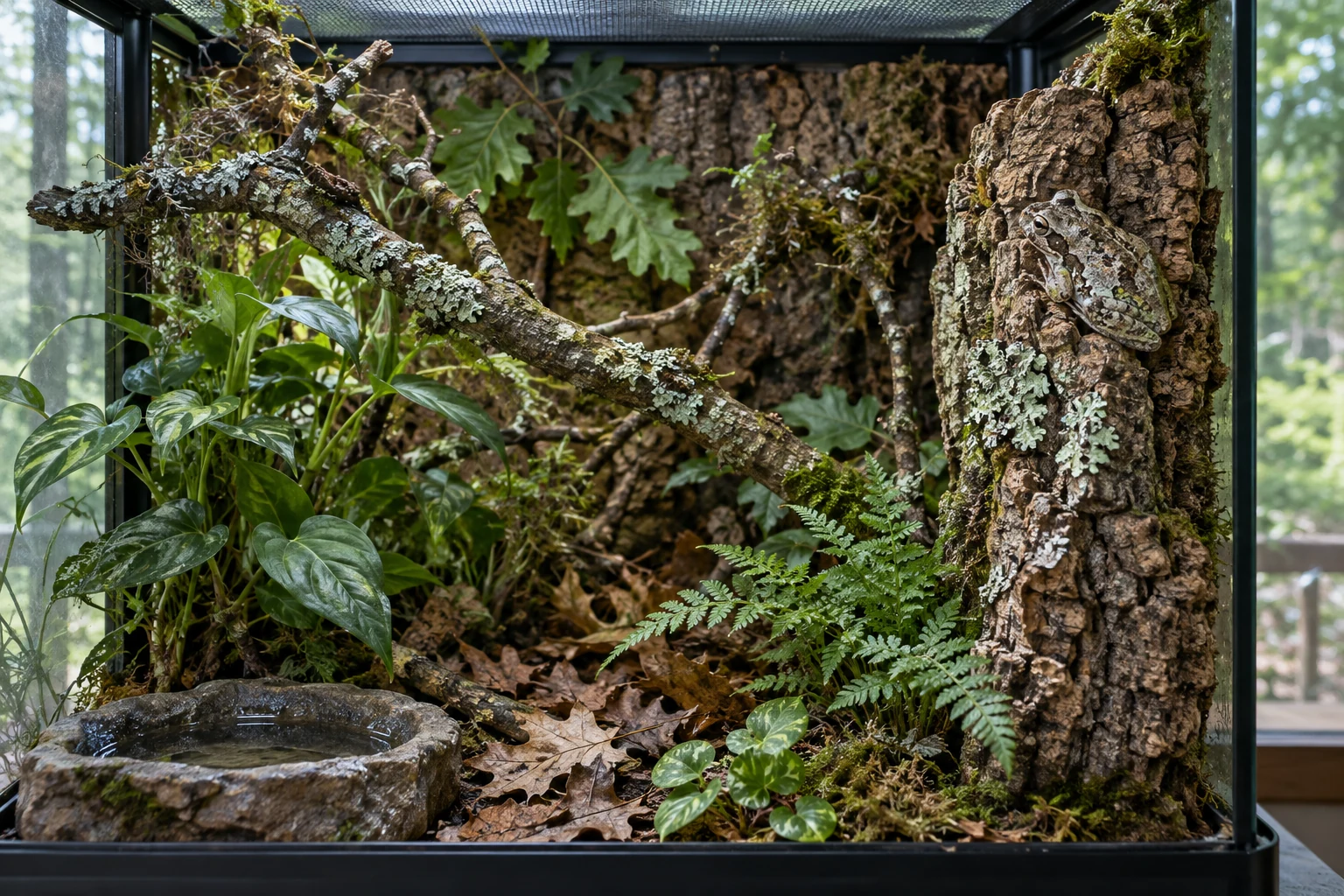
A stable woodland home
A 12 by 12 by 18 inch terrarium suits one or two frogs; an 18 by 18 by 24 inch enclosure holds three or four same-size animals.
- Create a lattice of sturdy branches, cork, and broad leaves.
- Secure every perch and soften landings with leaf litter.
- House same-size gray tree frogs only—never mix sizes or species.
- Keep the lid escape-proof; these frogs launch first and aim second.
Conditions at a glance
| Parameter | Target | Notes |
|---|---|---|
| Enclosure | 12 x 12 x 18 for 1 or 2 frogs | Vertical space; 18 x 18 x 24 holds 3 or 4 |
| Day temperature | 65 to 78 F | Ordinary room temperature; no heater in most homes |
| Night temperature | 60s F are fine | This species laughs at cool nights |
| Humidity | 50 to 70 percent | Mist daily; let it cycle down between |
| Water | Shallow dish, dechlorinated, changed daily | They soak at night |
| Prey size | Small; a quarter to half inch | Six-legged and smaller than the eye gap |
| Lighting | 12 hour cycle | Low-output UVB optional and helpful for growing frogs |
| Housing | Same-size groups are fine | Never mix sizes or species |
Temperature, lighting, and humidity

Diet and feeding
Gray tree frogs are quick-striking small-prey specialists. Feed at dusk when hunting behavior is strongest.
- Use small gut-loaded dubia nymphs as the staple.
- Rotate small mealworms and black soldier fly larvae.
- Keep all prey smaller than the space between the eyes.
- Adults generally take two to four items every two to three days.
Feeding schedule
| Life Stage | What To Feed | How Much | How Often | Supplements |
|---|---|---|---|---|
| Froglet | Pinhead-size prey, tiny BSFL, springtails | As much as they clear in a few minutes | Daily | Calcium + D3 at most feedings; multivitamin weekly |
| Juvenile | Quarter-inch dubia nymphs, small BSFL | 2 to 3 small items | Every other day | Calcium + D3 twice weekly; multivitamin every other week |
| Adult | Small dubia, small mealworms, BSFL | 2 to 4 items per frog | Every 2 to 3 days | Calcium + D3 weekly; multivitamin every other week |
Bioactive setup and handling
Safe cleanup crew
Springtails and dwarf white isopods process waste beneath leaf litter while the frogs live above the floor.
Watch, do not hold
Gray tree frogs stress quickly in hands. For necessary moves, use rinsed wet hands and cup the frog instead of gripping.
Simple hygiene
Wash after enclosure work. Mild skin secretions and possible salmonella are managed with ordinary responsible hygiene.
Health and troubleshooting
A healthy gray is plump, bright-eyed, sticky-footed, quiet through the day, and active after dark. Most problems trace to dryness, missed supplements, or water hygiene.
| What You See | Most Likely Cause | What To Do |
|---|---|---|
| Frog changed color entirely | Normal; temperature, humidity, background and mood | Nothing; enjoy the trick |
| Loud trilling at night | A male doing exactly what males do, mostly in spring | Nothing; relocate the tank if you are a light sleeper |
| Thin thighs, wobbly landings in a growing frog | Metabolic bone disease starting | Fix the calcium and D3 schedule now; add low-output UVB; vet if wobble persists |
| Dull, dry, tacky-looking skin | Dehydration or low humidity | Mist, refresh the dish, check the gauge for a few days |
| Redness on belly and thighs | Bacterial infection from stale water or substrate | Vet promptly; overhaul dish and substrate hygiene |
| Frog sits in the dish constantly | Enclosure too dry or too warm | Verify humidity and temperature; add misting |
| Escaped frog found dusty | The lid lost a round | Rinse the frog in dechlorinated water, rehydrate in a shallow soak, fix the lid |
Gray Tree Frog FAQ
Can I keep a gray tree frog I found in my yard?
Why can I never release a captive frog back outside?
Why did my gray frog turn green?
Can gray tree frogs live together?
Do gray tree frogs need a heater?
Why is my gray tree frog so loud at night?
What do gray tree frogs eat?
Are gray tree frogs poisonous?
Setting up for a Gray?
Tell us how many frogs you have and the enclosure size. We will help size the prey and feeding schedule.
