
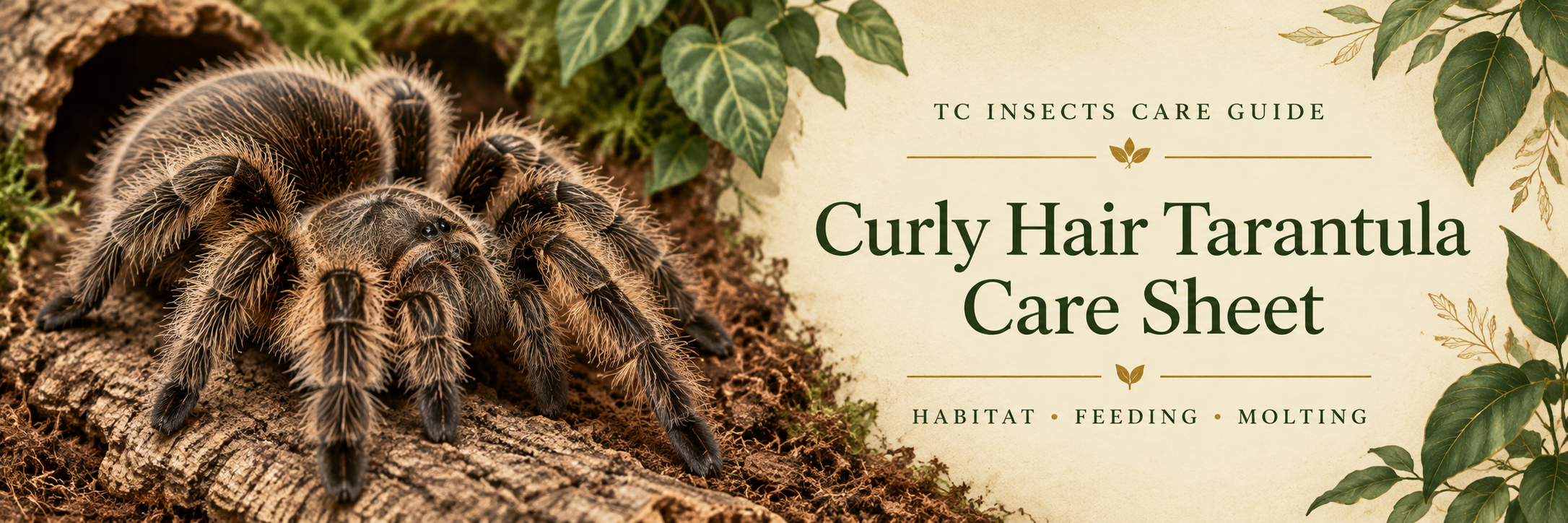
Curly Hair Tarantula Care Sheet
Complete care for the curly hair tarantula (Tliltocatl albopilosus): enclosure and substrate depth, why heating is usually wrong, the molt process that panics every new keeper, urticating hairs, feeding by size, and a troubleshooting chart.
Males live only 3 to 5 years after maturing.
A substantial, solid, slow-moving tarantula.
Docile, hardy, forgiving, and cheap to keep.
Meet the Curly Hair Tarantula
The curly hair tarantula from Central America is the species most experienced keepers recommend first, and for good reason: it is docile, slow-moving, hardy, cheap to feed, and covered in long curling bronze-gold hairs that make it genuinely handsome rather than merely impressive. It is a terrestrial, burrowing New World species that spends its days near a hide and comes out at dusk.
They ask for almost nothing: room temperature, a floor of dry substrate with one water dish, and a cricket-sized meal every week or two. There is no lighting, no heating in most homes, no humidity gradient and no UVB. The whole setup fits on a shelf and costs less than a bag of reptile substrate.
The important thing to understand up front is molting, because that is where new keepers panic, and the second is that this is a look-only animal.
What You Will Need
One of the shortest lists on the site, and the important entry is substrate depth.
Conditions at a Glance
One card, and most of it is what you do NOT need.
| Parameter | Target | Notes |
|---|---|---|
| Enclosure width | About 3 times the legspan | Floor space, deliberately low |
| Enclosure height | Low; no more than about 1.5 times legspan above substrate | Falls rupture abdomens |
| Substrate depth | 4 to 6 inches | They burrow; it also cushions a fall |
| Temperature | 68 to 78 F | Room temperature; no heat mat in most homes |
| Humidity | Dry, with a full water dish | Do not mist a curly hair into a swamp |
| Ventilation | Cross ventilation | Stagnant damp air causes mould and mites |
| Water | Shallow dish, always full | Their main moisture source |
| Lighting | None needed | Ambient room light on a normal cycle |
| Housing | One per enclosure, always | Tarantulas are cannibals |
Enclosure and Substrate
Aim for a footprint roughly three times the spider's legspan and keep the enclosure deliberately low. This matters more than it sounds: terrestrial tarantulas have a fragile abdomen, and a fall from height onto a hard floor can rupture it and kill the animal. Height above the substrate should be limited so that even a climb up the glass cannot end in a dangerous drop.
Fill with four to six inches of dry coco fiber or a coco and topsoil mix so the spider can burrow, add a piece of cork bark laid flat as a hide, and set a shallow water dish. Keep the lid cross-ventilated: stagnant humid air causes mould and encourages mites, and this species does not want a wet enclosure.
Temperature and Humidity
Ordinary room temperature of 68 to 78 degrees is exactly right, which means no heat mat and no lamp in a normally heated home. Heat mats attached to tarantula enclosures are a common cause of harm, because a spider cannot escape a hot floor in a small container and dehydrates against it.
Humidity handling is equally simple: keep the substrate largely dry and keep the water dish full. Curly hairs come from habitats that are not swamps, and the most common husbandry mistake is over-misting an enclosure into a damp, mouldy, mite-friendly box. The water dish does the job.
Feeding and Molting
Feeding is straightforward: appropriately sized feeder insects, roughly the size of the spider's abdomen or smaller, offered every five to ten days for juveniles and every one to two weeks for adults. Gut-loaded dubia roaches are ideal, with mealworms and black soldier fly larvae in rotation. Remove any uneaten prey within a day, because a loose cricket will harass a molting spider.
Molting is the part that alarms every new keeper. Before a molt the spider stops eating, may seal itself into its burrow, and its abdomen darkens. Then it flips onto its back and lies motionless with its legs curled, which looks exactly like a dead spider and is not. Never touch, never poke, never feed a tarantula on its back. The whole process can take many hours, after which the spider is soft and vulnerable and should be left alone for about a week before it is offered food again.
A tarantula on its back is molting. A dead tarantula is curled up on its legs underneath itself, in what keepers call the death curl. Learning that difference is the single most useful thing a new tarantula keeper can do.
| Life Stage | Prey Size | How Often | Molting Note | Handling |
|---|---|---|---|---|
| Spiderling | Small prey, smaller than the abdomen | Every 5 to 7 days | Molts often as it grows | Never |
| Juvenile | Prey about abdomen size | Every 7 to 10 days | Refuses food for a week or two before each molt | Never |
| Adult | Prey about abdomen size | Every 10 to 14 days | Molts roughly annually; females keep molting for decades | Never |
Everything a curly hair tarantula keeper needs from this guide. Untick anything you already have, then add the rest in one click.
Urticating Hairs and Handling
This is a look-only animal, and there are two reasons. The first is the spider: a fall from hand height can rupture a terrestrial tarantula's abdomen and kill it, which makes handling a genuine risk to the animal rather than to you.
The second is you. Like most New World tarantulas, a curly hair defends itself by flicking urticating hairs from its abdomen, tiny barbed bristles that cause real itching and irritation on skin and are far more serious if they reach your eyes. A bald patch on the abdomen means the spider has been flicking. Work slowly in the enclosure, use long tongs, never put your face close to a stressed spider, and wash your hands and forearms after maintenance.
Health and Troubleshooting
Tarantulas show very few symptoms, so most of keeping one well is knowing which alarming behaviours are actually normal. Three of the four rows below are normal.
| What You See | Most Likely Cause | What To Do |
|---|---|---|
| Lying on its back, legs curled upward, motionless | Molting. This is normal | Do not touch, do not feed, leave completely alone until it rights itself |
| Refusing food for weeks | Pre-molt, completely normal | Remove uneaten prey; keep water available; wait it out |
| Bald dark patch on the abdomen | Urticating hairs flicked off in defence | Normal; the patch refills at the next molt; reduce disturbance |
| Sealed itself into the burrow | Pre-molt or simply settling in | Leave it; keep the water dish full |
| Legs curled underneath the body, unresponsive | The death curl, often dehydration | Check the water dish immediately; an ICU setup may help; often terminal |
| Mould or mites in the enclosure | Too damp, or uneaten prey left in | Dry out the substrate, improve ventilation, remove leftovers within a day |
| Spider fell and the abdomen is leaking | Fall injury, a real emergency | Keep it still and low, seal the wound area per invert first aid, do not handle |
Curly Hair Tarantula FAQ
Part of the Tarantula Hub: every guide we have on tarantulas, in one place.
Keep reading: dehydration and the death curl.
Feeding a Tarantula?
Tell us the legspan and we will size the feeders correctly. Real keepers answer our email.
TC INSECTS · Care sheets written at the farm, not copied from forums · Porter, Texas
