
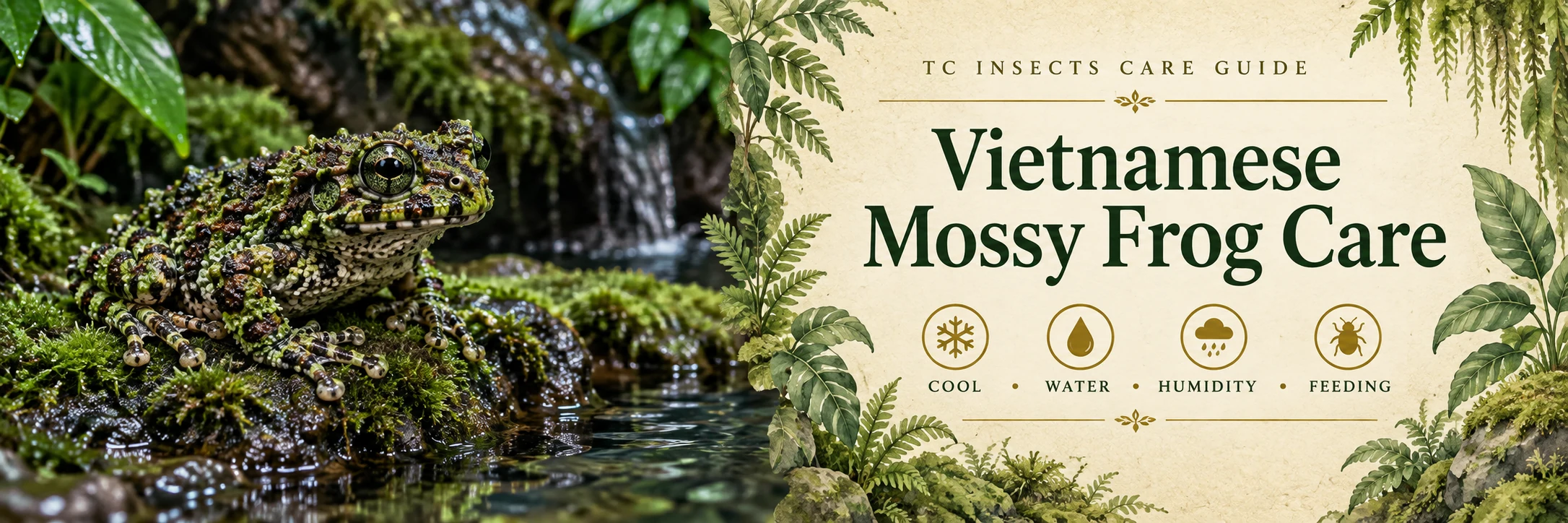
A practical guide to Vietnamese Mossy Frog care: a cool paludarium, clean water, land feeding, and everyday health.
Meet the Vietnamese Mossy Frog
Few animals wear a better disguise. Green, brown and black bumps make a resting frog look like wet moss. Native to northern Vietnam and nearby southern China, it inhabits flooded caves, rocky streams and water-filled tree hollows.
Cool, wet and partly aquatic
This is not a warm rainforest frog. Most problems begin when keepers treat it like one. Keep the water clean and the room cool and mossy frogs are hardy, long-lived and reliable eaters.
A nocturnal display animal
Expect long stretches of motionless camouflage in or beside the water. That is normal. They become more active after dark and should be handled only when necessary.
What you will need
The setup is part water and part land. The most important instrument is an accurate thermometer.
Conditions at a glance
| Parameter | Target | Notes |
|---|---|---|
| Day temperature | 65–75°F | Mid 60s to low 70s is best supported |
| Night temperature | 60–68°F | Cool nights are welcome |
| Danger line | Above 75–80°F | Several sources warn at 75; 80 is a hard limit |
| Humidity | 70–90% | Brief dips only with water always available |
| Water | 2–4 inches, one-third to half the floor | Always provide easy exits |
| Water changes | 25–50% every 1–2 weeks | More often without a filter |
| Lighting | Low LED, about 12 hours | UVB is not required |
| Group size | 2–4 per enclosure | Never mix species |
| Handling | Minimal | Clean, wet, lotion-free hands only |
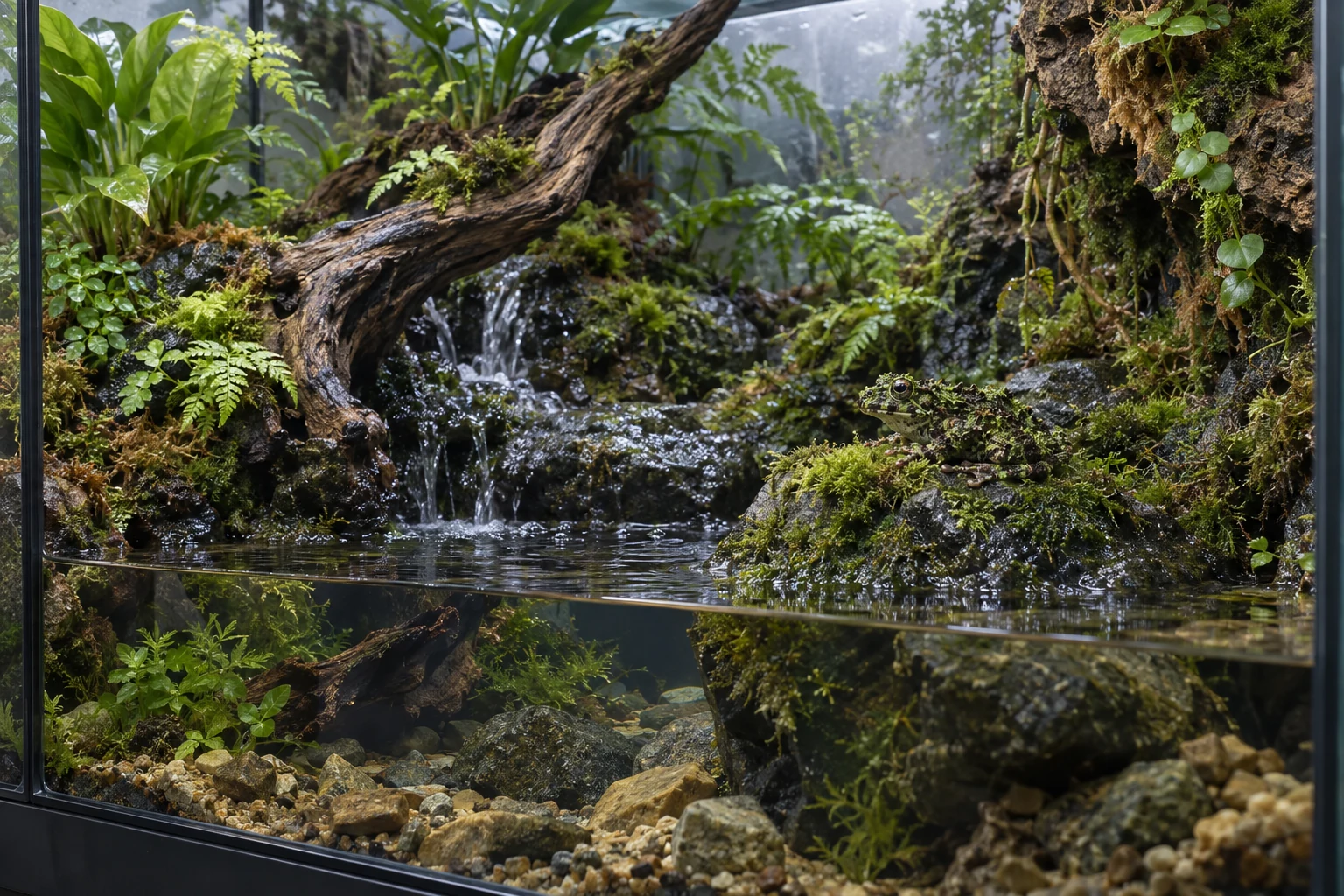
Build water and land together
Give the water a third to half of the floor at two to four inches deep, with sloped rocks, cork or wood so a frog can climb out anywhere. For two to four adults, 18 × 18 × 24 inches is a sensible minimum; 30 × 18 × 24 inches offers more room.
Above the waterline, add cork bark, driftwood and plants. Mossy frogs rest out of the water and lay eggs on surfaces above it.
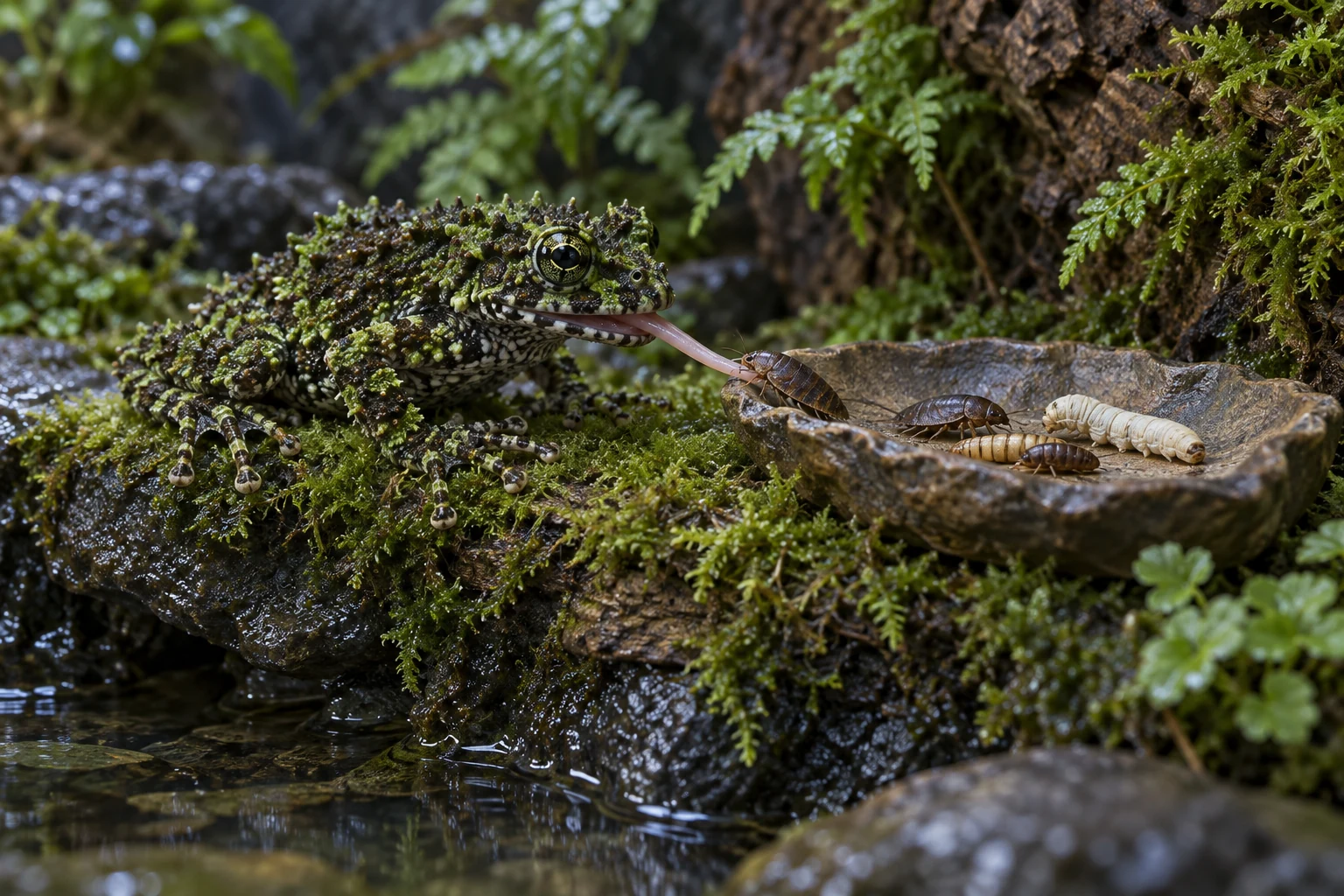
Feed on land, not in the water
Adults eat suitable roaches, BSFL, silkworms and earthworms, with mealworms occasionally. Froglets begin with insects around one-eighth to one-quarter inch long. Use a dish or feed on land so drowned insects do not foul the water.
Because their cool-climate metabolism is slow, start with moderate portions and let body condition decide whether to increase or reduce them.
Keep them cool
Ideal daytime temperatures sit in the mid 60s to low 70s with cooler nights. Several care sources become concerned at 75°F and treat 80°F as a hard limit. Advice recommending 75–82°F overlaps the danger zone and risks overheating the frogs.
Usually the correct heat source is none. Plan ahead with a cool room or basement, reliable air conditioning, lights that add little heat and good airflow. A frog that stays pressed into the water and turns sluggish on a warm day needs the room cooled immediately.
Humidity and water quality
Use dechlorinated tap, RO or distilled water. Run a gentle filter when possible and replace 25–50% every week or two. Change more often without filtration. A little tannin from an Indian almond leaf is useful, but cloudy or smelly water signals a problem.
Diet by life stage
| Life stage | Prey size | How often | Supplements | Notes |
|---|---|---|---|---|
| Froglet | ⅛–¼-inch insects | Daily or every other day | Dust most feedings | Keep prey tiny and soft |
| Juvenile | Small roaches, BSFL and silkworms | About every two days | Dust most feedings; multivitamin weekly | Size prey up gradually |
| Adult | Roaches, BSFL, silkworms and earthworms | 2–3 times weekly | Dust most feedings; multivitamin weekly | Judge by body condition, not a fixed count |
The same products listed in the original guide, organized for quick comparison. Untick anything you already have, then add the rest in one click.
Observe more, handle less
Mossy frogs are shy and jumpy, and their permeable skin absorbs residues. Handle only when necessary with clean, wet, lotion-free hands. Same-species groups of two to four can thrive together, but never mix them with other frogs.
Health and troubleshooting
| What you see | Most likely cause | What to do |
|---|---|---|
| Sluggish, sitting in water for hours on warm days | Overheating | Cool the room now; add airflow; check thermometer placement |
| Cloudy or smelly water, skin sores | Poor water quality | Change water, improve filtration and remove drowned feeders |
| Not eating in summer | Temperatures too high | Bring days back to the 60s and low 70s |
| Frog getting noticeably round | Overfeeding a slow metabolism | Feed less often and reassess body condition |
| Drowned feeders in the water | Feeding directly into the tank | Use a dish or feed on land |
| Gaping, bubbling or labored breathing | Respiratory problem, often heat-related | Correct temperature and see an exotics vet |
| Home-raised froglets nearly all male | Tadpoles raised too warm | Raise the next clutch in cooler water |
Vietnamese Mossy Frog FAQ
Are Vietnamese mossy frogs good for beginners?
They are hardy once settled, but they are not a beginner frog in the way a White's tree frog is. The narrow part of their care is temperature: they need a cool room, ideally mid 60s to low 70s by day, and a clean water area.
Do mossy frogs need a heater?
Almost never. They tolerate cool rooms into the 50s far better than heat, so the effort usually goes into keeping them cool, not warm.
What temperature is too hot for a mossy frog?
Treat 75°F as the warning line and 80°F as a hard limit. Advice recommending 75–82°F overlaps the danger zone in most other guidance.
Do Vietnamese mossy frogs need UVB?
No. If you light the enclosure for live plants, keep it low-output on a roughly 12-hour cycle and provide vitamin D3 through dusted feeders.
How deep should the water be for mossy frogs?
About two to four inches, covering a third to half of the floor, with sloped rocks, cork or wood so the frog can climb out easily from any point.
Can you handle a Vietnamese mossy frog?
Only when necessary. They are jumpy and stress easily, and their skin absorbs residues. Use clean, wet hands with no soap or lotion residue.
How long do Vietnamese mossy frogs live?
Ten to fifteen years is supported by zoo records and several care sources. Plan for a long-term commitment.
Can mossy frogs live together?
Yes. Groups of two to four work in a properly sized paludarium. Do not mix them with other frog species.
Building a Mossy Frog Paludarium?
Tell us your setup and we will size feeders and a cleanup crew for the land area. Real keepers answer our email.
Prepared by the TC INSECTS keeper team for practical, responsible Vietnamese Mossy Frog care.
