

Tiger Salamander Care
Complete husbandry for the cool-climate burrower: deep substrate, safe temperatures, sensible feeding, legal checks, and practical troubleshooting.
North America's subterranean “puppy”
Tiger salamanders are among the world's largest terrestrial salamanders. Glossy, powerful, and food-motivated, they often learn a feeding schedule and surface when the lid opens. Most of their life, however, happens underground—and that is a sign of a successful setup.
They share the genus Ambystoma with the axolotl, but follow a different life plan: tiger salamanders metamorphose into terrestrial, lung-breathing burrowers that require cool, damp, low-light conditions.
Check your state laws first
Tiger salamanders are regulated in several states. California prohibits possession because escaped or released pet-trade animals historically hybridized with the endangered California tiger salamander. Other states may restrict wild collection, set possession limits, or require native-amphibian permits.
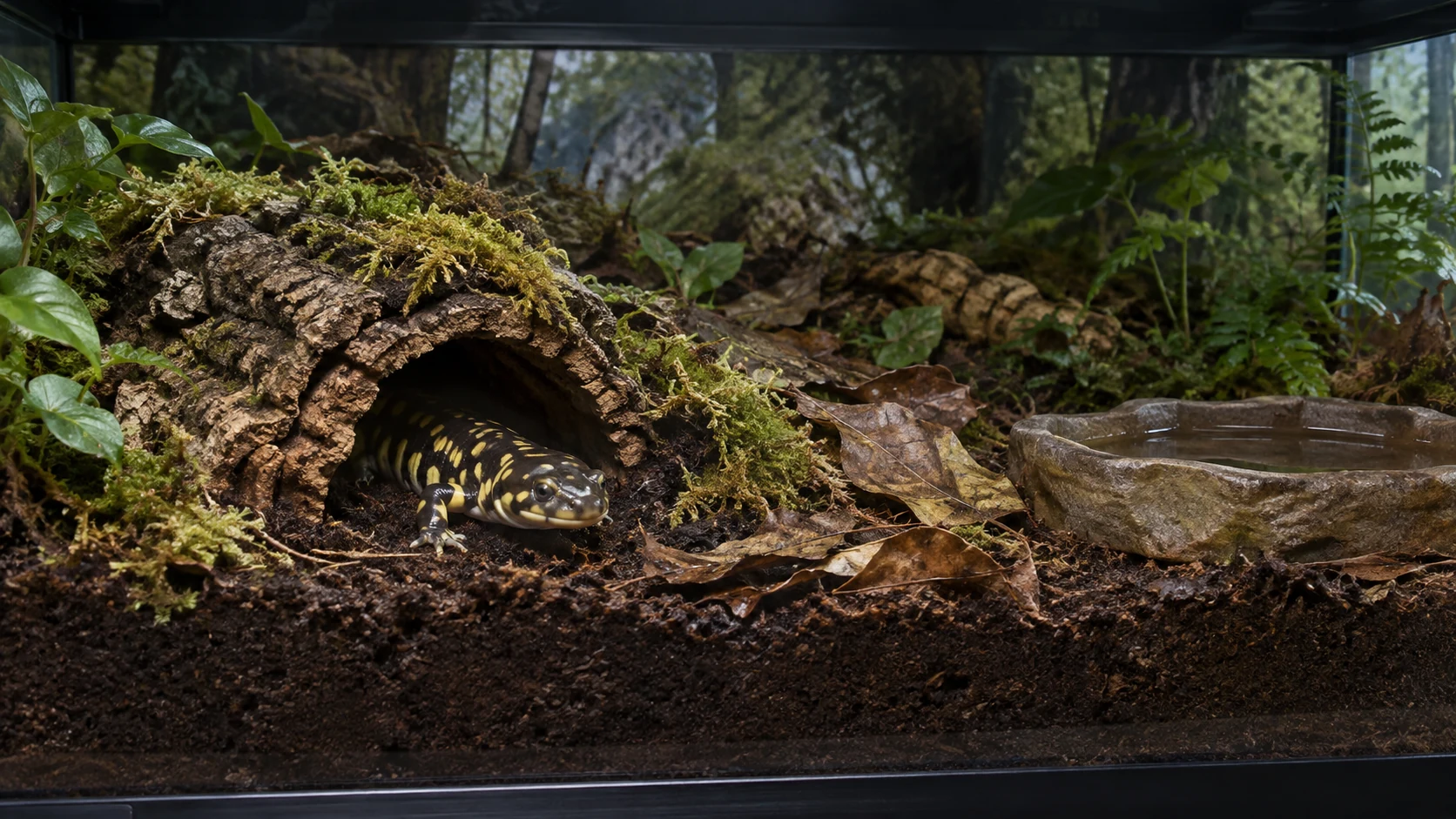
Cool, damp, deep, and secure
A 20 gallon long is the honest minimum for one adult. Build the enclosure around a deep burrow layer rather than decorations.
- Use four or more inches of plain coco fiber or additive-free topsoil.
- Keep the lower layers damp enough to hold a tunnel, never swampy.
- Add cork bark, a hide, leaf litter, and a shallow water dish.
- Use a secure screen top; these strong animals can push.
- Singles are simplest. If legal cohabitation is attempted, add floor space and separate hides and feed individually.
What you will need
Read the temperature rows twice
| Parameter | Target | Notes |
|---|---|---|
| Enclosure | 20 gallon long per adult | Add footprint for any additional animal |
| Ideal temperature | 60–70°F | A cool room is the whole heating plan |
| Temperature ceiling | Stress above 72–75°F | Sustained upper 70s is dangerous |
| Heat equipment | None | No heat lamp, basking bulb, or heat mat |
| Humidity | Moist substrate depths; 60–75% | Damp, never wet |
| Substrate | 4+ inches | They live in self-dug burrows |
| Water | Shallow, dechlorinated, changed daily | For soaking, not swimming |
| Lighting | Low ambient room light | UVB is unnecessary for this fossorial species |
Place the enclosure in a basement, north-facing room, or interior area away from windows. During a heat wave, relocate the enclosure to the coolest room or cool the surrounding space—do not add more equipment inside the tank.
Create a moisture gradient
The lower substrate should pass the squeeze test and hold a burrow while the surface can remain slightly drier. Constantly fogged walls, puddles, or a sour soil smell mean the enclosure is too wet and infection risk is rising.
Feed the burrow, not the begging face
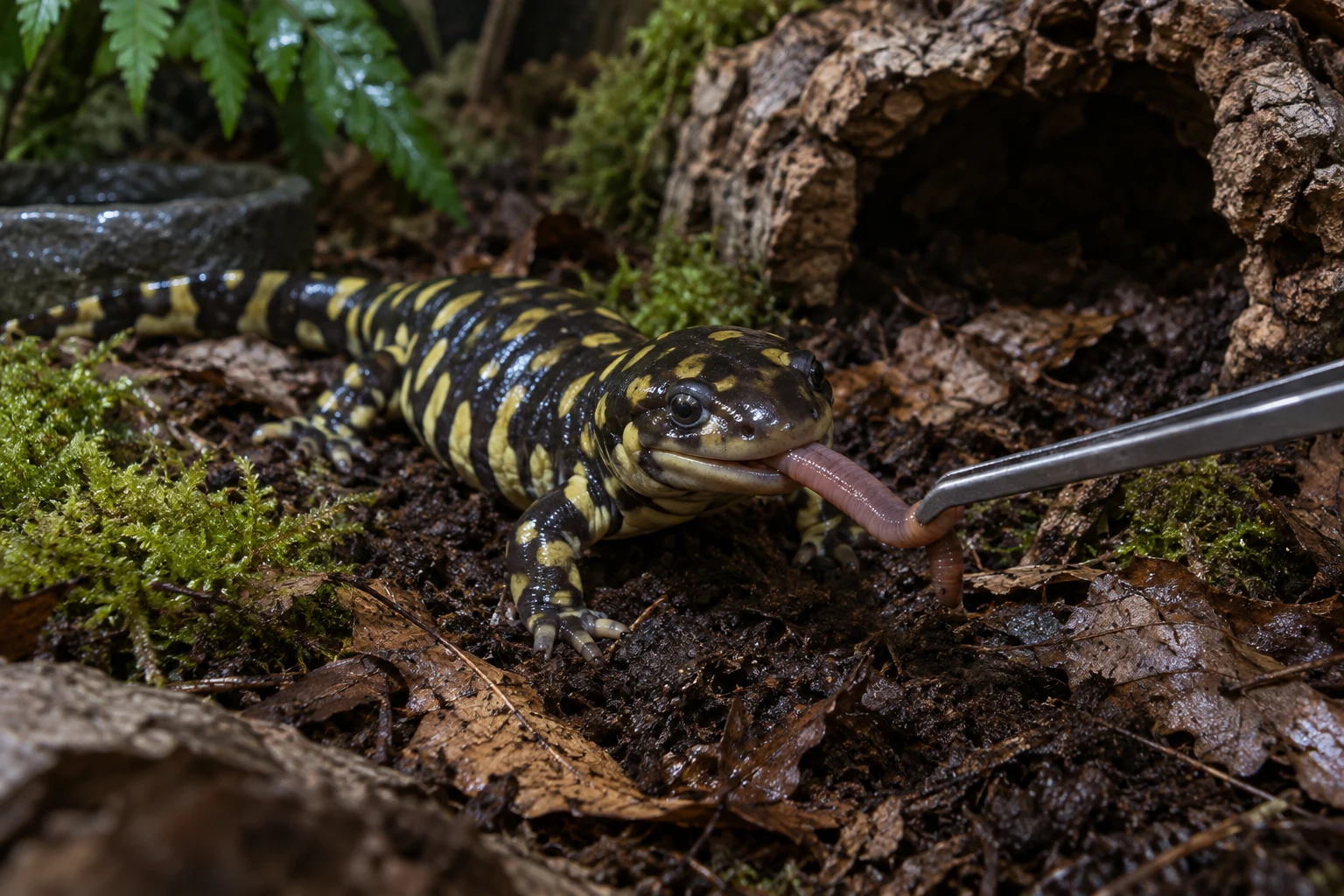
Nightcrawlers are an excellent staple. Rotate gut-loaded Dubia roaches, mealworms, and calcium-rich black soldier fly larvae. Skip pinky mice and prevent portion creep: tiger salamanders beg convincingly, but obesity is their most common captive problem.
- Healthy adults retain visible costal grooves along the sides.
- Weigh monthly and reduce portions if the body becomes a smooth tube.
- Use long tongs and remove uneaten insects.
- Dust feeders on the schedule below.
Portions by life stage
| Life stage | Food | Amount | Frequency | Supplements |
|---|---|---|---|---|
| Juvenile | Small Dubia, small mealworms, chopped nightcrawler | 2–4 items | Every other day | Calcium + D3 twice weekly; multivitamin every other week |
| Subadult | Dubia, mealworms, nightcrawlers, BSFL | A few solid items | 2–3 meals weekly | Calcium + D3 twice weekly; multivitamin every other week |
| Adult | Nightcrawlers, Dubia, occasional superworm | One sensible meal | Twice weekly; skip when smooth-sided | Calcium + D3 weekly; multivitamin every other week |
A natural fit for cool soil
A cool, deep, damp tiger enclosure can work well as a bioactive habitat. Use temperate springtails and dwarf white isopods; avoid larger isopod species with a resident animal. The cleanup crew can process waste in burrow layers you rarely see.
Observe more, handle less
Tigers tolerate necessary transfers better than many amphibians, but their permeable skin absorbs residues from your hands. For essential handling, use rinsed wet hands or nitrile gloves, stay low over a surface, and keep contact brief. Wash with soap afterward.
Most problems trace back to heat, weight, or wetness
| What you see | Most likely cause | What to do |
|---|---|---|
| Gone for days, surfaces to eat | Normal fossorial behavior | Nothing; the burrow is the home |
| Restless surface pacing in summer | Heat stress | Cool the room today and verify below 72°F |
| Smooth tube body, no side grooves | Obesity | Smaller meals, longer gaps, monthly weighing |
| Skin sores or red patches | Infection from wet or dirty substrate | Exotics vet; correct the gradient and replace substrate |
| Refusing food during warm weather | Heat suppressing appetite | Correct temperature first |
| Cloudy shed stuck in patches | Substrate too dry at depth | Re-moisten lower layers and offer a shallow soak |
| Thin despite eating, especially wild-caught | Parasites | Exotics vet with a fecal sample |
Tiger Salamander FAQ
Are tiger salamanders legal to own?
It depends on your state. California bans possession, and several other states regulate collection or require permits. Verify with your wildlife agency before acquiring one.
Do tiger salamanders need a heat lamp?
No. They thrive at 60–70°F, become stressed in the mid 70s, and can be harmed by sustained heat. Use a cool room, not heating equipment.
Are tiger salamanders related to axolotls?
Yes, both are in the genus Ambystoma. Axolotls remain aquatic with gills; tiger salamanders metamorphose into terrestrial burrowers. Never house them together.
Why do I never see my salamander?
Because the enclosure is working. Tigers are fossorial and commonly emerge at night or when they learn the feeding schedule.
Can I handle my tiger salamander?
Only briefly when necessary, with rinsed wet hands or nitrile gloves, low over a safe surface. Handling is a transfer skill, not bonding.
What do tiger salamanders eat?
Nightcrawlers are an excellent staple, rotated with suitable Dubia roaches, mealworms, BSFL, and occasional superworms.
How long do tiger salamanders live?
Ten to twenty years is common with correct care, and exceptional individuals can live longer.
Why is my salamander pacing the surface?
Check temperature first, especially in summer. Surface pacing commonly signals that the enclosure has passed its cool comfort range.
Build for the burrow
Cool temperatures, deep damp soil, a shallow water dish, varied feeders, and minimal handling create a stable long-term home.
Browse more care sheetsPrepared by the TC INSECTS team for practical, responsible salamander care.
