
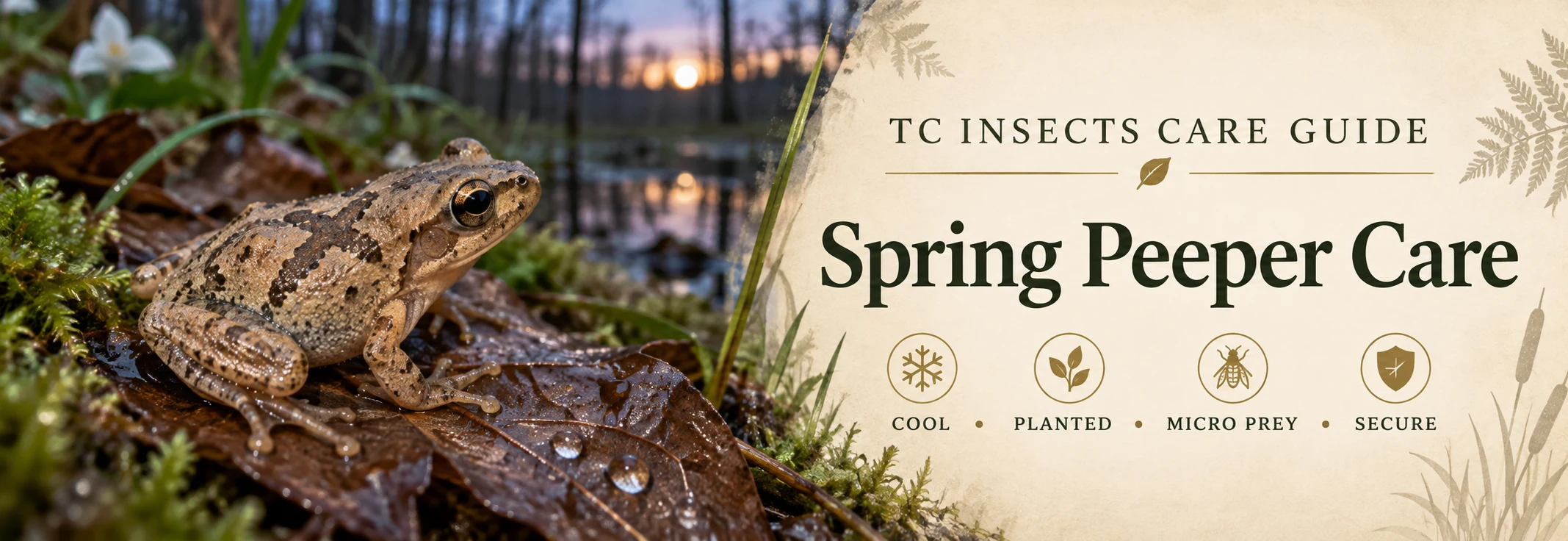
Spring Peeper Care
Practical care for a tiny cool-climate frog whose success depends on escape-proof housing and a permanent supply of micro prey.
The sound of winter ending
Pseudacris crucifer is a one-inch tan-to-grey frog marked by the dark X across its back. Its famous spring chorus carries far beyond the wetland, yet the animal is rarely kept because feeding something this small requires permanently running fruit-fly and springtail cultures.
Check native-amphibian laws first
Rules range from small personal-use allowances to permit requirements and outright bans. Search your state wildlife agency and read the actual rule before collecting.

Dense cover with every seam sealed
A 12 × 12 × 18 inch terrarium can house a small same-size group. The critical specification is escape-proofing, not volume.
- Use fine mesh and seal cord, hinge, and lid gaps.
- Add thin branches, grass-like plants, broad leaves, and leaf litter.
- Provide a very shallow water dish with a pebble bank or sloped exit.
- Keep one species only and ensure every frog gets food.
What you will need
Cool, lightly humid, and never overheated
| Parameter | Target | Notes |
|---|---|---|
| Enclosure | 12 × 12 × 18 for a small group | Tiny frogs that climb |
| Escape-proofing | Fine mesh, no gaps | The most common failure |
| Day temperature | 65–75°F | Heat is the danger |
| Night temperature | 50s to low 60s fine | Cold-tolerant species |
| Humidity | 50–70% | Light daily misting |
| Water | Very shallow with easy exit | Adults are poor swimmers |
| Prey | Fruit flies and springtails | Mouth only millimetres wide |
| Housing | Same-size groups | Single species only |
Micro prey is the whole challenge
Flightless fruit flies are the staple, springtails support the smallest frogs and stock a bioactive floor, and other pinhead prey add variety. Dust with fine calcium plus D3 at most feedings and keep a backup culture so a crash never leaves the frogs without food.
| Stage | Food | Schedule |
|---|---|---|
| Froglet | Springtails, melanogaster flies | Daily; calcium most meals |
| Adult | Fruit flies, springtails, pinhead prey | 5–10 tiny items daily or every other day |
| Cool season | Same foods, smaller portions | Follow appetite and keep supplementing |

A living pantry for a hands-off frog
Springtails and dwarf white isopods process waste while also supplying background food. Establish the cleanup crew before adding frogs. Never handle a peeper unless saving its life; herd it into a lidded deli cup rather than grabbing.
Small frogs have no margin
| What you see | Likely cause | Response |
|---|---|---|
| Frog missing | Escape through a seam | Search humid dark areas immediately; seal every gap |
| Thin or sunken | Prey too large or too few meals | Switch to fruit flies and springtails; feed daily |
| Lethargy in warm room | Overheating | Move to a cooler room |
| Not calling | Normal seasonal quiet | Calling belongs to breeding season |
| Dull dry skin | Low humidity | Mist and dampen leaf litter |
| Red legs or belly | Bacterial infection | Contact an exotics vet promptly |
| Weak or wobbly limbs | Calcium shortfall | Correct supplements and seek care if persistent |
Spring Peeper FAQ
Can spring peepers be kept as pets?
Yes, but they are a specialist animal rather than a beginner one, and the reason has nothing to do with hardiness. An adult is about an inch long with a mouth a few millimetres wide, so the entire diet is flightless fruit flies and springtails, which means running live cultures permanently. Keepers who cannot commit to that should choose a larger native tree frog.
What do spring peepers eat in captivity?
Micro prey, daily. Flightless fruit flies are the practical staple, springtails suit the smallest frogs and keep a bioactive tank stocked between feedings, and other pinhead-size invertebrates round it out. Everything gets dusted with a fine calcium plus D3 powder because tiny frogs carry no reserves.
Is it legal to catch and keep a spring peeper?
It depends entirely on your state, and this is worth five minutes on your wildlife agency website before you scoop one up. Some states allow a small personal-use number of common native amphibians, others require permits, others prohibit it. And once it has been in captivity it can never be released back outside.
Why is my spring peeper not peeping?
Because calling is breeding behaviour, largely confined to late winter and spring, and only males do it. A silent peeper the rest of the year is completely normal. If you want the chorus, you want spring, and you want a male.
Do spring peepers need a heater?
No, and heat is the real risk. They are freeze-tolerant animals that overwinter under leaf litter, so 65 to 75 degrees is comfortable and cool nights are fine, while sustained temperatures in the upper 70s and beyond stress them. Keep the tank in the coolest room you have.
How do I stop them escaping?
Assume every gap is an exit. A one-inch climbing frog escapes through cord ports, hinge gaps and loose mesh corners, and a loose peeper dehydrates fast in a house. Use fine mesh, inspect every seam by eye before the frogs go in, and re-check after any change to the lid.
How long do spring peepers live?
About three years is typical, and wild ones rarely reach four. Captive peepers with reliable food and cool temperatures can do at least as well, but this is a short-lived frog compared with a White's tree frog or an American toad, and worth knowing before you commit to running cultures.
Can I keep several together?
Yes, small same-size groups do fine and a planted tank of several is far more interesting than one frog. Keep it to this species alone, make sure every frog is getting food since the small ones lose out fast, and scale the enclosure with the group.
Feed tiny, seal tightly, keep cool
Reliable micro-prey cultures, careful escape-proofing, cool temperatures, and hands-off observation are the foundation of successful Spring Peeper care.
Browse more care sheetsPrepared by the TC INSECTS team for practical, responsible amphibian care.
