
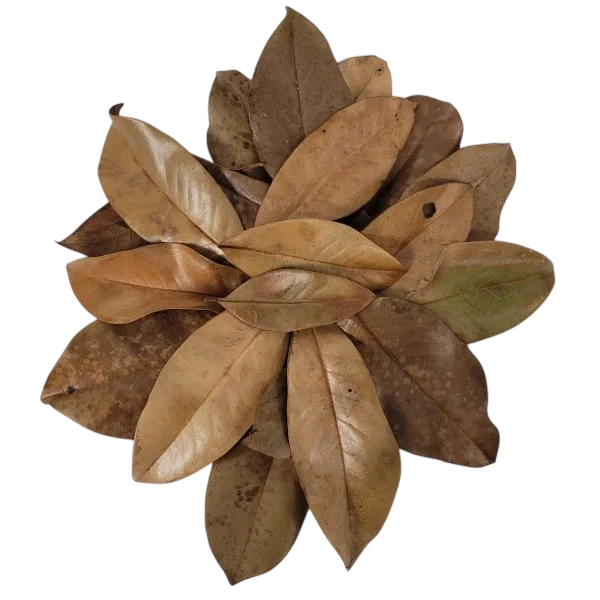
Magnolia Leaves for Sale
Overview
Magnolia Leaves are a single-species leaf litter product sold individually rather than by volume, with options of 2 leaves, 10 leaves, or a 21-leaf (1 gallon equivalent) count. The defining feature is durability. Magnolia leaves
break down notably slower than oak, sycamore, or maple, which gives bioactive enclosures and isopod cultures a longer-lasting leaf cover with a uniform, predictable visual presentation. Their waxy, sturdy surface holds
shape well under the humid conditions found in most vivariums and isopod setups.
Additionally, magnolia leaves are a long-established hobby staple in the dart frog and bioactive vivarium scene specifically. The slow decomposition pace and consistent appearance make them especially useful as anchor
leaves that stabilize the longer-term look of a planted vivarium, where keepers want visible leaf cover that does not break down within weeks.
Why Choose Magnolia Leaves?
- Slow decomposition: Magnolia leaves last notably longer in humid enclosures than most other bioactive hardwoods, which reduces how often you need to top off the leaf layer.
- Hobby reputation for mold resistance: The waxy surface and slow breakdown contribute to a long-established reputation in the bioactive hobby for resisting mold compared to faster-decomposing alternatives.
- Uniform single-species presentation: Unlike an assorted mix, every leaf in this product is the same species, which suits display-focused enclosures and keepers who want a curated visual layer.
- Trace food contribution: Although decomposition is slow, the leaves still contribute fiber and trace nutrients to isopod and springtail diets as they gradually break down.
- By-the-leaf sizing: The three count options (2, 10, or 21 leaves) suit single enclosures, small vivariums, or precisely measured additions where bulk volume is too much.
Honest Note on Magnolia vs Assorted Hardwoods
Two honest points are worth flagging clearly before purchase. First, slow decomposition works both ways. Magnolia leaves last longer than other hardwoods, which is great for keepers who want a stable long-term leaf layer.
However, if you specifically want leaves that break down quickly to feed a fast-eating colony like Porcellio dilatatus or Porcellio laevis, faster-decomposing options in the TC INSECTS Assorted Hardwood Leaf Litter mix
will work better as the primary food source.
Second, single-species packs are not a complete leaf litter solution on their own. A varied mix supports a more complete bioactive profile, since different hardwood species contribute different microfauna and different
decomposition rates. Magnolia works best as a durable anchor layer alongside an assorted mix rather than as the entire leaf cover by itself. The two products are complementary, not interchangeable.
If you want a balanced default for any isopod culture, the Assorted Hardwood Leaf Litter is the broader-use product. Magnolia Leaves are for keepers who specifically want the durability, presentation, or single-species
curation that this product provides.
How to Use Magnolia Leaves
Magnolia leaves are flexible and pair naturally with other leaf litter, substrate, and moss components.
For a New Enclosure
After layering substrate and any moss components, place magnolia leaves directly on top of the substrate surface. The existing TC INSECTS guidance is to apply about a 1 to 2 inch layer, but with magnolia specifically, the leaves are large enough that even a few leaves per square foot provide meaningful cover. Pair with Assorted Hardwood Leaf Litter for a varied surface profile.
As Anchor Cover in Vivariums
In dart frog and other amphibian vivariums, magnolia leaves work especially well as long-lasting surface cover that does not need frequent replacement. The durable shape also provides predictable shelter and surface area for resident animals and microfauna.
Crushing for Faster Access
The existing TC INSECTS guidance notes that crushing the leaves makes them easier for isopods to eat. This is a practical option for keepers who want to speed up consumption, especially for smaller species like Dwarf White Isopods or small Cubaris lines. Whole leaves work fine for larger species like Porcellio and Porcellionides lines.
Refreshing the Layer
Replace magnolia leaves as they break down or get eaten. Because of the slow decomposition, refresh intervals are typically longer than they would be for oak or sycamore. Avoid removing partially decomposed leaves, since they still carry microfauna value even as cover diminishes.
Which Count Should You Choose?
- 2 Leaves: A small precise addition for a single small enclosure, a tarantula sling cup, or a tightly measured top-off where bulk volume would be too much.
- 10 Leaves: Suited to one medium enclosure or a few small cultures, or a starter portion for a small bioactive vivarium.
- 21 Leaves (1 Gallon Equivalent): Bulk option for larger vivariums, multi-culture shelves, or keepers who want a substantial magnolia anchor layer across several enclosures.
Best For
- Dart frog and other amphibian vivariums where durable leaf cover stabilizes long-term presentation.
- Display bioactive enclosures where uniform single-species leaves suit the visual style.
- Isopod cultures needing long-lasting anchor leaves alongside a faster-decomposing mix.
- Small enclosures, tarantula slings, or precisely measured additions where a few leaves are enough.
- Keepers building layered leaf litter setups with assorted hardwoods for variety and magnolia for durability.
Not Best For
- Buyers who specifically want fast-decomposing leaves as a primary food source for fast-eating colonies.
- Use as the only leaf litter source. A varied mix supports a more complete bioactive profile.
- Use as substrate. Leaves sit on top of substrate, not in place of it.
- Buyers expecting an assorted variety pack. This is single-species magnolia by design.
- Keepers needing bulk volume immediately. Even the 21-leaf option is a defined count rather than an open quart of mixed leaves.
Recommended Pairings
- TC INSECTS Assorted Hardwood Leaf Litter as the varied base layer that magnolia anchors on top of.
- Premium Isopod Substrate as the working substrate that leaf litter sits on top of.
- New Zealand Long Fiber Sphagnum Moss for humid retreat zones alongside the leaf cover.
- TC INSECTS Isopod Food for the protein and trace nutrients that leaves alone do not provide.
- Springtails as a microfauna partner that thrives in and under leaf cover.
Frequently Asked Questions
Why use magnolia leaves instead of an assorted hardwood mix?
Magnolia leaves break down notably slower than most other bioactive hardwoods, which gives bioactive enclosures and isopod cultures a longer-lasting, more visually predictable leaf cover. The single-species format also
suits keepers who want a curated, uniform presentation. The two products are complementary rather than competitive: assorted hardwoods provide variety and faster food, while magnolia provides durable long-term cover
and visual stability.
How long do magnolia leaves last in a humid enclosure?
Significantly longer than oak, sycamore, or maple. Exact duration depends on humidity, temperature, isopod species, and colony size, but most keepers find magnolia leaves stay visibly intact for several months to over a
year in established cultures, while faster hardwoods break down in weeks to a few months. The slow pace is part of what makes magnolia a hobby staple.
Are magnolia leaves a complete leaf litter option on their own?
Generally no. A varied hardwood mix supports a more complete bioactive profile, since different leaf species contribute different microfauna and decomposition rates. Magnolia works best as a durable anchor alongside an
assorted hardwood mix rather than as the entire leaf cover.
Are magnolia leaves good for dart frog vivariums?
Yes. Magnolia leaves are a long-established staple in dart frog vivariums specifically, where the durable shape and slow decomposition provide consistent surface cover, predictable hiding spots, and stable visual
presentation. They pair naturally with the isopods and springtails that handle bioactive cleanup in the same enclosure.
Do magnolia leaves resist mold?
Magnolia leaves have a long-established hobby reputation for resisting mold compared to faster-decomposing hardwoods, which is part of why they are so widely used in humid vivariums. The waxy surface and slow
breakdown both contribute to this reputation. However, no leaf is fully mold-proof, and stagnant low-airflow enclosures with high moisture can still develop mold on any organic material.
How many magnolia leaves do I need for my enclosure?
It depends on enclosure size. The 2-leaf count works for very small setups (tarantula slings, small deli cup cultures). The 10-leaf count suits one medium enclosure or a small vivarium. The 21-leaf (1 gallon equivalent) count
covers larger vivariums or several enclosures at once. Most keepers underestimate how many leaves they need, since visible cover often calls for more than expected.
Learn More About Magnolia and Leaf Litter Use
For background on magnolia botany and the role of leaf litter in detritivore cultures, the following non-commercial sources are useful starting points.
-
Encyclopædia Britannica: Magnolia. A general reference on the magnolia genus, including the leaf structure that gives magnolia its distinctive durability and waxy surface compared to other hardwoods.
-
USDA Forest Service: Forest Soils. A research-focused resource on forest soils and the role of leaf litter in nutrient cycling, useful background for understanding how leaves of different species contribute differently to the decomposer food web that captive bioactive cultures replicate.
-
University of Florida IFAS: Sowbugs and Pillbugs. An extension page covering general biology, habitat preferences, and feeding ecology of sowbugs and pillbugs, helpful for understanding how leaf litter fits into a complete isopod husbandry routine.



Reviews
There are no reviews yet.