
Meet the All-Female Colony Gecko
Mourning geckos are parthenogenetic: functionally all female and able to produce fertile eggs without males. Every animal can lay eggs, so a pair becomes a self-sustaining colony.
Small, social and vocal
These nocturnal arboreal geckos live in family groups with real social structure, chirping and clicking to one another after dark. A planted colony is an unusually lively display in a modest footprint.
Two hard rules
Never keep one alone, and never let one reach outdoors. A single escaped female can establish a wild population, and the species is already introduced beyond its native range.
What you will need
Conditions at a glance
| Parameter | Target | Notes |
|---|---|---|
| Enclosure minimum | 12 × 12 × 18 inches for a pair | Vertical and planted; scale with the colony |
| Warm spot | 82–85°F | Low source on a thermostat |
| Cool zone | 70–75°F | A real gradient in a small tank |
| Humidity | 60–80%, cycling | Mist once or twice daily |
| Water | Droplets on leaves and glass | Standing dishes are rarely used |
| Lighting | 12-hour cycle + low-output UVB | Egg production makes UVB valuable |
| Diet | Prepared fruit diet + live micro prey | Both halves matter |
| Group size | Two minimum | Never keep one alone |
| Escape risk | Extreme | One female can found a population |
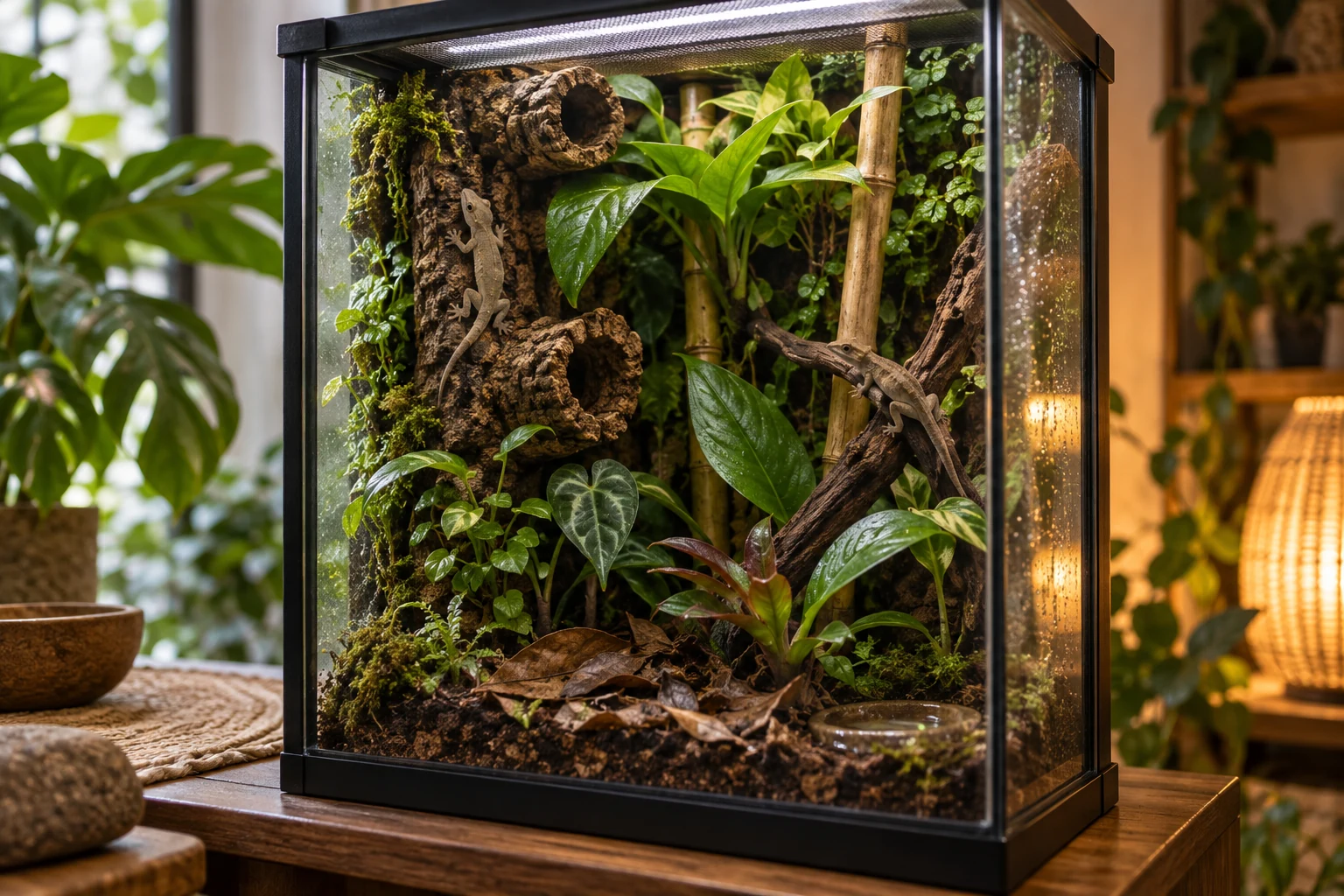
Use the whole vertical space
Furnish densely with cork tubes, bamboo, broad leaves and many hiding places. A 12 × 12 × 18-inch enclosure suits a starter pair; larger is better because the colony will grow.
Hatchlings are matchstick-small. Seal every lid and door gap, work slowly with the room closed and inspect the enclosure after every visit.

Prepared diet and live micro prey
Offer smooth complete gecko diet in shallow ledge cups and provide flightless fruit flies, springtails and pinhead dubia for larger adults. Neither half alone is complete.
Springtails seeded throughout the bioactive floor give hatchlings a permanent self-feeding resource when they cannot compete at a cup.
Temperature, humidity and UVB
Provide a thermostat-controlled 82–85°F warm spot and a 70–75°F cool zone. Cycle humidity from 60% to 80% with one or two daily mistings. Droplets are the colony's drinking water.
Run a 12-hour light cycle with low-output UVB. Constant egg production creates relentless calcium demand, making UVB and reliable supplementation more important here than for most nocturnal geckos.
Diet by life stage
| Stage | Food | Amount | Frequency | Supplements |
|---|---|---|---|---|
| Hatchling | Springtails, melanogaster flies, diet cup | Free access to micro prey | Daily | Fine calcium + D3 most feedings |
| Juvenile | Fruit flies, springtails, prepared diet | Light scatter + fresh cup | Daily to every other day | Calcium + D3 twice weekly; multivitamin weekly |
| Adult | Prepared diet, fruit flies, tiny dubia | Cup + 5–10 small prey per gecko | Diet every 2 days; prey 2–3× weekly | Calcium + D3 2–3× weekly; multivitamin every other week |
Micro-feeder and cleanup-crew picks
The bioactive option
Springtails in the substrate serve as both cleanup crew and hatchling food. Dwarf white isopods process colony waste. Establish both before adding geckos so the smallest animals have a ready food source.
Do not handle—and never release
These geckos are tiny, fast, fragile and extremely difficult to recapture. Handling benefits neither gecko nor keeper. Work with the room closed and check the lid every time.
Every individual can reproduce alone. One escapee in a suitable climate is a genuine invasive-species risk. Never release surplus animals; rehome them to other keepers.
Health and troubleshooting
| What you see | Most likely cause | What to do |
|---|---|---|
| Kinked spine or rubbery jaw | Calcium drain from egg laying | Dust more, offer calcium, add UVB and see a vet |
| Stuck shed on toes | Humidity dipping too low | Increase misting; add damp retreat |
| One gecko hiding and losing weight | Social pressure or crowding | Add cover and feeding stations, or split colony |
| Colony growing quickly | Normal parthenogenesis | Plan a larger tank or rehoming |
| Gecko escaped | Lid gap | Search warm high surfaces at night; seal gaps |
| Eggs on glass and cork | Normal reproduction | Leave or remove deliberately; do not crack them |
| Ignoring food cup | Cup too deep or diet too thick | Use shallow cups, smooth mix and micro prey |
Mourning Gecko FAQ
Are all mourning geckos female?
Effectively yes. They reproduce without males, and each female can lay fertile eggs. A pair will grow into a colony on its own.
Can I keep a single mourning gecko?
No. This is a genuinely social species with family-group behavior. Keep at least two.
Do mourning geckos need UVB?
Low-output UVB is strongly beneficial because constant egg production creates heavy calcium demand.
What do mourning geckos eat?
Complete powdered gecko diet plus flightless fruit flies, springtails and tiny dubia. Dust live prey with calcium and D3 two or three times weekly.
Why must they never escape outside?
A single female can establish a wild population. Seal the lid, work with the room closed and rehome surplus geckos.
How fast will my colony grow?
Faster than many keepers expect. Adults lay glued pairs of eggs regularly, so plan future space or rehoming early.
Can I handle them?
No in practice. They are tiny, fast and fragile. Mourning geckos are a watch-and-listen pet.
Do they make noise?
Yes. Settled colonies chirp and click to one another after dark.
Starting a Mourning Gecko Colony?
Tell us your tank size and we will build a fruit-fly and springtail rotation that keeps hatchlings fed.
Prepared by the TC INSECTS keeper team for practical, responsible Mourning Gecko care.
