
American Green Tree Frog Care
Practical care for a hardy, nocturnal, hands-off display frog.
A southeastern icon built for nighttime display
Dryophytes cinereus is slim, smooth, bright green, and marked by a white or cream side stripe. Hardy and inexpensive to house, it thrives at ordinary household temperatures but remains a look-only frog with delicate permeable skin.
Build a secure vertical habitat
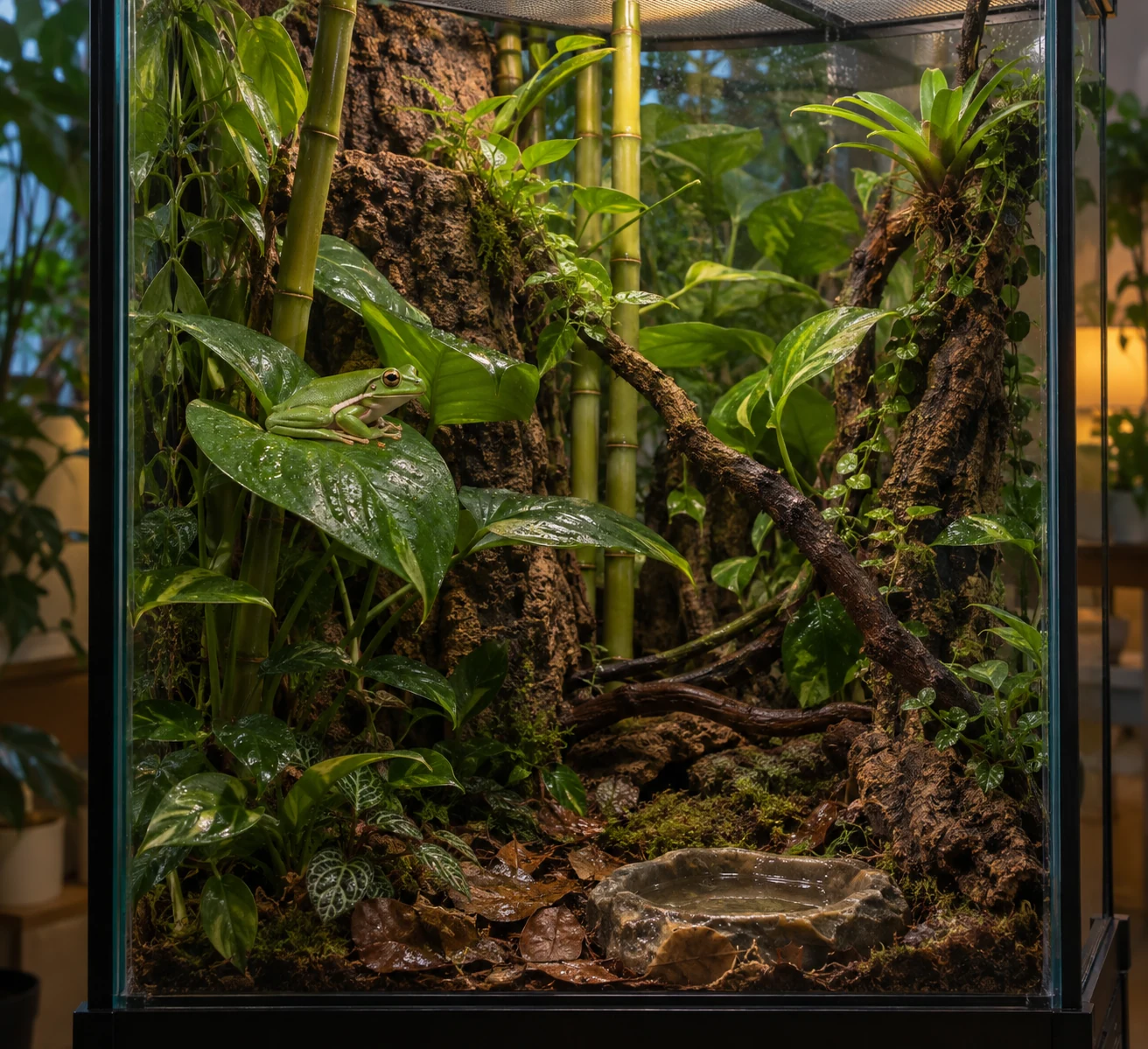
An 18 × 18 × 24 inch terrarium comfortably houses one or two same-size frogs. Use vertical branches, bamboo, cork, and broad leaves for daytime resting and nighttime hunting.
- Secure every lid gap.
- Keep one species only.
- Provide a shallow dechlorinated water dish.
- Use a screen top for airflow.
- Add drainage and leaf litter for planted or bioactive builds.
What you will need
Room-friendly temperatures with daily humidity cycling
| Parameter | Target | Notes |
|---|---|---|
| Enclosure | 18 × 18 × 24 for 1–2 | Vertical climbing space |
| Day | 72–80°F | Room temperature in most homes |
| Night | 65–72°F | Natural evening drop |
| Humidity | 50–70% | Mist daily; allow a drop |
| Ventilation | Screen top | Prevents skin and respiratory trouble |
| Water | Shallow, dechlorinated, changed daily | Often used at night |
| Prey | ¼–½ inch | Never wider than eye gap |
| Lighting | 12-hour cycle | Low UVB optional |
| Housing | Same-size groups | Single species only |
Feed small moving prey after dark
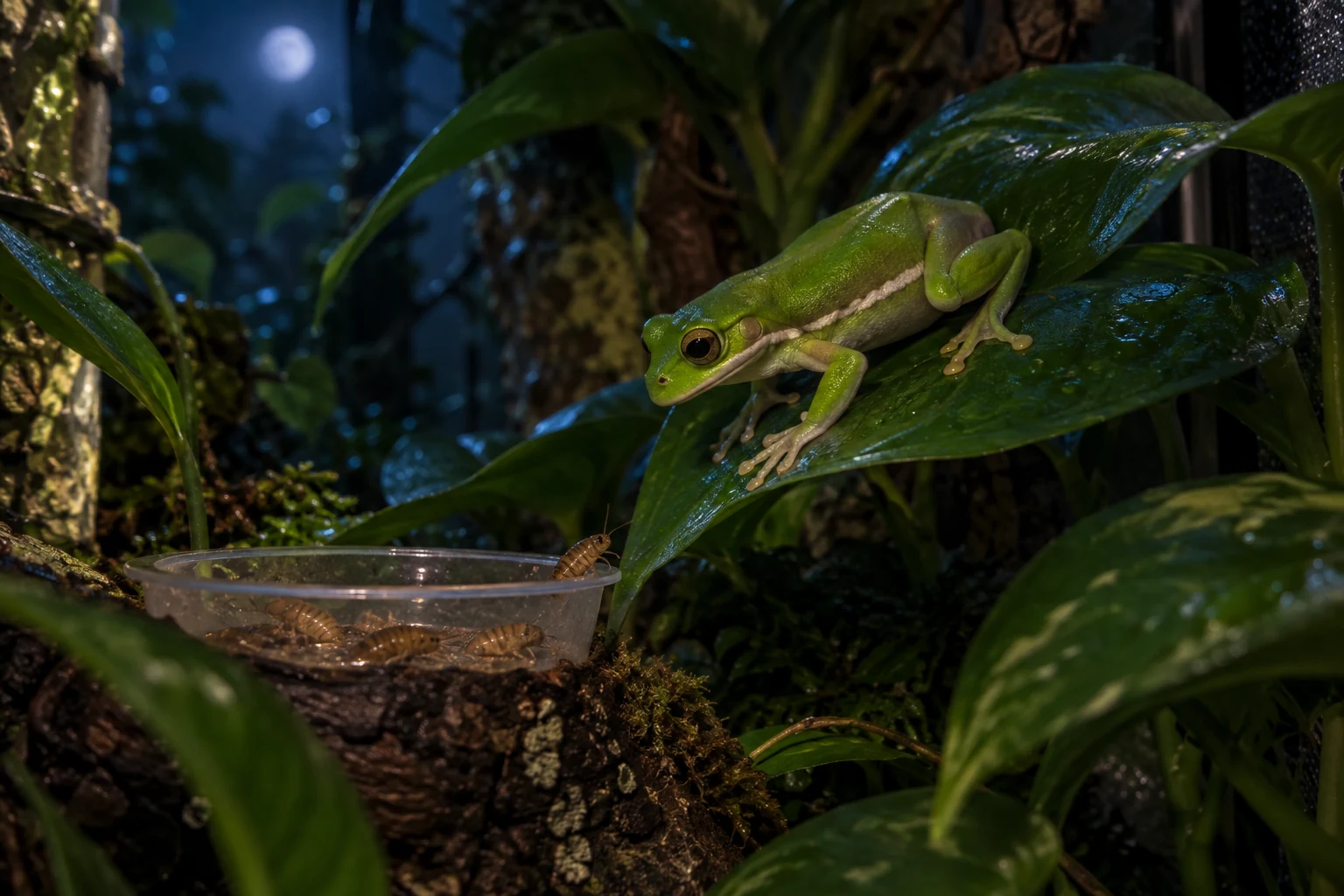
Use gut-loaded small Dubia nymphs as the staple, with small mealworms and BSFL in rotation. Adults take two to four appropriately sized items every two to three days.
| Stage | Food | Schedule |
|---|---|---|
| Froglet | Pinhead prey, springtails, tiny BSFL | Daily; calcium most meals |
| Juvenile | ¼-inch Dubia, small BSFL | 2–4 items every other day |
| Adult | Small Dubia, mealworms, BSFL | 2–4 items every 2–3 days |
Keep the floor working and your hands off
Springtails and dwarf white isopods suit a planted build; leaf litter feeds the cleanup crew. Handle only for necessary moves, using rinsed wet hands or a cup, because the frog's skin absorbs residues and a startled frog leaps without looking.
Watch moisture, water hygiene, and supplements
| What you see | Likely cause | Response |
|---|---|---|
| Brown or grey color | Normal shift with mood, temperature, background | No action if behavior is normal |
| Dry, dull, tacky skin | Low humidity | Mist, refresh water, verify hygrometer |
| Honking at night | Healthy calling male | Move tank if sleep is affected |
| Bent limbs or wobbly landings | Metabolic bone disease | Correct calcium/D3, add UVB, see a vet |
| Red belly or thighs | Bacterial infection | Vet promptly; correct hygiene |
| Constant soaking | Too dry or too warm | Check humidity and temperature |
| Weight loss | Possible parasites | Exotics vet with fecal sample |
Green Tree Frog FAQ
Can I keep a green tree frog I caught outside?
Often yes, legally, but check first: your state wildlife agency sets the rules on possessing native amphibians, and they range from a small allowance to a permit requirement to a ban. Read the actual rule, then commit, because a frog that comes inside can never be released back out.
Why is my green tree frog brown?
Colour shifting is normal for this species. They move between bright green, olive, grey and brown depending on temperature, humidity, background and mood, and a stressed or cold frog often darkens. A frog that eats, climbs and calls normally is fine in any of those shades.
How loud are they really?
Loud. A calling male produces a nasal honk repeated dozens of times a minute, and it carries through walls, which is charming on a summer evening and less so at 2am in a bedroom. If sound matters, house them somewhere other than where you sleep.
Can green tree frogs live in a group?
Yes, and a small group in a planted 18 x 18 x 24 is the classic display. Keep every frog roughly the same size, house only this species in the tank, and add floor space if you go beyond two or three.
Do they need a heat lamp?
Usually not. They are comfortable at 72 to 80 degrees by day with a drop into the upper 60s at night, which most homes provide without equipment. If a bulb is needed for a cold room, use the lowest wattage on a thermostat and keep the top of the tank from baking.
What do American green tree frogs eat?
Small moving insects: gut-loaded small dubia roach nymphs as the staple, with small mealworms and black soldier fly larvae in rotation, dusted with calcium plus D3. Adults take two to four items every couple of days, fed after dark when they actually hunt.
Can I handle them?
No, beyond brief necessary moves. Their skin is thin and permeable, handling is a real stressor, and a startled green tree frog leaps without looking. Use rinsed wet hands or a cup for transfers and wash afterward.
How long do they live?
About six years is typical, and individuals reach ten or more with clean water, correct humidity and consistent supplementation. That is a long run for a frog that often costs less than a bag of feeders.
Build upward and keep it simple
Secure vertical space, clean water, daily humidity cycling, small feeders, and hands-off observation support a long healthy life.
Browse more care sheetsPrepared by the TC INSECTS team for practical, responsible amphibian care.
