
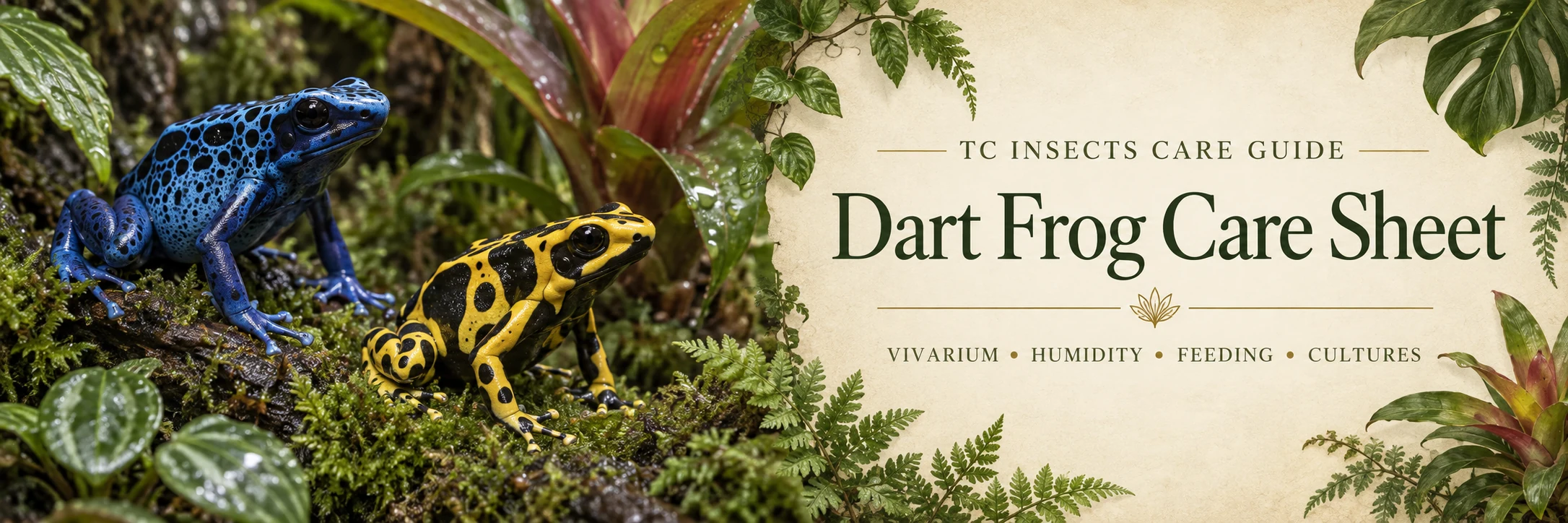
Meet the beginner dart frogs
Poison dart frogs are bold, active daytime jewels of planted vivariums. Dendrobates tinctorius—including azureus—is the largest and boldest; D. leucomelas is forgiving of groups and temperature swings; D. auratus is slender, often shyer and available in many colour forms.
Captive-bred frogs are not toxic
Wild frogs build toxins from alkaloids in ants and mites. Frogs raised on fruit flies and springtails do not develop those toxins. Their delicate permeable skin still makes them display animals, not handling pets.
Beginner—with an asterisk
These are hardy relative to other dart frogs, but heat and dry air are unforgiving. Their small prey also requires live fruit-fly cultures and a consistent supplement routine.
Which dart frog should you start with?
| Species | Adult size | Housing | Heat danger | Good to know |
|---|---|---|---|---|
| D. tinctorius / azureus | 1.5–2 in | Single or true pair | Above 80°F | Boldest and largest; females fight |
| D. leucomelas | 1.2–1.6 in | Small groups with cover | 85°F+ | Most forgiving of company and swings |
| D. auratus | About 1.6 in | Groups with monitoring | Above 85°F | Slender, often shy, many locales |
What you will need
Set up the planted bioactive vivarium and let it stabilize for a couple of weeks before adding frogs.
Conditions at a glance
| Parameter | Target | Notes |
|---|---|---|
| Day temperature | 68–78°F | Most air-conditioned homes are suitable |
| Night | Down to ~65°F | Mild drop is natural |
| Danger line | 80°F tinctorius; 85°F others | Overheating can kill within hours |
| Humidity | 70–100% | Aim near 80–90% for tinctorius and leucomelas |
| Misting | Once or twice daily | Let the hygrometer guide frequency |
| Lighting | 10–12 hours | Plant light; low-output UVB optional |
| Ventilation | Mostly glass, narrow screen | Humidity without stagnant air |
| Space | ~10 gallons per adult | Floor area matters most |
| Housing | Never mix species or morphs | Prevents aggression and hybrids |

Build from the bottom up
Use a drainage layer so soil never sits in water, a mesh barrier, several inches of ABG-style mix and generous leaf litter. Add plants and cork, then seed springtails and dwarf white isopods a couple of weeks before the frogs. A narrow ventilation strip prevents stagnant mouldy air while retaining humidity.
Culture tiny live prey
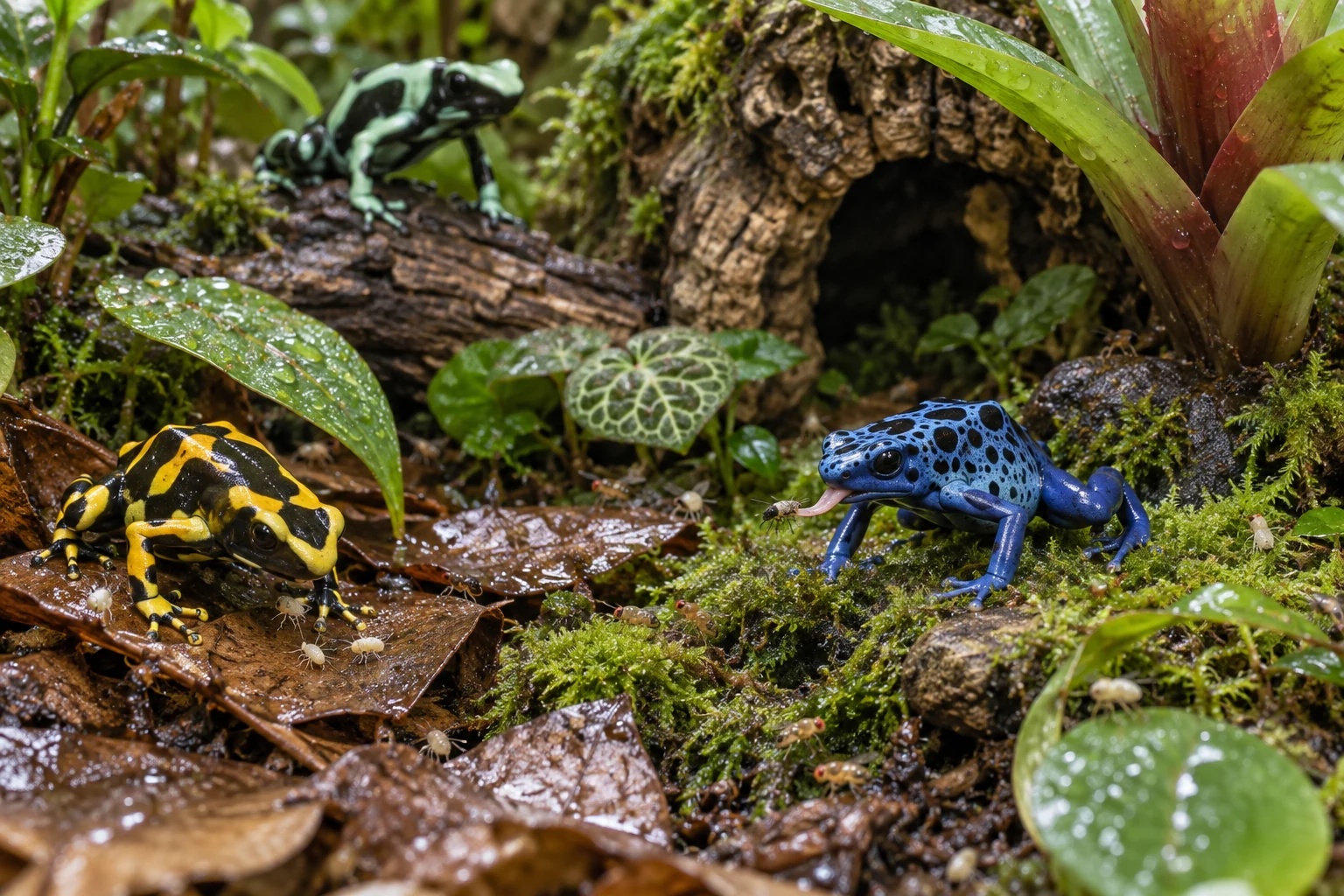
Fruit flies are the staple: melanogaster for froglets and small frogs, hydei for larger juveniles and adults. Springtails and small isopods fill gaps at every age. Never offer prey wider than the space between the frog’s eyes, and skip wild insects because of pesticides, parasites and toxin-building alkaloids.
Heat is the number-one danger
Keep days at 68–78°F and allow nights into the mid-60s. Treat 80°F as the warning line for tinctorius and 85°F for leucomelas and auratus. Do not use heat lamps: they create hot spots and dry the vivarium. Plan for summer power or air-conditioning failures.
Humid—not stagnant
Maintain 70–100% humidity, usually 80–90% for tinctorius and leucomelas. Mist once or twice daily with dechlorinated, RO or distilled water, adjusting to the hygrometer. Water dishes are optional; if used, they must be extremely shallow with an easy exit because dart frogs are weak swimmers.
Lighting and the UVB question
Run a good LED or T5 plant light for 10–12 hours. UVB remains debated: specialists often consider it unnecessary when feeders receive calcium with D3, while general reptile guidance favors low-output UVB. Glass blocks nearly all UVB. The supplement schedule below is not optional either way.
Feeding and supplements
| Life stage | Main prey | Frequency | Supplements | Notes |
|---|---|---|---|---|
| Froglet | Melanogaster, springtails | Daily | Dust every feeding | Keep springtails thriving |
| Juvenile | Melanogaster, then hydei | Daily; 20–40 small insects | Dust every feeding; preformed vitamin A every 2–4 weeks | Do not underfeed during growth |
| Adult | Hydei or melanogaster, springtails, isopods | 3–4 times weekly | Dust every feeding; vitamin A every 2–4 weeks | Reduce if frogs become plump |
Use calcium with D3 or a complete amphibian supplement at every feeding. Amphibians cannot efficiently convert beta-carotene into vitamin A, so use a preformed vitamin A product periodically. Do not stack several complete supplements because vitamins A and D3 can accumulate.
Look, don’t hold
Captive-bred frogs are not toxic, but their skin is delicate and absorbs residues. Handle only when moving or medically necessary; guide the frog into a container or use clean wet hands. Never apply soap, lotion or sanitizer before contact.
Read the frog and the environment
| What you see | Likely cause | What to do |
|---|---|---|
| Restless, uncoordinated frog | Overheating | Cool room immediately; veterinary help if persistent |
| Dry skin or hiding constantly | Low humidity | Verify hygrometer; improve misting and lid coverage |
| Mould, sour smell, condensation everywhere | Stagnant saturated vivarium | Improve drainage and narrow ventilation |
| Weight loss despite eating | Parasites or too little food | Review counts; exotics vet with fecal sample |
| Poor aim / cannot catch prey | Possible vitamin A deficiency | Review supplements; amphibian vet |
| Bullying or one frog hiding | Group mismatch | Separate; reassess species and sex ratio |
Poison Dart Frog FAQ
Are captive-bred dart frogs poisonous?
No. Wild frogs build toxins from alkaloids in their prey; captive-bred frogs raised on fruit flies and springtails do not develop them.
Can you hold a poison dart frog?
Only when necessary. They stress easily and absorb residues through delicate skin; guide them into a container or use clean wet hands.
Do dart frogs need UVB?
It is debated. Low-output UVB is optional, but calcium with D3 at every feeding and preformed vitamin A every few weeks are essential.
What size tank does a dart frog need?
Plan about ten gallons of floor space per adult. An 18×18×18 front-opening terrarium suits a pair of smaller species; tinctorius and groups need more.
Can dart frogs live together?
Leucomelas often tolerate small groups, auratus groups require monitoring, and tinctorius are best single or in true pairs. Never mix species or colour forms.
What do dart frogs eat?
Melanogaster and hydei fruit flies are staples, with springtails and small isopods. Dust every feeding and avoid wild-caught insects.
How long do dart frogs live?
Ten years is common with good care and some pass twenty, making the vivarium a long-term commitment.
What temperature is too hot?
Treat 80°F as the danger line for tinctorius and 85°F for leucomelas and auratus. Overheating can kill within hours.
Building your first dart frog vivarium?
Tell us the species, enclosure size and room temperature and we’ll help size the setup and feeder cultures.
Prepared by the TC INSECTS keeper team for practical, responsible dart frog care.
