
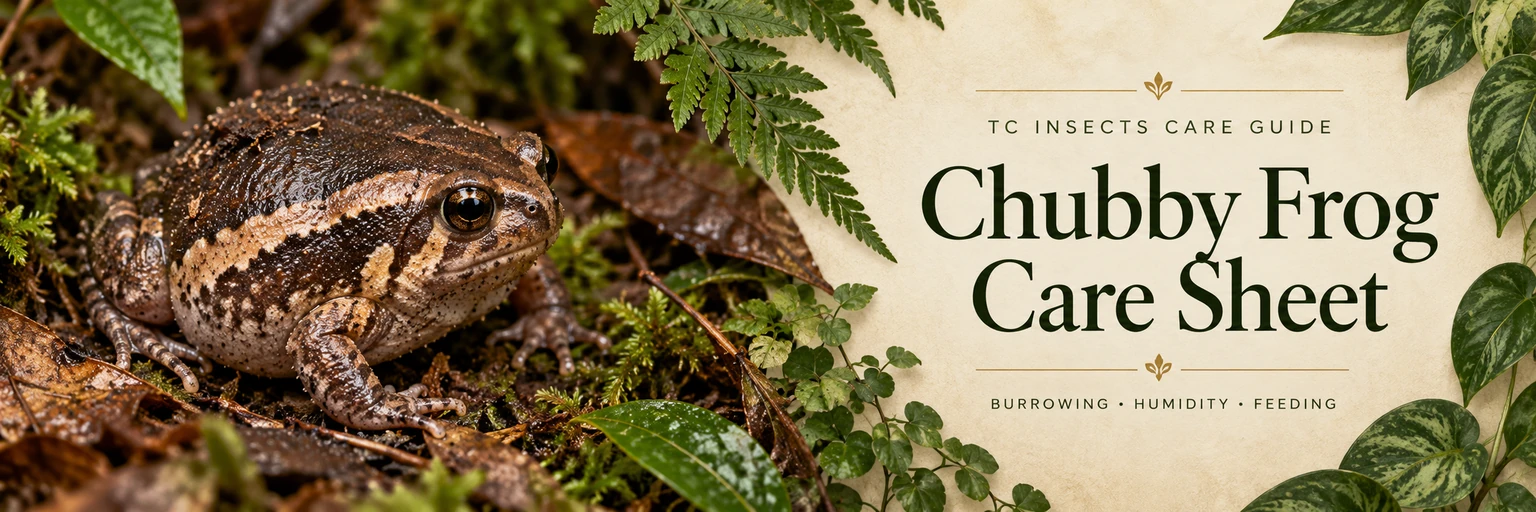
A practical guide to the Chubby Frog: burrowing habitat, humidity, small feeder insects, and everyday care.
Meet the Chubby Frog
The chubby frog—also sold as the Asian painted frog, banded bullfrog or Malaysian bullfrog—is a round, short-legged burrower from Southeast Asia. Its chocolate-brown body carries a broad tan-to-copper stripe from the eyes down each side.
Easy care, quiet display
Chubby frogs are hardy, comfortable at ordinary room temperatures and content in a simple setup. The trade-off is visibility: a healthy frog may spend the day buried and appear mainly for an evening check-in.
Built for monsoon nights
In the wild they burst into activity after heavy rain, when males call from temporary pools. A captive frog that starts calling after a humidity spike is responding to the same natural cue.
What you will need
Nothing here is specialist equipment. The one line not to cut short is substrate depth.
Conditions at a glance
| Parameter | Target | Notes |
|---|---|---|
| Enclosure | 20-gallon long for one or two | Floor space beats height |
| Day temperature | 68–80°F | The mid 70s suit the full recommended range |
| Night temperature | Down to about 68°F | A small drop is natural |
| Humidity | Around 70% | Raise to 85–90% only to trigger breeding |
| Substrate | Deep, damp coco fiber | Avoid gravel, sand, bark chips and perlite |
| Water | Shallow, heavy dish | Dechlorinated and refreshed daily |
| Lighting | Not required | Only needed for live plants |
| Feeding | Small insects every 2–3 days | The mouth is small; size prey down |
| Housing | Solo is fine | Never mix with other frog species |

Build for burrowing
Floor space and substrate depth matter more than height. Use deep coco fiber—optionally blended with composted bark and topped with leaf litter—so the frog can disappear completely. It should hold a tunnel shape without being soggy; squeeze a handful and only a drop or two should come out.
Avoid gravel, sand, bark chips, perlite and vermiculite, which can be swallowed with prey. Springtails and dwarf white isopods make an excellent cleanup crew in a bioactive enclosure.

Many small insects
Even a large adult has a small mouth. Offer small dubia roaches, small black soldier fly larvae, small red runner roaches and silkworms, with mealworms as an occasional extra. Never offer anything wider than the frog's head.
Adults do well on three to six suitable insects every two to three days; juveniles eat more often. Trim portions if the frog develops visible fat pads—obesity is easy to overlook on an animal already named “chubby.”
Temperature, humidity and water
Good care sources split slightly between 68–78°F and 75–80°F, so aim for the mid 70s. Most homes need no heat. If the room runs cold, use a thermostat-controlled heat mat on one side rather than a lamp that dries the substrate.
Diet by life stage
| Life stage | Prey size | How often | Supplements | Notes |
|---|---|---|---|---|
| Froglet | Fruit flies, springtails, pinhead prey | Daily | Dust every feeding | Newly morphed froglets are under half an inch |
| Juvenile | Small dubia, BSFL and red runners | Every 1–2 days | Dust every feeding | Steady growth phase |
| Adult | 3–6 small insects per meal | Every 2–3 days | Every 2–4 feedings, at least weekly | Many small items beat a few large ones |
Everything a Chubby Frog keeper needs from this guide. Untick anything you already have, then add the rest in one click.
Puffing up and sticky secretion
A threatened chubby frog inflates like a balloon, making itself difficult to swallow. If disturbance continues, it releases a sticky white skin secretion. The secretion is distasteful, and laboratory work shows it can damage blood cells in a dish, but no human handling injuries are documented.
Keep handling brief and necessary only, use clean wet hands, avoid touching your eyes and mouth, and wash afterward. A frog that puffs up is asking to be put down. The secretion is another reason never to house this species with other frogs.
Health and troubleshooting
Because this frog spends so much time out of sight, make a quick evening look at body shape and skin part of the routine.
| What you see | Most likely cause | What to do |
|---|---|---|
| Never visible during the day | Normal nocturnal burrowing | Check in the evening; leave it buried |
| Puffed up or sticky | Stress from handling | Put it back, handle less and wash hands |
| Dry, tacky skin or sunken eyes | Substrate too dry or no water dish | Dampen substrate, refill dish and offer a soak |
| Bloated and straining to breathe | Impaction from prey or substrate | See a vet promptly; correct prey size and substrate |
| Red flush on belly or thighs | Possible red-leg infection | Isolate and see a vet immediately |
| Soft or bowed limbs | Metabolic bone disease | Correct calcium and D3; consult an exotics vet |
| Very round with fat pads | Overfeeding | Reduce portions and use smaller prey |
| New frog thin and not eating | Stress, cool conditions or parasites | Check temperatures and arrange a fecal test |
Chubby Frog FAQ
Are chubby frogs good for beginners?
Yes. They are hardy, tolerate ordinary room temperatures, need no special lighting, and do well in a simple setup. The main adjustment is expectations: they are nocturnal burrowers, so you will see yours far more at night than during the day.
Is chubby frog slime poisonous to humans?
Not in any documented way. When harassed, a chubby frog releases a sticky white secretion that is distasteful and irritating, and lab studies show it can damage blood cells in a dish, but no human injuries from handling are recorded. Keep handling brief, avoid touching your eyes or mouth, and wash your hands afterward.
Why is my chubby frog always buried?
Because that is what chubby frogs do. They are nocturnal burrowers that spend the day dug into the substrate and come out at night to hunt. A frog that stays buried is usually comfortable, as long as it is eating and the substrate is damp.
Do chubby frogs need a heat lamp?
Usually not. Their comfortable range overlaps normal home temperatures, roughly 68–80°F with the mid 70s ideal. If your room runs cold, a thermostat-controlled heat mat on one side is a better backup than a lamp.
Do chubby frogs need UVB?
No. Lighting is only needed if you grow live plants, as long as the frog gets vitamin D3 through dusted feeders. A normal room light cycle is fine.
What do chubby frogs eat?
Small dubia roaches, small black soldier fly larvae, small red runner roaches and silkworms, with mealworms as an occasional extra. Offer several small insects rather than one large item.
How big of a tank does a chubby frog need?
A 20-gallon long is a good starting point for one or two adults, with more floor space always better and substrate depth mattering more than height.
Can chubby frogs live together?
A chubby frog can live alone, and small same-species groups can work in a large enclosure—around 60 gallons for two or three adults. Never mix them with other frog species.
Keeping a Chubby Frog?
Tell us its size and we will match feeders small enough for that famously small mouth. Real keepers answer our email.
Prepared by the TC INSECTS keeper team for practical, responsible Chubby Frog care.
