
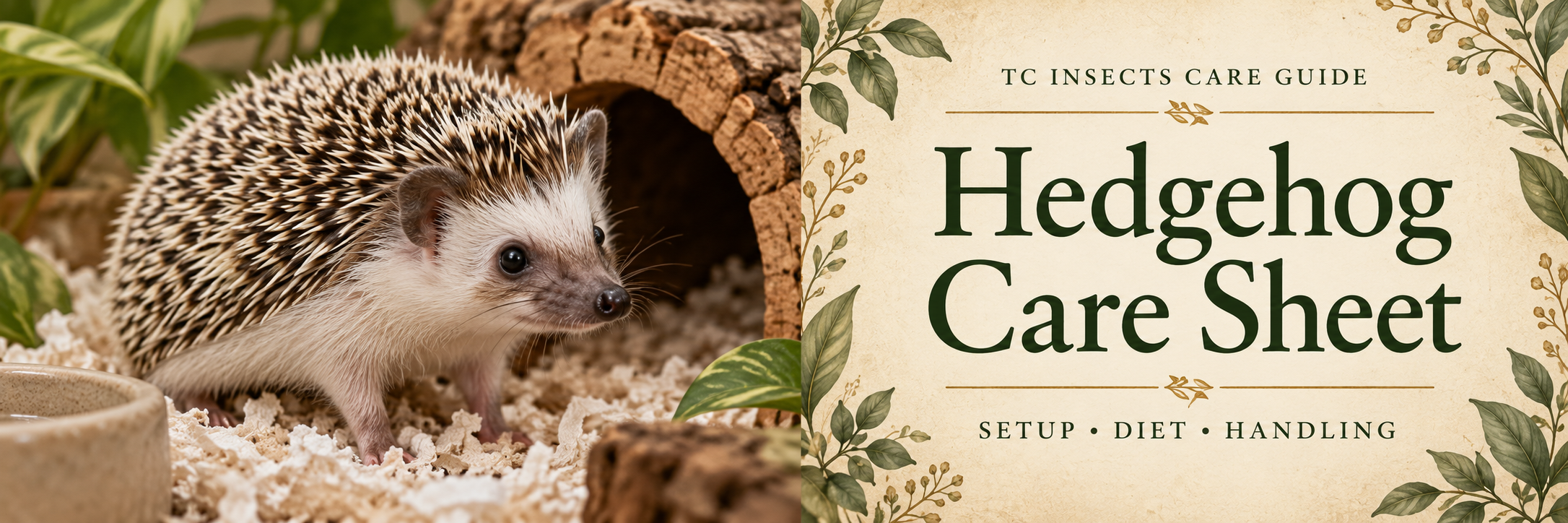
African Pygmy Hedgehog Care Sheet
This sheet covers the African pygmy hedgehog, the hedgehog species kept as a US pet: enclosure size and the exercise wheel it needs every night, temperature and the real risk of a hibernation attempt, an honest diet that pairs a dry staple food with real insects, quilling, self-anointing, handling and temperament, common health problems, and the state and city laws that ban or restrict ownership in specific places.
Males run 400 to 600 grams, females 300 to 400; a rough at-home obesity check.
Vet sources give 4 to 8 as typical, with some individuals living close to 10.
Simple diet and setup, but legality is real and health problems are common.
Meet the African Pygmy Hedgehog
The African pygmy hedgehog, Atelerix albiventris, is the hedgehog species kept as a pet in the United States. It belongs to the order Eulipotyphla and the family Erinaceidae, and it is also called the four-toed hedgehog or the white-bellied hedgehog, names that describe its four-toed hind feet and its white to cream belly. Pet hedgehogs sold in the US are captive bred. A federal animal health rule, 9 CFR 93.701, has prohibited importing hedgehogs from any region where foot and mouth disease exists, which covers this species' African range, since 1990, so the US pet population comes from a closed breeding stock built up over more than three decades.
Buyers sometimes confuse this animal with the lesser hedgehog tenrec, sold under the trade name hedgehog tenrec. The two are not related. A tenrec sits in a different mammal order entirely, closer to elephants and manatees than to hedgehogs, and it has a longer, ratlike snout and tends to bite rather than curl into a ball when it feels threatened. An older hobbyist theory once held that the modern pet hedgehog is a hybrid with the Algerian hedgehog; current hobbyist consensus treats that idea as outdated and unsupported. If a listing calls an animal a hedgehog tenrec, it is not the animal covered on this page.
State and City Legality: Check Before You Buy
Legality is the first question to answer before buying a hedgehog, not the last. As of this review in September 2026, private ownership is not allowed in California, Georgia, Hawaii and the District of Columbia, and Pennsylvania is unsettled. California lists every species of the order Insectivora, hedgehogs included, as a restricted animal under Fish and Game Code Section 2118 and Section 671 of Title 14 of the California Code of Regulations, and marks the whole group as detrimental, meaning a threat to native wildlife, agriculture, or public health or safety; the state's restricted species permits are issued for purposes such as research, exhibiting, breeding for exhibitors and shelters, and none of them covers keeping a pet. Georgia lists hedgehogs, order Erinaceomorpha, among the wild animals that need a license or permit under Code Section 27-5-5 and its Department of Natural Resources wild animal rules, and the department says plainly that wild animal licenses and permits cannot be issued to pet owners.
Hawaii's Department of Agriculture admits only the non-domestic animals on its approved and restricted lists, no pet hedgehog species is on them, and state law prohibits any animal that is on no list, so a hedgehog cannot legally be brought in or kept; department staff have pointed to the damage an escaped insect eater could do to native insects and tree snails. Pennsylvania is the one we could not settle. No Pennsylvania statute or regulation we could reach names hedgehogs, and no Game Commission page we could find mentions them either. Its Game and Wildlife Code, Title 34, does require a permit to possess exotic wildlife, keepers widely report that the Game Commission treats hedgehogs that way, and bills to allow them have been introduced repeatedly since 2017 without passing. If you live in Pennsylvania, call the Game Commission before you buy, because we are not going to tell you it is settled either way. Washington DC works from a closed list of animals that may be kept as household pets, in DC Code Section 8-1808, and hedgehogs are not on it.
A city rule can be stricter than its state's. New York City's Health Code, Article 161, prohibits keeping insectivorous mammals and names the hedgehog specifically, while New York State's own wild animal pet law covers a defined list of animals that does not include hedgehogs, so there is no state level ban outside the city. That is the clearest example in this review of a local rule overriding a state one, and exactly why checking your state alone is not enough. New Jersey and Wisconsin sit in the middle. New Jersey requires a permit to possess any exotic mammal that is not on its exempt species list, and hedgehogs are not exempt, so a pet keeper needs the Exotic and Nongame Individual Hobby permit from the state's Fish and Wildlife program. Wisconsin's Department of Natural Resources does not require a license to possess a nonnative species like a hedgehog, but bringing one in from outside the state requires an animal import permit from the Wisconsin Department of Agriculture, Trade and Consumer Protection plus a certificate of veterinary inspection.
These lists change. Maine required permits for hedgehogs until 2017, when the Legislature directed its Department of Inland Fisheries and Wildlife to allow them without one; the department's unrestricted species list now names the African pygmy hedgehog, so any list that still counts Maine among the restricted states is out of date, and Maine itself notes that towns can further regulate the keeping of animals the state allows. This review did not find a ban or permit requirement in other states, but that is not a guarantee those states are unrestricted, a list like this one can go stale the same way the old Maine entries did, and cities and counties anywhere can add rules of their own. Before you buy, check directly with your own state wildlife or agriculture agency and your own city or county government; do not rely on this page, or any other single source, as the final word.
What You Will Need
The shopping list is short, but a closed, no-slit exercise wheel and a steady, thermostat-controlled heat source are not optional extras. Both address real risks covered later on this page: a hedgehog that cannot run will not get the exercise it is driven to seek every night, and one kept too cold can slip into a dangerous hibernation attempt.
Conditions at a Glance
The whole environment on one card, useful for a fast pre-purchase check or a quick reference once the hedgehog is already home. Sources disagree on some of these numbers more than usual for this species; where they do, the table below gives the safer, better-supported figure rather than the loosest one found, and the sections that follow explain exactly where the disagreement comes from and why.
| Parameter | Target | Notes |
|---|---|---|
| Ambient temperature | 72 to 80°F, held all day and night | No basking spot; the whole enclosure needs to stay warm |
| Danger floor | Below about 72°F | Risk of torpor, a hibernation-like shutdown |
| Humidity | Low, under about 40% | Merck Veterinary Manual and one generalist source give under 40%; others just say low |
| Light cycle | 12 to 14 hours light, 10 to 12 dark | Steady year round; no UVB needed |
| Enclosure size | At least 6 sq ft adult floor space | Smaller figures circulate; bigger is better |
| Bedding depth | 3 to 4 inches in at least part of the cage | Merck and one generalist source agree; paper or fleece preferred, never cedar or corn cob |
| Diet mix | Dry staple food plus fresh insects | Vets range from two or three times a week to a small daily serving; neither food alone is the full diet |
| Lifespan | 4 to 8 years typical | Some individuals reach close to 10 |
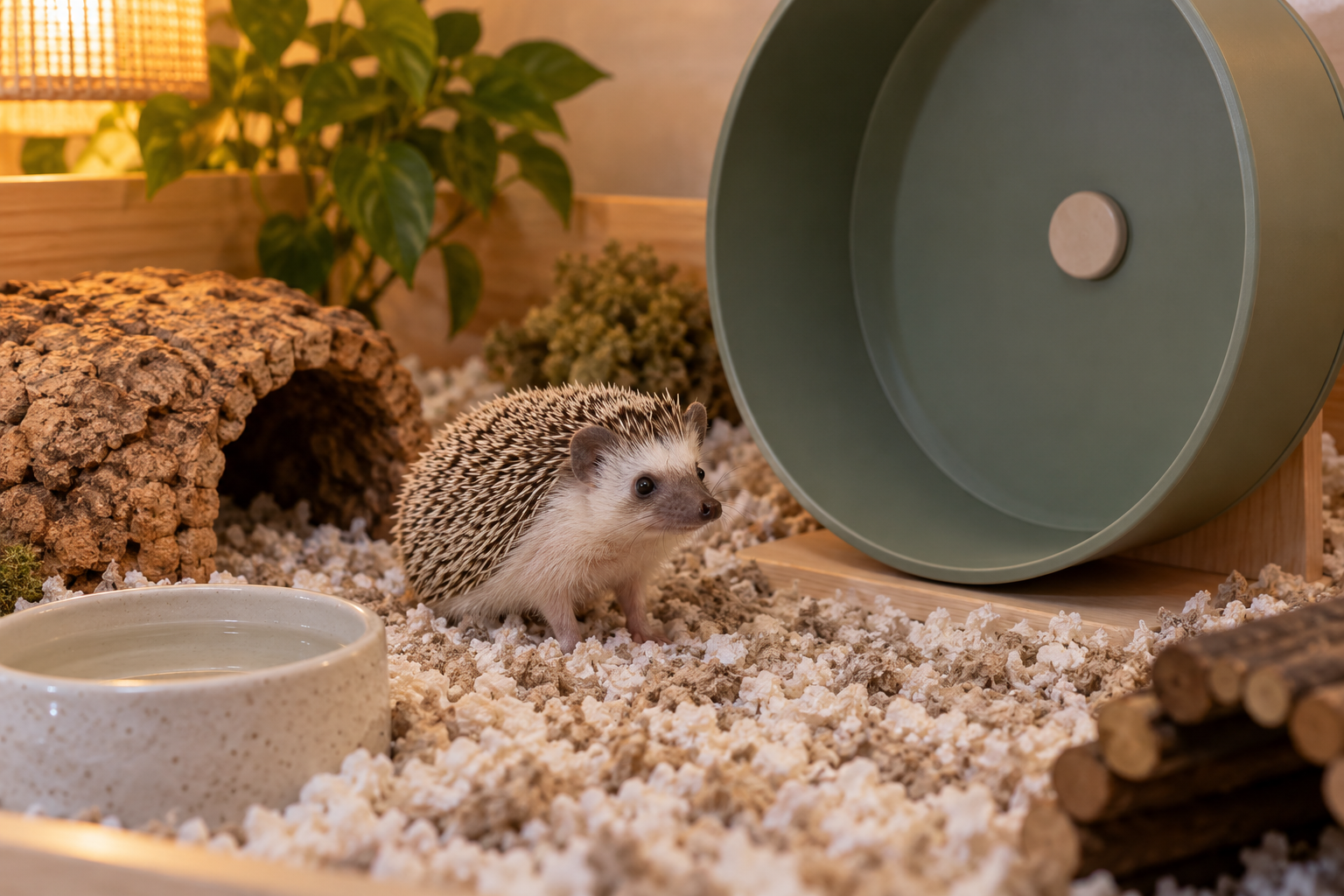
Cage, Bedding and the Exercise Wheel
Sources disagree on the smallest acceptable enclosure by more than double: one veterinary hospital gives 16 by 24 inches, about 2.7 square feet, while a UK exotics factsheet gives roughly 4 square feet and two other sources set the floor at 3 by 2 feet, 6 square feet. Treat the smaller numbers as a floor, not a target, and use 6 square feet as the real minimum for an adult, with more always welcome. Wire flooring is never appropriate; it injures a hedgehog's feet. A solid floor is standard, under a secure, climb-proof lid or fence, since hedgehogs climb better than most new owners expect.
Fleece liners, plain paper-based bedding, or clean towels checked for loose threads are the recommended substrate. Two sources agree on depth: the Merck Veterinary Manual recommends 3 to 4 inches of substrate in at least some areas of the cage so the hedgehog can burrow, and a generalist care sheet gives the same 3 to 4 inches for paper bedding, so the figure is better supported than the research first suggested. Bedding type is where sources vary more: veterinary references also accept recycled paper pellets, aspen shavings and hay, while agreeing that cedar, dusty or scented shavings and corn cob are out. Avoid pine or cedar shavings: their aromatic oils irritate the respiratory tract, and the shavings themselves are linked to mite, tick, or lice problems. Avoid corn cob bedding too, since it supports bacterial and fungal growth and risks a gut impaction if swallowed. Most hedgehogs can be litter trained if the litter area is kept away from food and sleeping spots.
A large, closed, no-slit exercise wheel is close to essential, not a nice-to-have. Wild hedgehogs range roughly 650 to 1,000 feet every night hunting for food, so a captive hedgehog is highly motivated to run, and a wheel is how that drive gets satisfied indoors. A slitted or open-rung wheel can catch and injure a foot or leg, so the closed, solid-surface design is the one to buy.
Temperature, Light and the Risk of Hibernation Attempts
Hedgehogs are not baskers. Instead of a hot spot next to a cool end the way a reptile enclosure is built, the whole space needs one warm range held around the clock. Sources give different numbers for that range: one veterinary source calls 75 to 80°F ideal but separately calls 75 to 85°F the range that avoids torpor on the same page, a husbandry course puts the comfortable band at 72 to 80°F, and a generalist source widens it to 70 to 85°F. The one figure every source agrees on is the floor: below about 72°F, a hedgehog can slip into torpor, a hibernation-like shutdown dangerous for a species not built to truly hibernate in captivity.
Aim for 72 to 80°F as a practical target and use a thermostat-controlled heat source rather than a basking bulb, since this species needs steady warmth everywhere in the enclosure, not a gradient. Humidity gets less attention than temperature: most sources describe the target only as low, without a number, but the Merck Veterinary Manual and a generalist care sheet both put it under 40 percent, so aim for that and expect a dry room to suit this animal better than a humid one.
Hedgehogs are mammals, so they do not need UVB to make vitamin D the way a reptile does; a UVB bulb marketed for a hedgehog enclosure is solving a problem this animal does not have. What actually matters is a steady day and night photoperiod. Peer-reviewed research on hedgehog seasonality found that short winter day length is a main driver of the hibernation cycle in the wild species studied. Hobbyist guidance for pet African pygmy hedgehogs is to hold a steady 12 to 14 hours of light and 10 to 12 hours of dark year round, specifically so the animal's body never gets the seasonal light cue that would normally start a hibernation attempt.

What Hedgehogs Eat: Insects Plus a Staple Food
In the wild a hedgehog is a true insectivore, eating insects, worms, snails and small prey. In captivity it adapts well to an omnivorous diet built around a commercial base, and that base should fill most of the food dish. Feed a dedicated dry hedgehog food or a high quality, low fat, high protein cat food that is relatively low in iron; one veterinary source is direct that the full nutritional needs of captive hedgehogs are still not completely established, so a well chosen commercial base matters more here than guesswork. Hobbyist guides narrow the target further, to roughly 30 to 34 percent protein and 10 to 15 percent fat, non-fish based, though no veterinary source in this research confirmed those exact percentages.
Fresh insects belong on top of that base, not in place of it. Veterinary references treat them as a normal part of a pet hedgehog's diet: the Merck Veterinary Manual adds a small daily serving of moist foods or invertebrate prey such as mealworms, waxworms or gut-loaded crickets to the main diet, and VCA suggests gut-loaded insects two to three times a week. One commercial food brand markets its kibble as needing no insects at all; that is a marketing claim, and this sheet follows the veterinary guidance instead. From TC's catalog, dubia roaches and black soldier fly larvae work well as the everyday staple share: both are soft-bodied and easy to digest, and BSFL carry a naturally favorable calcium to phosphorus ratio.
Silkworms are a good hydration-forward option two to three times a week. Mealworms make a fine occasional treat rather than a staple, since they run higher in fat and are harder shelled than the staples above, which matters for a species that gains weight easily. See the full feeder picks for hedgehogs for sizes across the rotation, and gut-load insects before offering them so the feeder itself is carrying good nutrition into the diet, not just bulk. TC does not sell crickets or any vertebrate, both of which show up on general hedgehog feeding lists elsewhere, so this sheet only covers the feeder-insect share TC can actually fill.
Round out the diet with a small amount of fruit or vegetables, and cooked egg or lean poultry or fish at no more than about a teaspoon a day. Sources disagree on how often to offer insects: a veterinary hospital recommends two to three times a week, while several hobbyist guides describe a small serving closer to daily. Since obesity, not underfeeding, is the health problem named most often in this species, this sheet favors the moderate, vet-sourced two to three times a week and treats daily insect servings as the more permissive end of a real range, not a safe default. A pet hedgehog does not have to travel to find food the way a wild one does, which is part of why overfeeding is so easy.
Calcium or Vitamin Supplements?
Whether to add a calcium or vitamin powder on top of a complete diet is debated inside the hobby itself. Some breeder-level sources warn that a complete kibble already covers mineral needs and that oversupplementing calcium can cause harm; others recommend calcium and vitamin D3 specifically for a hedgehog eating a lot of insects. Two veterinary references, the Merck Veterinary Manual and VCA, say a hedgehog fed a balanced commercial diet does not need added vitamins or minerals, and no veterinary source in this research recommended a specific supplement or amount, so this sheet does not add one; ask an exotics vet before you do. If you do dust feeders with calcium, treat it as an occasional addition, not a daily habit, until a vet says otherwise for your specific animal.
Everything an african pygmy hedgehog keeper needs from this guide. Untick anything you already have, then add the rest in one click.
Quilling and Self-Anointing
Hedgehogs replace quills gradually throughout life, not all at once. Young hedgehogs go through a distinct quilling process as baby quills are pushed out by adult quills, generally described in bursts between about 2 and 6 months of age, with a veterinary hospital source giving a similar window and each burst typically taking about a month. Losing some quills every day during a quilling burst is normal, even if it looks alarming the first time. Badly irritated scratching, patchy bald spots, or quill loss outside those expected age windows point to mites, a diet problem, or something else worth a vet visit instead.
Self-anointing, sometimes called anting, is a behavior unique to this species: the hedgehog works a new scent or taste into a froth in its mouth, then spreads that froth over its own quills with its tongue. It can happen with a new food, a new bedding, or almost any strong new smell. The purpose is not fully understood, but it is considered a normal behavior, not a sign of illness or distress, so there is no need to intervene when you see it.
Handling and Temperament
Hedgehogs are solitary and nocturnal to crepuscular, most active at night and asleep through much of the day. A startled hedgehog puffs up, hisses or clicks, raises its quills, and rolls into a tight, near-perfect ball; snuffling and grunting are the normal, relaxed sounds instead. Consistent, gentle daily handling from a young age is what produces a calmer adult; a hedgehog that is rarely or roughly handled tends to stay balled up and defensive around people well into adulthood.
Because of the quills and a real risk of carrying Salmonella without showing any signs of illness, veterinary sources recommend against this pet for households with children under 5, older adults, or anyone who is immune compromised. Careful handwashing after handling matters for the whole household, not just the primary keeper. This is a look-and-handle-carefully pet more than a cuddle-on-command one, and a new hedgehog that stays balled up for the first while is behaving normally, not proof that something is wrong.
Sexing and Breeding Basics
The gap between the anus and the genital opening is the reliable landmark once a hedgehog is old enough to check. In an adult male the penile opening sits roughly 2 inches up the belly from the anus and looks like a small, raised belly button. In an adult female the vulva sits right next to the anus, no more than about half a centimeter away.
The male's opening starts out close to the anus in infancy, in nearly the same spot as a female's, and migrates up the belly as the animal matures, which is why reliably sexing a very young hoglet is hard even for an experienced keeper. Body size is not a reliable way to sex a hedgehog either, since age, individual variation, and pregnancy all affect it.
Breeding Basics
Gestation runs about 34 to 39 days. Litter size averages 3 to 4 pups, with a documented range of about 1 to 7. Sexual maturity can arrive as early as 2 to 3 months, but breeder guidance is to wait until at least 6 months before breeding a female, for her safety and the litter's. A widely repeated hobbyist rule holds that a female should have her first litter before about 12 months of age because her pelvis is said to fuse by then, making a later first birth more dangerous; that claim is itself debated inside the hobby, and no veterinary or scientific source in this research confirmed the underlying anatomy. Treat the 6 to 12 month window as accepted practice, not the pelvis-fusion story as settled fact.
Common Health Problems
Most of the problems below are worth a call to an exotics vet rather than a home fix. A hedgehog hides how sick it feels until a problem is already advanced, which is the normal pattern for a small prey species, not a reason to wait and see before calling someone who can actually examine the animal.
| What You See | Most Likely Cause | What To Do |
|---|---|---|
| Steady weight gain, can no longer fully curl into a ball | Obesity, the most common diet-related problem in this species | Cut back on high-fat treats; weigh regularly against the adult weight range |
| Wobbling, dragging hind legs, tremors, losing the ability to curl up | Wobbly hedgehog syndrome, a progressive neurological disease of unknown cause, seen in roughly 1 in 10 pet hedgehogs in the US | Exotics vet exam as soon as possible; prognosis is generally poor |
| A new lump, mass, or non-healing sore anywhere on the body | Neoplasia is unusually common in this species, reported in nearly every body system | Exotics vet exam promptly; do not wait to see if it changes |
| Dry, flaky skin, itching, or quill loss outside a normal quilling window | Possible Caparinia mites, sometimes called quill mites | Vet skin scraping; dry skin from low humidity or diet can look similar, so do not guess |
| Diarrhea | Can come from infection, diet, parasites, or another cause; hedgehogs can carry Salmonella without looking sick | Vet visit; wash hands thoroughly after handling and cleaning |
| Sluggish, cool to the touch, unresponsive | Possible torpor from an enclosure that dropped below about 72°F | Warm the animal and the enclosure gradually; call an exotics vet |
African Pygmy Hedgehog FAQ
Building a Hedgehog's Insect Rotation?
Tell us your hedgehog's age and current diet, and we will match feeder insects sized right for a small mouth, dubia roaches, BSFL, and silkworms among them. Real keepers answer our email.
TC INSECTS · Real keeper advice from a working Texas insect farm
