
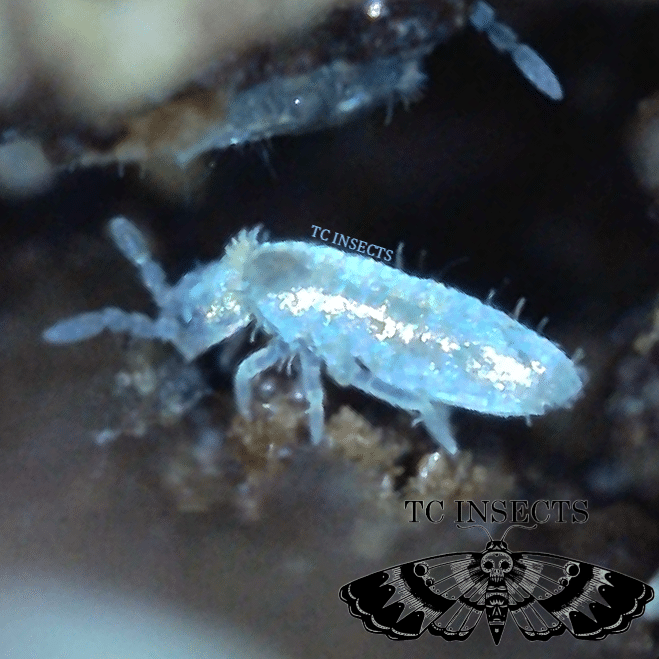
Lepidocyrtus sp. Pearlescent Springtails for Sale
The Pearlescent is the practical middle option in the TC INSECTS Lepidocyrtus lineup. Lepidocyrtus sp. carries a glossy pearl-like, silver-white body that catches light and reads as faintly iridescent under good lighting. As a result, customers get a functional cleanup culture that also doubles as a visually interesting addition to bioactive enclosures and dedicated cultures. Unlike pure display species, the Pearlescent stays affordable and productive enough to use as a working cleanup crew.
TC INSECTS sells the Pearlescent for keepers who want more than a plain white tropical springtail but who do not need the iridescent intensity (or the collector price) of the Ultraviolet. One honest note: the pearl shine is most visible under macro lighting or against darker substrates. In dim or evenly lit setups, the appearance reads closer to a glossy white.
Overview
Most affordable springtails sold for cleanup are plain white tropicals. Most visually striking springtails are priced as collector cultures. The Pearlescent sits between those two categories. Because of its pearl-glossed body and moderate-to-high reproductive rate, it works as both a cleanup species and a low-key display species in the same culture.
If you are building a varied rack, this culture pairs well with other live springtails covering pure cleanup, drier-tolerant niches, and full collector display roles.
Pronunciation
leh-pih-doh-SIR-tus (genus). Pearlescent is a hobby trade name.
Care Level
Easy to intermediate. Care matches what most bioactive keepers already do for standard tropical springtails. As a result, customers transitioning from white tropicals can keep this culture productive without a real learning curve.
Appearance and Size
The Pearlescent has a pale pearl, silver-white, or lightly iridescent body. The shine comes from the genus-typical Lepidocyrtus scaled surface that reflects light. However, the color intensity stays softer than the Ultraviolet, which uses the same scale structure to produce more vivid purple and blue tones.
Body shape is the typical elongated Lepidocyrtus form. Customers usually see the shine best under macro lighting, indirect bright light, or against darker substrate backgrounds. By contrast, against pale culture media or in dim setups, the body reads closer to a glossy white.
Adult Size
Very small, commonly around 1 to 3 mm. Visible to the naked eye on a clean substrate, but the shine is easier to appreciate up close.
Reproductive Rate
Moderate to high once established. Cultures build steadily under stable moisture, light feeding, and good airflow. The reproductive output sits between standard tropical whites and pure display species, which fits the all-around positioning of this culture.
Pearlescent Springtail Care
Temperature
65 to 80°F preferred. In practice, a target around 68 to 76°F works well for most cultures. The Pearlescent handles stable room temperature with no special equipment. However, sudden temperature swings, hot windows, and direct heating vents stress this species the same way they stress most springtails.
Humidity
Moderate to high with good ventilation. The substrate should stay visibly moist, never flooded. Springtails need moisture access at all times. Furthermore, the pearl appearance can dull if the culture dries out or becomes stressed, so consistent moisture supports both reproduction and visual color.
Culture Setup
- Container with a tight lid and breathable ventilation.
- Substrate options include clay, plaster, soil mixes, coco-based culture media, or a charcoal base.
- Leaf litter, bark, or moss on top for grazing surface and humidity refuge.
- Darker substrate or culture backgrounds bring out the pearl shine more than pale media.
Diet and Feeding
Biofilm, Mold, and Organic Matter
The Pearlescent consumes mold, fungi, biofilm, bacteria, algae, and small organic debris. Because of its moderate-to-high reproductive rate, it contributes meaningful cleanup once a population establishes. However, springtails do not replace enclosure maintenance. If mold becomes heavy, fix airflow and watering habits before relying on the cleanup crew.
Supplemental Food
In a dedicated culture, feed light pinches of a measured springtail food like TC INSECTS Springtail Culture Booster. A prepared diet keeps the culture cleaner than raw food scraps, with fewer mite issues. As a result, the culture stays presentable for display purposes while also reproducing well.
Feeding Notes
- Feed lightly and consistently.
- Wait until previous food is mostly gone before adding the next pinch.
- Remove visibly moldy food chunks before they sour the substrate.
- Spot mist if the surface starts looking dry.
Breeding and Culture Growth
Pearlescent cultures build steadily under stable conditions. Most keepers see clear population growth within several weeks of starting a culture. For long-term success, keep at least one backup culture in a separate container so a crashed main culture does not require a reorder.
Culture Maintenance
- Maintain at least one backup culture.
- Refresh substrate when it becomes packed, sour-smelling, or fouled.
- Keep airflow active.
- For display purposes, periodically move the culture under brighter indirect light to enjoy the pearl shine.
Natural Habitat Background
The Pearlescent is sold under the genus-level name Lepidocyrtus sp., since species-level identification within this genus is genuinely difficult. As a result, this culture is best treated as a captive-bred line rather than a wild-caught locality specimen. The genus Lepidocyrtus belongs to the family Entomobryidae and is widely distributed in soil, leaf litter, and organic-rich habitats worldwide.
Best Uses
- Bioactive terrariums and vivariums where keepers want both cleanup function and visual interest.
- Planted setups with darker substrate where the pearl shine reads against the background.
- Isopod cultures and bioactive mixed-microfauna bins.
- Dart frog enclosures and humid amphibian habitats.
- Backup cultures with mid-range reproductive output.
- Display cultures for keepers who want visible movement without paying collector prices.
Not Best For
- Bone-dry desert enclosures. The Pearlescent is moisture-dependent.
- Sealed dead-air setups. Ventilation is non-negotiable.
- Keepers who want maximum cleanup volume per dollar. A pure production species like the Tropical Thunder produces more cleanup output.
- Keepers who want maximum iridescent display. The Ultraviolet is the brighter display option.
Receiving and Acclimation Guidance
Open the package indoors in a draft-free area away from pets and direct sun. Inspect the culture for visible movement. Springtails are tiny, so check the cup walls, food surface, and substrate for activity. If the medium looks shipping-dry, lightly mist or add a small amount of clean water. Do not flood the culture trying to rehydrate it.
To seed an enclosure, place part of the culture near moist substrate, leaf litter, bark, or moss. Then cover lightly so the springtails can move into protected humid areas. Keep at least part of the original culture as a backup colony.
How the Pearlescent Compares to Other TC INSECTS Lepidocyrtus Cultures
TC INSECTS carries multiple Lepidocyrtus species, and each one fills a different role. The Pearlescent is the practical middle option. By contrast, the Tropical Thunder is the high-production cleanup workhorse, smaller and faster-breeding for keepers who need maximum cleanup volume. On the other end, the Ultraviolet is the collector-grade display species with vivid iridescent purple, blue, and gold scale refraction. As a result, most keepers run combinations: Tropical Thunder for raw cleanup, Pearlescent for the affordable middle option, and Ultraviolet for display.
Frequently Asked Questions
What makes the Pearlescent different from a standard white tropical springtail?
The pearl-glossed body. Under good lighting, the Pearlescent reads as silver-white or lightly iridescent, while standard tropical whites stay matte. As a result, the Pearlescent works for keepers who want both cleanup function and visual interest in the same culture.
How does the Pearlescent compare to the Ultraviolet springtail?
Both are Lepidocyrtus, but they serve different purposes. The Pearlescent is the affordable middle option with a softer pearl shine. The Ultraviolet is the collector display species with vivid iridescent purple, blue, and gold color shifts. Most keepers pick based on whether they want function with a visual bonus, or pure display.
How does the Pearlescent compare to the Tropical Thunder?
The Tropical Thunder is the production-volume cleanup species, smaller and faster-breeding. The Pearlescent reproduces moderately to highly but is bought partly for the pearl shine. Customers needing maximum cleanup pick Tropical Thunder, while customers wanting visible function pick Pearlescent.
Can the Pearlescent live with isopods?
Yes. In bioactive enclosures they coexist with most common isopods. For dedicated cultures, keep them separate so harvesting and counts stay clean.
Why does the pearl shine look different under different lights?
The scale structure on the body refracts light differently depending on angle, brightness, and background. Under macro lighting or against darker substrates, the pearl effect is most visible. By contrast, dim setups or pale backgrounds make the body read closer to a matte glossy white.
Can Pearlescent springtails be used as feeders?
Yes, as tiny supplemental feeders for small frogs, micro geckos, and similar insectivores that take springtail-sized prey. However, their main role is cleanup crew support and culture maintenance, not high-volume feeder production.
Learn More About Springtails and Bioactive Care
- TC INSECTS Springtail Care Guide: In-house TC INSECTS guide covering springtail care, culture setup, feeding, and troubleshooting.
- GBIF: Lepidocyrtus: Biodiversity database record with taxonomy and distribution for the genus Lepidocyrtus.
- iNaturalist: Lepidocyrtus: Citizen science reference for the genus Lepidocyrtus, including community-submitted observations and identification photos.
Final Notes
The Pearlescent earns its place as the affordable middle option in the TC INSECTS Lepidocyrtus lineup. Keep it moist, ventilated, lightly fed, and under good lighting for display. Pair it with a high-production cleanup species like the Tropical Thunder for full cleanup coverage, and the Ultraviolet for full display variety. As a result, you get a working cleanup culture with a visual bonus, without paying collector-tier pricing.



Reviews
There are no reviews yet.