
Hypogastruridae sp. Tiny Blue Springtails for Sale
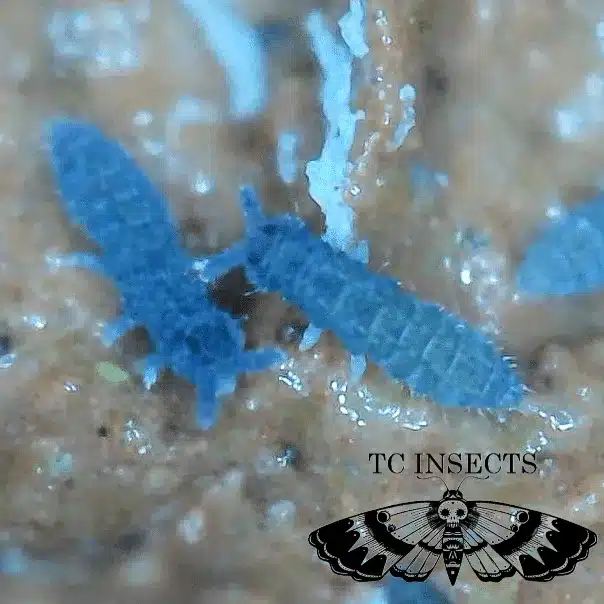
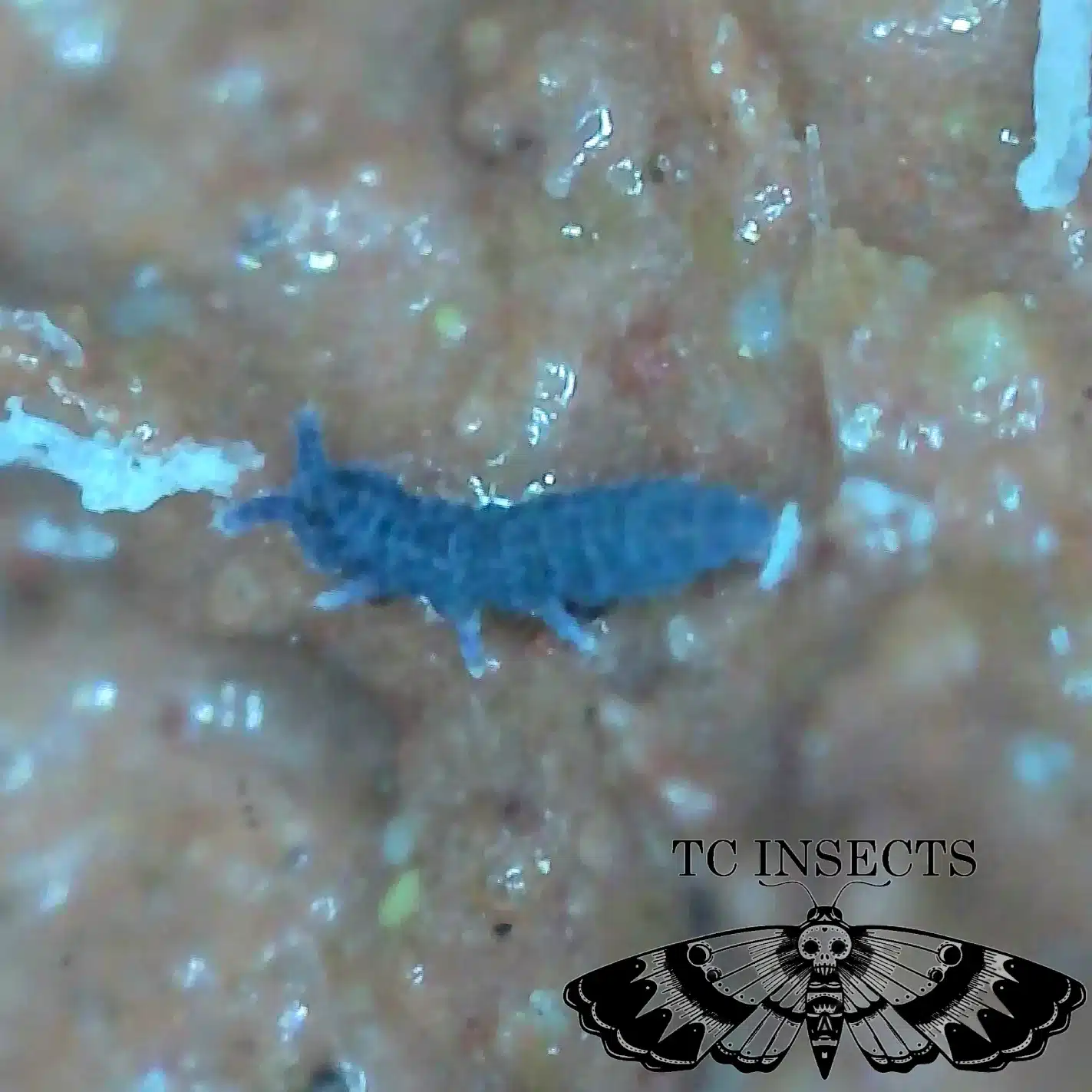
The Tiny Blue is the springtail you buy when standard 1 to 3 mm cleanup species are too big for your animal. Hypogastruridae sp. tops out at around 0.7 mm, which makes it one of the smallest springtails available in the hobby trade. Because of that micro-size, the Tiny Blue does the same cleanup job as a normal springtail but stays small enough that larger reptiles do not register it as prey or get harassed by movement in the substrate. The deep blue, blue-gray, or dark slate body is the visual signature, and under magnification individuals show a soft fuzzy texture that gives the species its hobby personality.
TC INSECTS sells the Tiny Blue specifically for bioactive setups with smaller geckos, juvenile lizards, ground-dwelling reptiles, and other animals where a typical-size springtail can become an irritant. One honest note up front: most customers can only see these clearly under magnification. People often think the culture cup is empty on arrival. The springtails are there. They are just that small.
Overview
Most cleanup crew springtails sold in the hobby fall in the 1 to 3 mm range. As a result, they work fine in tropical dart frog and amphibian setups but can become disturbing for some larger reptile enclosures. The Tiny Blue solves that problem. At a maximum of 0.7 mm, the species is small enough to operate invisibly inside a bioactive enclosure while still consuming mold, fungi, biofilm, and small organic debris.
If you are building a varied culture rack, this Tiny Blue pairs well with larger-bodied cleanup species and other live springtails covering different roles. Most keepers run Tiny Blue specifically for reptile enclosures and a larger species for dart frog or amphibian vivariums.
Pronunciation
high-poh-gas-TROOR-ih-day (family). Tiny Blue is a hobby trade name.
Care Level
Easy to intermediate. The care basics match other tropical springtails. However, the extremely small size means customers may have a harder time observing the culture, monitoring activity, and judging when to feed. As a result, TC INSECTS recommends Euro-Clay culture style for this species, which makes individuals easier to spot and harvest.
Appearance and Size
Tiny Blue springtails have a deep blue, blue-gray, or dark slate body. Coloration is one of the most distinctive features in the hobby trade, since most cleanup-focused springtails are pale white. Under magnification, individuals show a soft fuzzy textured appearance that gives them visual personality despite the small size.
Because of the tiny body, customers usually need a hand lens, magnifier, or macro phone camera to see them clearly. Look for movement on the culture medium surface, container walls, food spots, and damp areas. By contrast, scanning the cup with the naked eye often makes the culture look empty when it is actually fully active.
Adult Size
Up to approximately 0.7 mm at full adult size. This is roughly one-third to one-quarter the size of typical hobby springtails, which is why this species reaches into microhabitats other cleanup crews cannot.
Reproductive Rate
High once established. Cultures can become prolific under stable moisture, gentle ventilation, and light feeding. However, because individuals are so small, population growth can be hard to see in early weeks even when reproduction is active.
Tiny Blue Springtail Care
Temperature
70 to 80°F preferred. In practice, a target around 72 to 78°F works well for most cultures. Stable temperature matters more than hitting an exact number. Avoid heat lamps, sunny windows, basking zones, and sudden temperature swings.
Humidity
High humidity with good ventilation. The Tiny Blue is moisture-dependent and reacts faster than larger springtails to dry-outs. Keep the substrate consistently moist, never flooded. Furthermore, gentle airflow prevents stagnant cultures, which can sour quickly at this small body size.
Culture Setup
- Container with a tight lid and gentle ventilation.
- Euro-Clay culture style works best for visibility. Soil and bioactive substrate cultures also work.
- Use charcoal, moss, leaf litter, or bark on top for grazing surface and humidity refuge.
- Avoid sealed dead-air setups. Even though the Tiny Blue likes high humidity, stagnant containers crash this species fast.
Diet and Feeding
Biofilm, Mold, and Organic Matter
The Tiny Blue consumes mold, fungi, algae, biofilm, bacteria, decaying plant matter, and small organic debris. Because of the high reproductive rate, an established population contributes meaningful cleanup volume even though each individual is tiny. However, springtails do not replace enclosure maintenance. Fix airflow and watering habits before relying on the cleanup crew for mold problems.
Supplemental Food
In a dedicated culture, feed light pinches of a measured springtail food like TC INSECTS Springtail Culture Booster. Because individuals are so small, only a tiny amount of food is needed at a time. Overfeeding crashes Tiny Blue cultures faster than it crashes larger-species cultures.
Feeding Notes
- Feed sparingly. Tiny springtails need tiny portions.
- Wait until previous food is mostly gone before adding the next pinch.
- Remove visibly moldy food chunks before they sour the substrate.
- Spot mist if the surface starts looking dry. Tiny Blue cultures dry out faster than larger-species cultures.
Breeding and Culture Growth
Tiny Blue cultures grow prolifically in stable moist conditions. However, give the colony time to establish before heavy harvesting. Because individuals are so small, early populations look invisible to the naked eye even when reproduction is active. Most keepers see clearly active cultures within a few weeks of stable care.
Culture Maintenance
- Maintain at least one backup culture. For tiny species, backups matter more than usual.
- Refresh substrate when it becomes packed, sour, or fouled.
- Use Euro-Clay or similar culture media if you want to track population growth visually.
- Spot mist regularly. Small body size means faster water loss per individual.
The Reptile-Safe Cleanup Crew Angle
This section matters more for the Tiny Blue than for any other springtail TC INSECTS sells. Many bioactive setups housing larger animals (small geckos, juvenile lizards, ground-dwelling reptiles, certain inverts) experience behavioral issues when typical-size springtails move around the enclosure substrate. The animal can register movement as prey, get stressed by constant subsurface activity, or harass the springtails directly. As a result, the cleanup crew gets eaten faster than it can reproduce, and the bioactive function collapses.
The Tiny Blue solves this. At 0.7 mm, the species moves through fine substrate pockets and microhabitats below the size threshold that most reptiles register. Cleanup function continues quietly. Furthermore, the deep blue coloration helps the springtails blend into darker substrates rather than visually attracting predator attention. For bioactive reptile keepers, this is the species that lets a long-term cleanup crew actually establish.
Natural Habitat Background
The Tiny Blue is sold under the family-level name Hypogastruridae sp., since species identification within this family is not currently confirmed. Hypogastruridae is a widespread springtail family within Collembola, with many species associated with moist soil, leaf litter, fungi, algae, and protected microhabitats. As a result, this culture should be treated as a captive-bred high-humidity species rather than a wild-locality specimen.
Best Uses
- Bioactive reptile enclosures with smaller geckos, juvenile lizards, or ground-dwelling species where larger springtails cause behavioral issues.
- Humid bioactive terrariums and vivariums.
- Planted vivariums with moss and leaf litter where microhabitats favor tiny species.
- Isopod cultures running on high-humidity setups.
- Microfauna diversity racks where keepers want a tiny colored species alongside larger cleanup crews.
- Supplemental feeder use for micro-frogs, froglets, and other tiny insectivores that take 0.7 mm prey.
Not Best For
- Keepers who want to see their springtails without magnification. Tiny Blue is too small for naked-eye observation in most cases.
- Bone-dry desert enclosures. This species needs consistent moisture.
- Setups where customers expect to harvest large quantities quickly. Visibility issues slow harvesting on this species.
- Bioactive setups with very large reptiles where the Tiny Blue contribution gets dwarfed by enclosure size. Larger springtails work better at scale.
Receiving and Acclimation Guidance
Open the culture indoors in a draft-free area away from pets and direct sun. Inspect carefully, ideally with a magnifier or macro phone camera. Springtails are tiny here, so the culture often looks empty at first glance. Look for movement on damp surfaces, cup walls, and food spots.
If the medium looks shipping-dry, mist lightly or add a small amount of clean water depending on the culture style. Do not flood the culture. To seed an enclosure, place part of the culture near moist substrate, moss, or leaf litter, then cover lightly so the springtails can move into protected humid pockets. Keep part of the original culture as a backup.
How Tiny Blue Compares to Other Blue-Colored Springtails
TC INSECTS also offers Blue Podura springtails (Proisotoma minuta). Both species share blue body coloration, but they fill different roles. The Tiny Blue, in family Hypogastruridae, tops out at 0.7 mm and is bought specifically for reptile-safe cleanup. By contrast, the Blue Podura, in family Isotomidae, runs closer to standard springtail size and is sold mainly for general cleanup and visual interest in tropical vivariums. As a result, customers needing the smallest blue springtail pick Tiny Blue, while customers wanting a standard-size blue species pick Blue Podura.
Frequently Asked Questions
Why is my culture cup empty? I cannot see anything moving.
The springtails are there. At 0.7 mm, the Tiny Blue is too small for most people to see clearly without magnification. Use a hand lens, magnifying glass, or macro phone camera and look at the culture medium surface, container walls, and damp food areas. Movement becomes obvious under magnification.
Are these really safe to use with reptiles?
Yes. At 0.7 mm, the Tiny Blue is below the size threshold that most reptiles register as prey or react to behaviorally. As a result, this species establishes long-term cleanup populations in bioactive reptile enclosures where larger springtails would normally get eaten or chased.
How does the Tiny Blue compare to other blue springtails?
The Tiny Blue is in family Hypogastruridae and maxes at 0.7 mm. The Blue Podura is in family Isotomidae and runs closer to standard 1 to 3 mm springtail size. Both are blue. They serve different cleanup and display roles. See the comparison section above for full detail.
Can I keep Tiny Blue with isopods?
Yes. In bioactive enclosures they coexist with most common isopods. For dedicated cultures, keep them separate so harvesting and observation stay manageable.
Do they really do meaningful cleanup at that size?
Yes, because of the high reproductive rate. Once a culture establishes, total population biomass becomes substantial even though individuals are tiny. Furthermore, the small size lets them reach microhabitats other cleanup crews cannot access.
Can Tiny Blue springtails be used as feeders?
Yes, as tiny supplemental feeders for micro-frogs, froglets, and other very small insectivores that take 0.7 mm prey. However, their main role is cleanup crew support, especially for reptile-safe applications.
Learn More About Springtails and Bioactive Care
- TC INSECTS Springtail Care Guide: In-house TC INSECTS guide covering springtail care, culture setup, feeding, and troubleshooting.
- BugGuide: Hypogastruridae: Identification reference for the family Hypogastruridae within Collembola.
- iNaturalist: Hypogastruridae: Citizen science reference for the family with global observation data and identification photos.
Final Notes
The Tiny Blue earns its place as the reptile-safe cleanup crew specialist in the TC INSECTS catalog. Keep the culture moist, ventilated, lightly fed, and use Euro-Clay culture style for visibility. Pair with a larger species in setups where reptile-safe size is not a concern, and keep a backup culture for long-term supply. As a result, you get a deep blue 0.7 mm cleanup crew that solves a real bioactive problem larger springtails cannot.


Reviews
There are no reviews yet.